FM1 5.1 - Oblique impact with a fixed surface
Resolve an oblique collision into components parallel and perpendicular to a smooth fixed surface (FM1 5.1). You will recover rebound velocities, infer an unknown wall direction and coefficient of restitution, and calculate impulse and kinetic-energy loss.
Only the normal component changes
Can a ball lose kinetic energy in a collision while keeping its sideways velocity unchanged? Yes: a smooth wall supplies an impulse perpendicular to itself, so only the normal component changes.
Use a plan view of motion on a smooth horizontal floor towards a fixed vertical wall. The vectors lie in the horizontal floor; an upward arrow on the page does not represent vertical height. During the short impact, the wall's impulse supplies the change in horizontal momentum.
You already know
Newton's law of restitution uses separation speed divided by approach speed along the impact direction, with . Impulse is . Resolve a velocity into perpendicular components using the assumed A-level Mathematics trigonometry.
Let be a unit vector along the wall and a unit normal pointing into the accessible region. An approaching velocity has normal component ; its approach speed is .
Smooth fixed-surface impact
Write , with . Immediately after impact,
The parallel component is unchanged because there is no tangential impulse. Restitution applies only to the normal component. The sphere's momentum is not conserved across the wall impact: the wall supplies an external impulse.
Not in the formula booklet: learn it.
For incidence and rebound angles measured to the surface, with positive parallel component and ,
This derived angle relation is not in the booklet. If angles are measured to the normal instead, the tangent ratio reverses: for , . Label the reference line before resolving.
Worked example 1: a horizontal wall in plan view
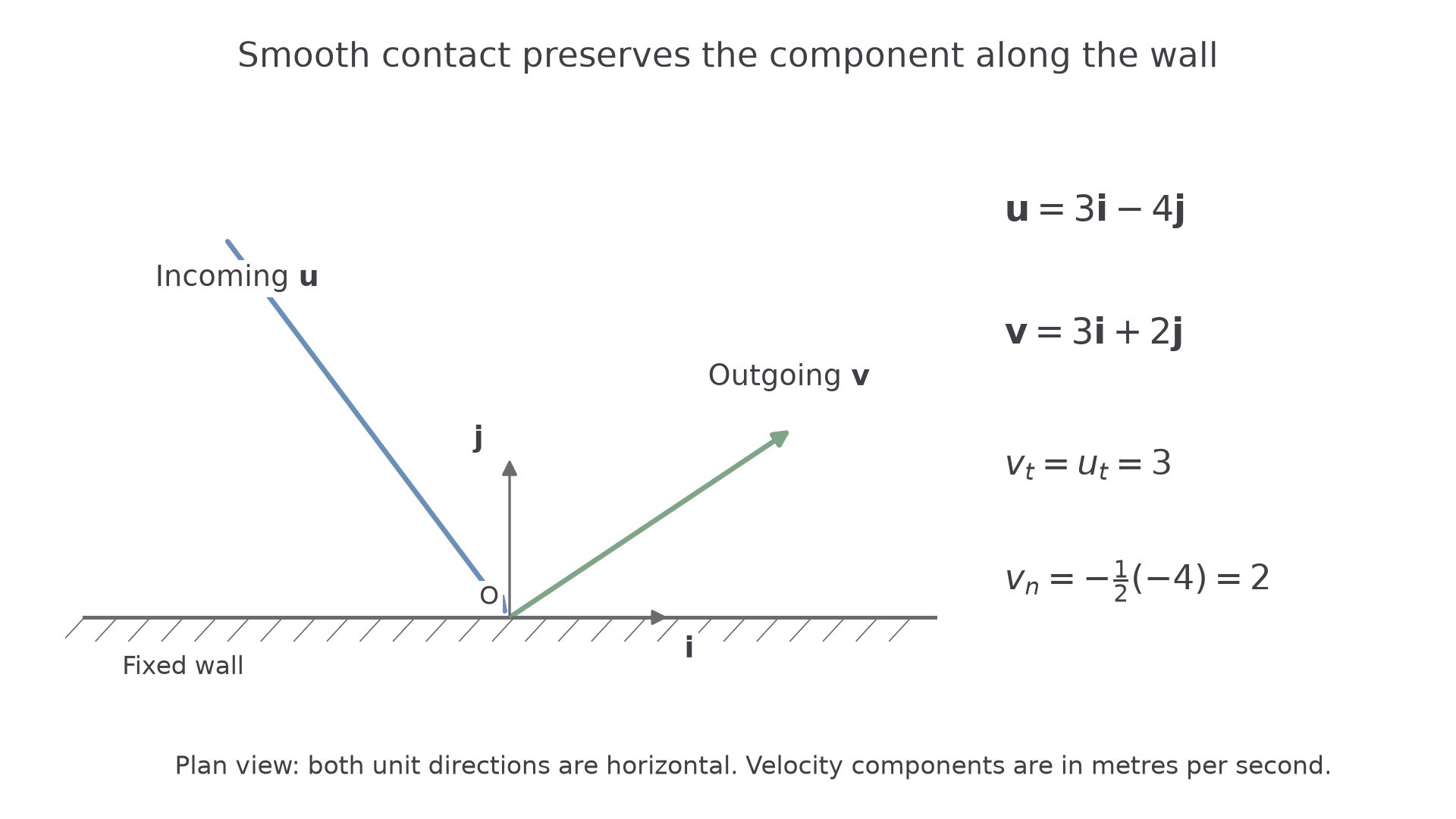
Question. A smooth sphere approaches a fixed wall parallel to with velocity . The accessible side is positive , and . Find its rebound velocity, speed and angle to the wall.
Plan. Keep the parallel component , reverse and scale the normal component, then recover speed and direction.
Why this step? Scaling the whole incoming velocity by would change the parallel component even though the wall supplies no parallel impulse.
Answer. The velocity is , speed , at to the wall into the accessible region.
Check. The normal separation speed is half the approach speed , while the parallel component remains .
Change only the coefficient of restitution from to .
Worked example 2: a smaller normal rebound
Question. Repeat the calculation for the same incoming velocity and wall, with .
Plan. Retain the parallel component and update only the normal multiplier.
Why this step? A smaller makes the outgoing path closer to the surface because its normal speed is reduced while its parallel speed stays fixed.
Answer. The velocity is , speed , at to the wall.
Check. The normal-speed ratio is , and .
For , the normal rebound component is zero. An obliquely incident sphere with non-zero parallel component then moves along the surface; it does not necessarily come to rest. For perpendicular incidence with , the entire velocity is zero and no rebound direction is defined.
[DIAGRAM: asset_name: Normal rebound and unchanged parallel motion; asset_slug: 9fm0-fm144-wall-components; caption: A smooth wall changes the normal velocity while preserving the parallel component; description: A plan view shows a wall along the horizontal axis, with the accessible region above it. An incoming arrow reaches the origin from the upper left with velocity (3,minus 4), and the outgoing arrow leaves with velocity (3,2). The surface normal points upwards and the tangent points right. Separate labels give incoming normal minus 4, outgoing normal 2, unchanged parallel 3 and coefficient one half.]
Watch out
Wrong: , or reverse both velocity components. Right: apply restitution to the normal component and keep the parallel component, with its sign.
Change only the coefficient again.
Resolve along a sloping wall
A wall's direction may be given as a vector rather than an axis. Choose unit tangent and normal vectors, calculate the signed components and rebuild the rebound velocity in the original axes.
For a wall parallel to , convenient choices are
They are perpendicular unit vectors. Either normal orientation can be used consistently; here points into the accessible side.
Vector form of a fixed-wall rebound
For a unit normal ,
This follows by retaining the tangential component and replacing the normal component by times its initial value. For a non-unit normal , the equivalent formula is
The denominator is essential when the normal is not a unit vector.
Not in the formula booklet: learn it.
You can instead write two scalar equations for the unknown velocity components: preserve the tangent projection and apply restitution to the normal projection. Both approaches express the same mechanics.
Worked example 3: a wall given by its direction
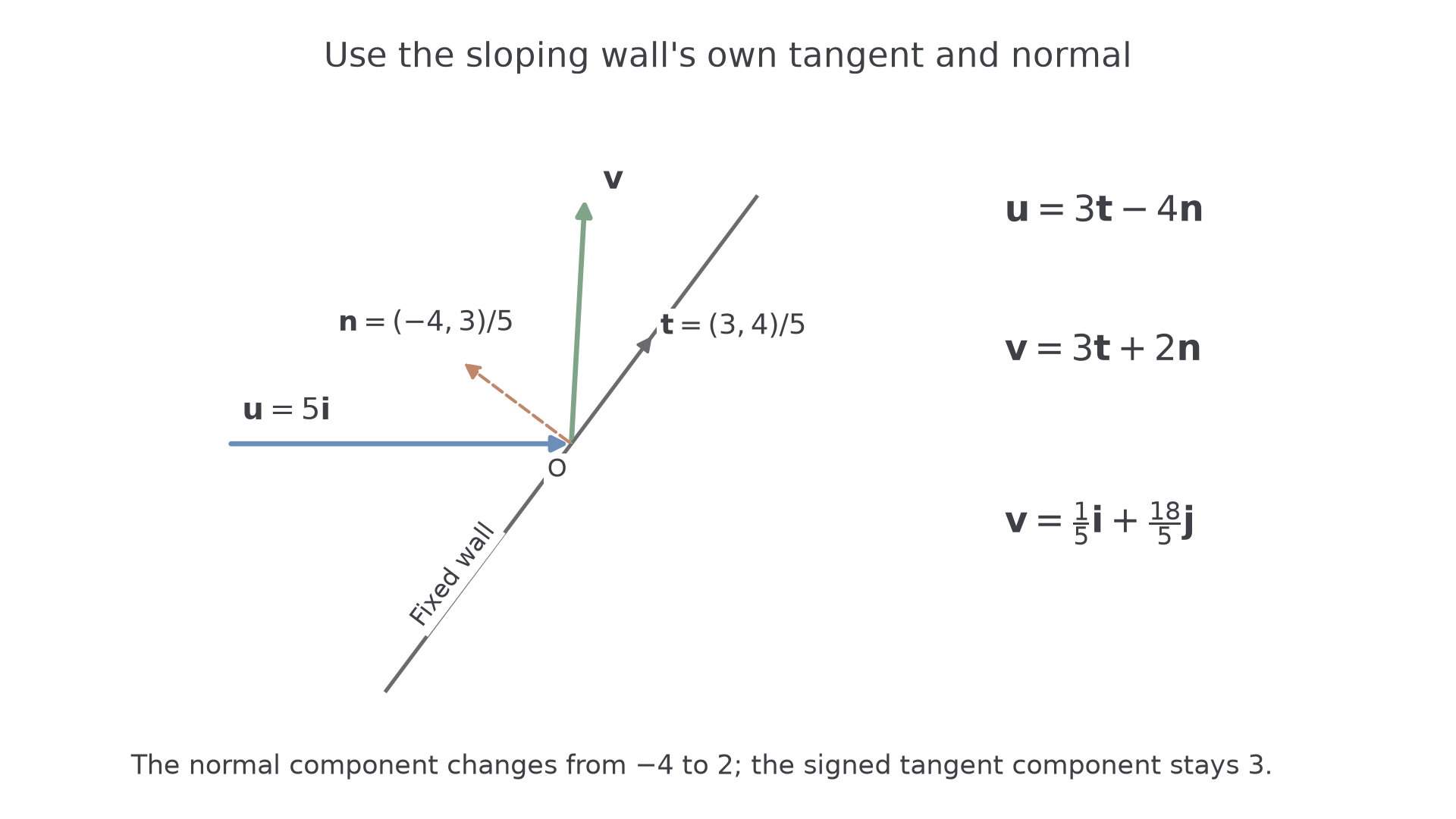
Question. A sphere with velocity strikes a fixed smooth wall parallel to . The accessible normal is , and . Find its rebound velocity.
Plan. Resolve onto , change the normal component, then combine in the original basis.
Why this step? The physical normal is sloping, so neither the nor the component alone is the normal component.
Answer. .
Check. , , and the speed is .
Change only the incoming velocity to . Its tangent component is now negative, and must stay negative.
Worked example 4: a signed tangential component
Question. Use the same wall and , but take . Find the rebound velocity.
Plan. Project the new incoming velocity and preserve the sign of its tangent component.
Why this step? A negative original component after rebound does not mean motion into the wall: approach or separation is judged along the sloping normal.
Answer. .
Check. Its normal projection is , so it separates into the accessible region; its tangent projection remains .
[DIAGRAM: asset_name: A sloping wall needs its own tangent and normal; asset_slug: 9fm0-fm144-sloping-wall; caption: The signed tangent and normal components are resolved in the wall's frame; description: A plan view shows the wall through the origin parallel to (3,4), the accessible normal (-4,3) and an incoming horizontal path with velocity (5,0). The outgoing path has velocity (one fifth,18 fifths). A side panel gives tangent component 3 unchanged and normal component minus 4 changed to 2. The wall and trajectory arrows are labelled separately.]
Watch out
Wrong: . This normal has length , not , so the scalar product is not the velocity component. Right: project onto , then reconstruct using unit tangent and normal vectors.
State the tangent and normal you are using, and give the final velocity in the requested form. Components in a rotated wall frame are useful working, but must be converted back when asked.
Continue this lesson.
You’re previewing NovaLearn without an account. Create a free account to read the rest.
Create free account