CP 5.1 - Volumes of revolution from parametric equations
A parametric curve supplies the radius and the axial position separately. You will convert both volume formulae into the parameter, handle decreasing coordinates without a negative volume, and calculate volumes for a curved body joined to a cylindrical section.
Changing the slice thickness into a parameter
The curve , , , bounds a region above the -axis. Why does fail to give its volume of revolution? The radius is correct, but the parameter does not measure horizontal distance: equal changes in do not give equal slice thicknesses.
You already know
For a full turn about the -axis, ; about the -axis, . Parametric equations give and in terms of a common parameter. The chain rule gives in a change of variable.
Here , so a small parameter change gives approximately of horizontal thickness. Near the curve advances slowly in ; near it advances faster. The derivative gives each slice its proper weight.
Parametric volume about the x-axis
For , , with increasing as runs from to , the region between the curve and the -axis gives
The bounds correspond to the left and right boundaries. If the axial coordinate reverses direction, split the curve into suitable sections and avoid counting the same solid twice. Not in the formula booklet: learn it.
You do not need to eliminate the parameter. Convert the radius, the differential and the limits together, so every part of the integral uses the same variable.
Worked example 1: a non-constant horizontal speed
Question. The curve , , , bounds a region with the -axis and the lines , . Find the exact volume when it is rotated through about the -axis.
Plan. Use and , then integrate with the given parameter limits.
Why this step? The factor measures horizontal thickness. Without it you would add the right circular areas using the wrong slice widths.
Answer. cubic units.
Check. Eliminating the parameter gives . Thus .
The second example changes only the equation for , from to . The same radius function now needs a different thickness factor.
Worked example 2: changing the horizontal coordinate
Question. The curve , , , is used in the same construction about the -axis. Find the exact volume.
Plan. Replace by , keeping .
Why this step? The derivative belongs to the coordinate along the rotation axis, . Differentiating instead would measure vertical changes, which are not the slice thickness here.
Answer. cubic units.
Check. The Cartesian radius is , so the volume divided by is .
There is also a useful invariance: tracing the same boundary at a different parameter speed cannot change its volume. In Worked example 1, put . Then , , and
The derivative compensates exactly for the change of pace. Changing only , as in Worked example 2, changes the actual curve; changing parameter consistently leaves the solid unchanged.
Watch out
Wrong: . Right: about the -axis. Replace the differential as well as the radius.
The next curve changes the vertical offset; its horizontal thickness factor stays the same.
Rotation about the y-axis and decreasing coordinates
About the -axis, the radius is and the slice thickness comes from , so the required derivative changes to .
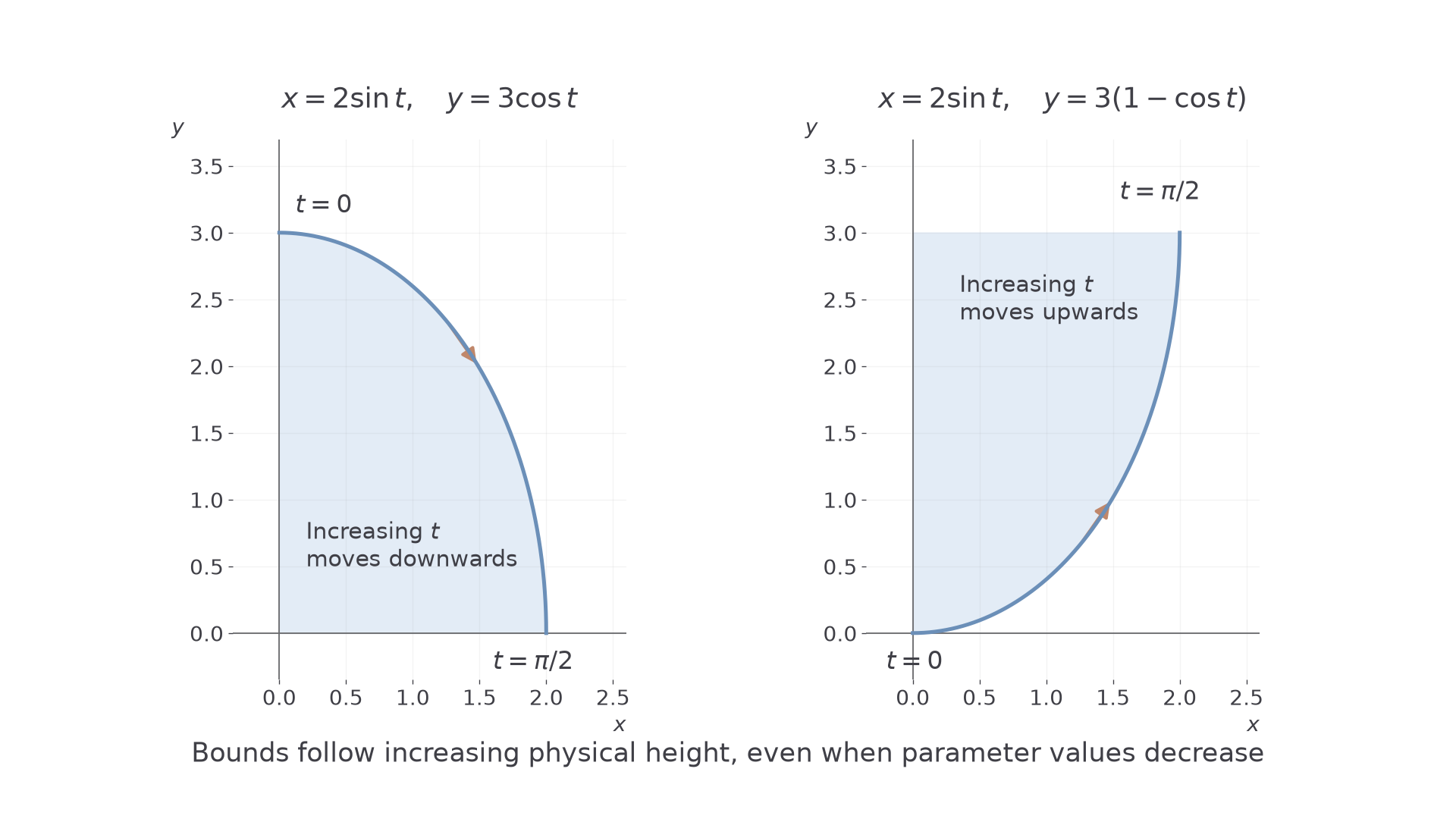
The physical integral runs from the lower height to the higher height. The corresponding parameter values might run backwards. Draw a small endpoint table before deciding their order.
Parametric volume about the y-axis
For a full rotation of a region between the curve and the -axis,
Use the parameter value at the lower height first and the value at the upper height second. When decreases with increasing , these bounds run from a larger to a smaller . For a monotonic section, an equivalent form is , with . Not in the formula booklet: learn it.
The absolute-value version is a consequence of correct orientation, not a repair for an unexplained negative answer. If a curve retraces a boundary, integrating with absolute values over the whole trace can still count the same volume twice.
Worked example 3: a decreasing height
Question. The curve , , , bounds a first-quadrant region with the coordinate axes. Find its exact volume of revolution about the -axis.
Plan. The bottom height occurs at and the top height at ; use those oriented bounds with .
Why this step? Increasing moves down the curve. Writing the lower height first therefore means writing the larger parameter value first.
Answer. cubic units.
Check. Eliminating the parameter gives , so .
The second example changes only the height equation to reflect the same profile vertically. Heights now increase with the parameter, so the natural parameter order works directly.
Worked example 4: an increasing height
Question. Find the volume about the -axis for the region between , , , the -axis and the line .
Plan. Heights increase from to , so integrate from to , using .
Why this step? The new height is minus the old height, so its derivative has the opposite sign. The endpoint order changes with it.
Answer. cubic units.
Check. Reflecting the solid from Worked example 3 in the horizontal plane changes its orientation but preserves every slice area and hence its volume.
Endpoint arrows make the orientation easy to see before any integration.
[DIAGRAM: asset_name: Parameter direction and physical height; asset_slug: 9fm0-cp33-oriented-heights; caption: Increasing the parameter can move either down or up the solid; description: Two equal-scale panels show x equals two sin t with y equals three cos t on the left and y equals three times one minus cos t on the right. The left curve goes from (0, 3) at t equals zero to (2, 0) at t equals pi over two; the right goes from (0, 0) to (2, 3). Arrows along each curve show increasing t, with shaded regions between the curve and the vertical rotation axis.]
Watch out
Wrong: integrate from to with , then present a negative volume. Right: use bottom-to-top parameter bounds, or explicitly integrate the positive slice thickness on a monotonic interval.
The following profile has different dimensions. Keep the endpoint reasoning rather than copying a memorised sign.
Joining a curved body to a cylinder
A model may describe only part of a solid parametrically; calculate each non-overlapping component and combine their volumes.
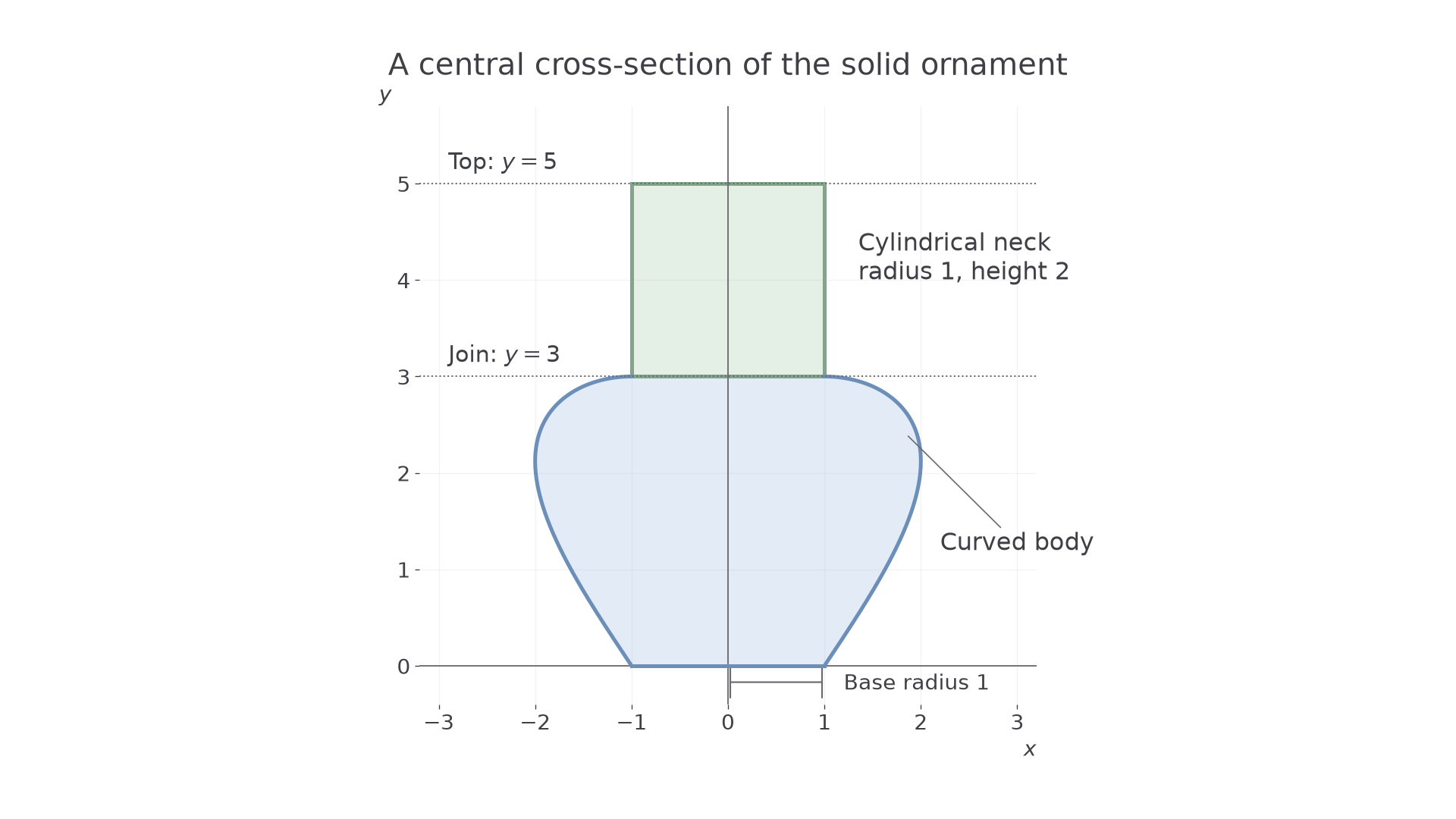
Consider a solid ornament with a curved lower body and a cylindrical neck. The body is formed by revolving the region between its profile and the -axis. A separate cylinder sits above it, meeting along one circular face. Adding their volumes counts that shared face as no volume, so nothing is duplicated.
For a profile involving , expand the squared radius and use . The factors or from the thickness derivative often make the resulting integrals manageable. These are the same substitution and trigonometric methods you know from A-level Mathematics.
Worked example 5: a body and neck model
Question. An ornament's body is modelled by revolving , , , and the region between this profile and the -axis, through about that axis. A cylinder of radius and height is attached above the body. All lengths are in centimetres. Find the exact total volume.
Plan. Use positive vertical thickness from bottom to top, expand the body's squared radius, then add the cylinder.
The three elementary integrals are
The last antiderivative follows by writing . Hence
Why this step? The derivative supplies a factor. Using the double-angle identity exposes exactly the products whose antiderivatives are short powers of sine or cosine.
Answer. .
Check. The body's radius lies between and , so its volume lies between and . The computed lies within those bounds. The cylinder begins at height , where the body radius is , so their circular faces fit.
The next example changes only the amplitude of the body's bulge, from to . The neck, height and endpoint radii stay the same.
Worked example 6: a wider bulge
Question. An ornament has the same neck as in Worked example 5, but its body profile is , , . Find the exact total volume, in .
Plan. Square the new radius before expanding; reuse the same elementary antiderivatives and add the neck volume.
Why this step? Doubling the bulge does not double the volume: the radius is squared, producing both a doubled cross-term and a quadrupled squared term.
Answer. .
Check. This is larger than , as every interior body slice is wider. The body radius is at most , so its volume is below the enclosing cylinder's .
The model assumes circular cross-sections perpendicular to the axis and the stated smooth profile. If observations show an asymmetric body or different measured dimensions, those are relevant limitations. A hollow object's external volume would also differ from its material volume unless the cavity were subtracted.
[DIAGRAM: asset_name: Curved body and cylindrical neck; asset_slug: 9fm0-cp33-body-neck; caption: Calculate the curved body and cylindrical neck separately, then add them; description: A central vertical cross-section shows the profile x equals one plus sin two t, y equals three cos t, and its reflection in the y-axis. The body occupies heights zero to three, with radius one at both endpoints and a wider middle bulge. A cylinder of radius one extends from height three to five. Horizontal dotted lines distinguish the join at height three and the top at five.]
Watch out
Wrong: expand as . This omits the cross-term, so every interior slice has the wrong area. Right: .
Keep that expansion visible before integrating, so each contribution to the body volume can be followed.
Exam tip
When Pearson requests algebraic integration, show how the squared radius becomes an integrable expression and show the substitution of limits. A calculator's volume output does not demonstrate those method steps.
The opening integral missed , the horizontal-thickness factor. Correcting it gives ; any consistent reparameterisation gives that same physical volume.
Quick Recap
- About the -axis use ; about the -axis use , with correctly oriented bounds.
- Convert the radius, differential and limits together. The derivative measures the physical slice thickness.
- Match parameter bounds to increasing axial position; split non-monotonic or repeated traces before calculating geometric volume.
- Expand the whole squared radius, choose useful trigonometric identities and combine non-overlapping component volumes.
The opening curve needs : the derivative makes the answer independent of parameter speed.