CP 9.8 - Damped and forced oscillations
Resistance changes both the shape and long-term behaviour of an oscillator's motion. You will model resistance proportional to velocity, distinguish light, critical and heavy damping, and solve forced-motion models by combining a transient response with a steady response.
Modelling resistance and classifying damping
Does adding more resistance always bring a displaced object back sooner? It suppresses oscillations, but sufficiently strong resistance can also make the eventual return slower. The roots of a differential equation explain both effects.
You already know
SHM has restoring acceleration proportional to negative displacement. Constant-coefficient homogeneous equations are solved using an auxiliary equation; a forced equation is solved by adding a particular integral to its complementary function.
Measure displacement from equilibrium. A linear restoring force is , while resistance proportional to velocity is , with , . The resistance changes direction automatically when velocity changes sign. With an applied force , Newton's second law gives the model.
Linear damped-motion model
Here is mass, the damping coefficient and the restoring-force coefficient. Free motion has ; forced motion has a specified input.
Not in the formula booklet: learn it.
The model assumes constant coefficients, a linear restoring force and resistance proportional to velocity. Any constant force already balanced at equilibrium disappears when displacement is measured from that equilibrium. Large-amplitude real motion may violate the linear restoring-force assumption.
For free motion, use . With , the sign of gives three cases.
| Case | Auxiliary roots | Form and behaviour |
|---|---|---|
| Light damping: | Decaying sine/cosine motion | |
| Critical damping: | A repeated negative root | |
| Heavy damping: | Two distinct negative roots | A sum of two decaying exponentials |
Here is the light-damping angular frequency. These classification and frequency results are not supplied in the formula booklet. The case is undamped, not lightly damped.
Key idea
Damping can give decaying oscillation or a non-oscillatory return. Inspect the discriminant before choosing a solution form.
Distinguish a repeated root from a complex pair in this check.
Light damping and a decaying envelope
Complex auxiliary roots retain the oscillation, while their negative real part supplies exponential decay. Include the exponential factor when differentiating for initial velocity.
For , the roots are , giving . The oscillatory factor has amplitude , so the envelope curves bound the displacement. Actual extrema need not occur where the trigonometric factor alone is maximal.
Worked example 1: a damped release from rest
Question. Solve , given , .
Plan. Use the complex-root solution, differentiate its product, then apply both conditions.
Thus .
Why the term ? Differentiating the exponential contributes it even at . Ignoring that term would change the initial velocity.
Answer. .
Check. The roots satisfy , and the initial derivative is .
Worked example 2 changes only the initial velocity. The decay rate and oscillatory frequency belong to the equation, so neither changes.
Worked example 2: an inward initial velocity
Question. Solve the same equation with , .
Plan. Retain the same general form and change the derivative-condition equation.
Why can the sine term disappear? The derivative of the decaying cosine already supplies the required initial inward velocity.
Answer. .
Check. , and , so displacement approaches zero while changing sign repeatedly.
The oscillation period of the trigonometric factor is , but the full displacement is not periodic: successive cycles have smaller sizes. Distinguish the time between corresponding phases from a function repeating exactly.
Watch out
Wrong: set as in undamped SHM. Right: here , because the exponential factor also changes with time.
Use another initial velocity with the same damped equation.
Critical and heavy damping
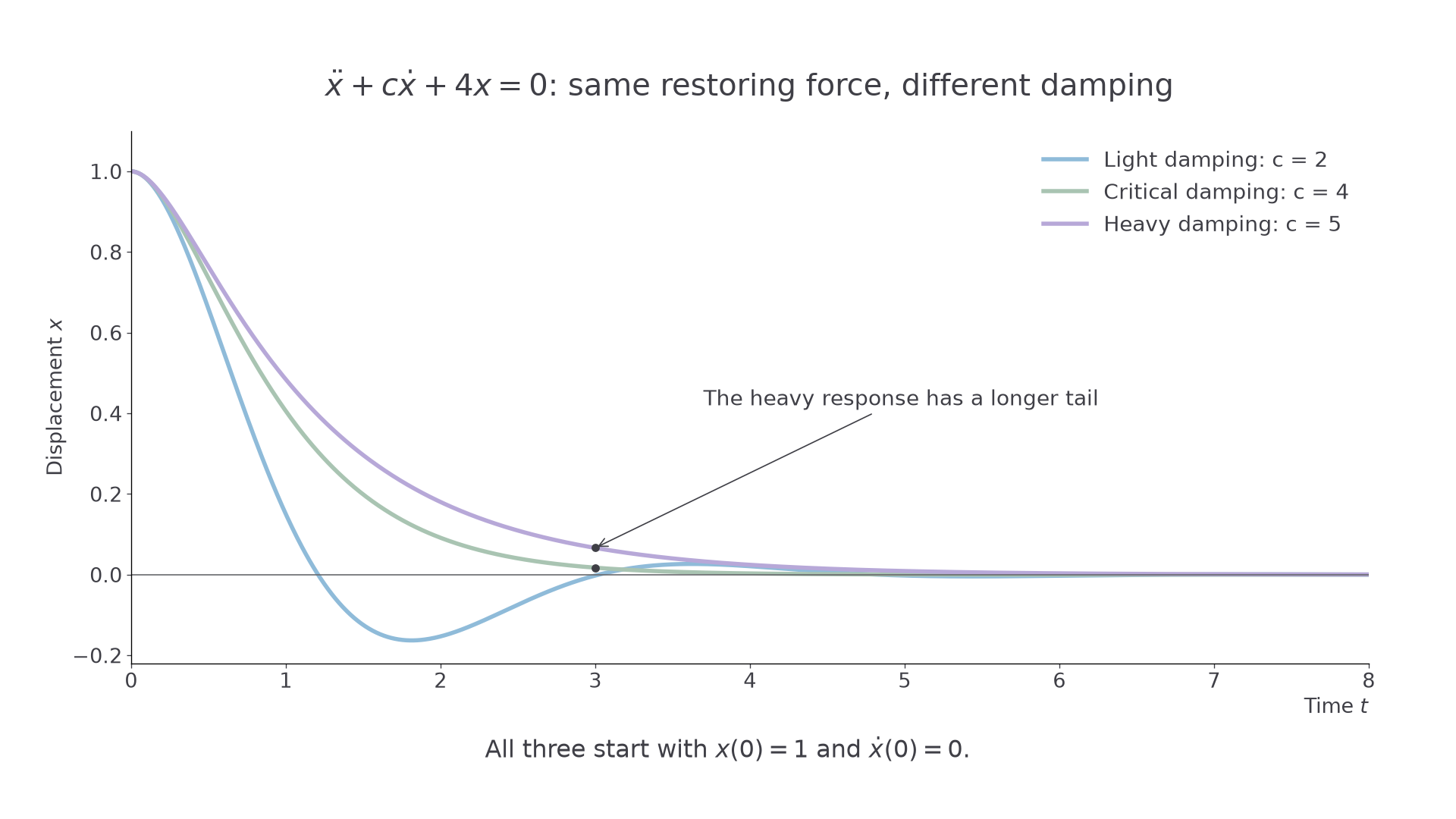
A repeated negative root gives critical damping; two distinct negative roots give heavy damping. Both responses tend to equilibrium without a continuing oscillation. Initial velocity can still affect whether an individual response crosses equilibrium, so do not infer every detail from the classification alone.
[DIAGRAM: asset_name: Light critical and heavy damping from the same initial data; asset_slug: 9fm0-cp98-damping-comparison; caption: With the same mass and restoring coefficient, increasing damping removes oscillation but can lengthen the late return; description: A time-displacement graph compares solutions of x double dot plus c x dot plus 4x equals zero with x(0)=1 and x dot(0)=0. The light curve c=2 crosses the axis, the critical curve c=4 equals (1+2t) exp(-2t), and the heavy curve c=5 equals (4 exp(-t)-exp(-4t))/3. All approach zero, with the heavy curve above the critical curve at later times.]
Continue this lesson.
You’re previewing NovaLearn without an account. Create a free account to read the rest.
Create free account