FP2 1.5 - Isomorphic groups
Decide whether small groups have the same structure and construct an isomorphism when they do (FP2 1.5). You will preserve every product, use element orders to reject impossible matches and connect cyclic groups, symmetry, matrices and permutations.
Rename the elements while preserving the operation
Could addition modulo and multiplication modulo be the same group in disguise? Their elements have different jobs: the additive identity is , while the multiplicative identity is . A suitable renaming can preserve the entire operation.
You already know
Cyclic groups are generated by powers of one element. Element order is the first positive return to the identity, and . Transformations and permutations compose rightmost first. Lagrange restricts orders, but matching sizes alone does not describe all products.
Try the correspondence
For example, becomes . The diagram checks the complete tables under that same renaming.
[DIAGRAM: asset_name: The same Cayley structure under different labels; asset_slug: isomorphic-cayley-tables; caption: The same correspondence preserves every cell of the additive and multiplicative tables.; description: Side-by-side four-by-four Cayley tables show addition modulo4 with headings0,1,2,3 and multiplication modulo5 with corresponding headings1,2,4,3. Corresponding entries share the same neutral or one of three pale accent backgrounds. The mapping0 to1,1 to2,2 to4,3 to3 appears above them. All text is dark ink.]
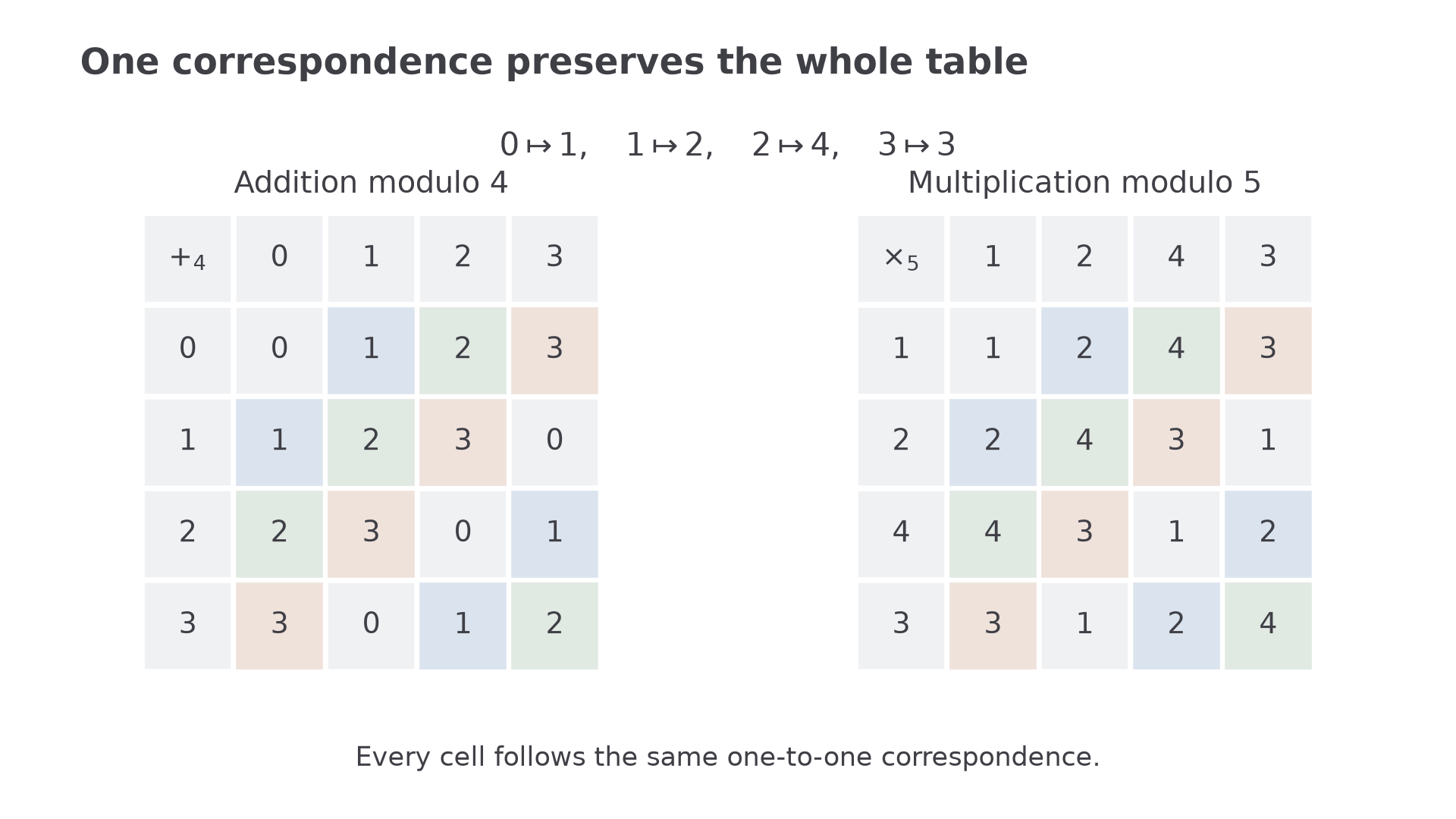
The symbols can change, and so can the way the operation is written. What must survive is which result belongs to each ordered pair.
Group isomorphism
An isomorphism from to is a bijection such that
A bijection is one-to-one and onto: every target element is paired with exactly one source element.
Groups connected by such a map are isomorphic, written .
The definition and isomorphism rules in this lesson are not in the formula booklet.
Key idea
An isomorphism renames all elements through one bijection while preserving the entire operation table.
One successful product is a check, not a proof covering every pair.
Build an isomorphism by matching generators
For cyclic groups, the generator determines the rest. Choose where the generator goes, then send each of its powers to the corresponding power of the target generator.
Cyclic groups of the same size
If and both have finite order , then
defines an isomorphism. Both cycles have the same length, so the correspondence is well-defined and bijective; adding exponents preserves products:
Exponents are interpreted modulo the common cycle length.
Not in the formula booklet: learn it.
For additive residues, means repetitions of the generator . We will map , under addition modulo , to , under multiplication modulo .
Worked example 1: send the additive generator to two
Question. Construct an isomorphism that sends to .
Plan. Send the -fold additive generator to , list the mapping, and justify preservation for every sum.
The four images are distinct and fill . Since , reducing modulo does not change modulo . Thus
for all .
Why this step? The exponent rule proves preservation for every pair, including sums that wrap past .
Answer. is a bijection preserving the operations, hence an isomorphism.
Check. . Its image is , while .
Change only the chosen image of the generator from to the other generator .
Worked example 2: another valid isomorphism
Question. Construct an isomorphism that sends to .
Plan. Use , retaining the same source operation.
All four images are distinct. Since , reducing modulo again leaves its image unchanged:
Why this step? The image of is forced to be the square of the chosen image of ; it cannot be paired independently.
Answer. is another isomorphism.
Check. maps to ; the target product is .
A choice that is not a generator can fail even when its power rule preserves products.
Watch out
For , . This is not one-to-one, so it is not an isomorphism. That failure rejects this map; it does not reject the isomorphisms already constructed between these groups.
Change the generator image once more and test the proposed correspondence itself.
Use preserved properties to reject impossible matches
Before constructing a correspondence, look for an obstruction. Isomorphisms preserve more than the total number of elements.
Properties preserved by an isomorphism
If is an isomorphism, then
and
Commutativity and cyclicity are also preserved.
A mismatch proves that groups are not isomorphic. Matching these features is not, in general, a substitute for proving the operation-preserving bijection.
Not in the formula booklet: learn it.
For example, forces . Also , and bijectivity makes equivalent to . Their first positive returns therefore agree.
Worked example 3: an element order that cannot be matched
Question. Are , under addition modulo , and , under multiplication modulo , isomorphic?
Plan. Compare a source element's order with the orders available in the target.
Why this step? An image of the additive generator would need order , and the target has no such element.
Answer. No. Element orders cannot be preserved, even though both groups have four elements.
Check. The target identity has order , so it cannot supply the missing order either.
Change only the target group to the four square rotations .
Worked example 4: a match supported by a complete reason
Question. Are and isomorphic?
Plan. Establish that both groups are cyclic of the same size, then specify the generator correspondence.
Why this step? Equal cyclic size gives a reason for every product to match; equal size alone would not.
Answer. Yes. The map is an isomorphism.
Check. Both identities correspond, and the additive inverse of maps to the inverse of .
An invariant is most efficient when it reveals a mismatch. When it does not, finish with a valid structural argument.
Watch out
“Both groups have four elements, therefore they are isomorphic” is false: and provide a counterexample. To prove an isomorphism, supply the operation-preserving bijection or justify a sufficient result such as both groups being cyclic of the same order.
Change the target to another familiar four-element symmetry group.
Continue this lesson.
You’re previewing NovaLearn without an account. Create a free account to read the rest.
Create free account