CP 5.6 - Integrals giving inverse trigonometric functions
Some algebraic integrands have inverse trigonometric antiderivatives. You will recognise the arcsine and arctangent forms, choose sine or tangent substitutions for related integrals, and distinguish these from a reciprocal difference of squares, which gives a logarithm.
A square root giving arcsine
Why does integrate to an angle, while does not give the same answer? The square root changes the structure completely. Recognising exactly what is in the denominator is the first decision.
You already know
The derivative of is , and that of is . Substitution requires changing both the integrand and the differential. A derivative check is a reliable way to recover a missing constant factor.
For , differentiating gives
because . The chain factor cancels the scale inside the square root.
Arcsine integral
For and ,
In the formula booklet.
The positive parameter is the square root of the constant term, not the constant itself. For , use .
Worked example 1: a standard form
Question. Find , for .
Plan. Match to the standard arcsine integral.
Why no factor outside? The chain factor is cancelled by the square-root scale.
Answer. .
Check. Its derivative is .
Worked example 2 changes only the coefficient of . A substitution is now needed to expose the standard form.
Worked example 2: scaling the variable
Question. Find , for .
Plan. Put , including the factor .
Why this step? Replacing the argument by doubles its derivative, so the outside factor is necessary.
Answer. .
Check. Differentiation gives .
Matching the appearance is only half the task; differentiating the proposed answer checks its scale.
Watch out
Wrong: . Right: include outside. An argument change brings a chain factor with it.
Change both scales in the matched check.
A sum of squares giving arctangent
A reciprocal sum of squares has a different antiderivative. Without a square root, the scale from the denominator does not cancel the chain factor in the same way.
Arctangent integral
For ,
This holds for every real .
In the formula booklet.
Differentiating the answer gives . Both factors of are needed before the denominator is simplified.
Worked example 3: a reciprocal sum of squares
Question. Find .
Plan. Match and use both the outside factor and the scaled argument.
Why this factor? alone differentiates to , three times the required integrand.
Answer. .
Check. At , the answer's derivative is , matching the integrand.
Worked example 4 changes only the coefficient of , just as in the arcsine pair. Now the standard integral already has an outside scale factor too.
Worked example 4: two scale factors
Question. Find .
Plan. Put , then apply the arctangent formula with .
Why this step? One factor comes from scaling , the other from the standard arctangent integral. They have separate jobs.
Answer. .
Check. Its derivative is .
The denominator has no real zero, so there is no interval restriction from a denominator singularity here.
Watch out
Wrong: use outside arctangent because the denominator begins with . Right: the standard form uses , giving before any additional variable scaling.
Practise keeping both scales visible.
Choosing a sine substitution for a difference of squares
When a root contains , choose . The identity turns the root into something manageable.
Choose . Then , so , rather than an unresolved absolute value. Also . This substitution strategy is not listed in the formula booklet: learn how the identity motivates it.
[DIAGRAM: asset_name: Triangles behind sine and tangent substitutions; asset_slug: 9fm0-cp56-substitution-triangles; caption: Sine matches a difference under a root; tangent matches a sum of squares; description: Two right triangles for positive x and a are shown. The sine triangle has opposite side x, hypotenuse a and adjacent side square root of a squared minus x squared, with x=a sin theta. The tangent triangle has opposite side x, adjacent side a and hypotenuse square root of a squared plus x squared, with x=a tan theta. Each theta is placed at the lower-left vertex.]
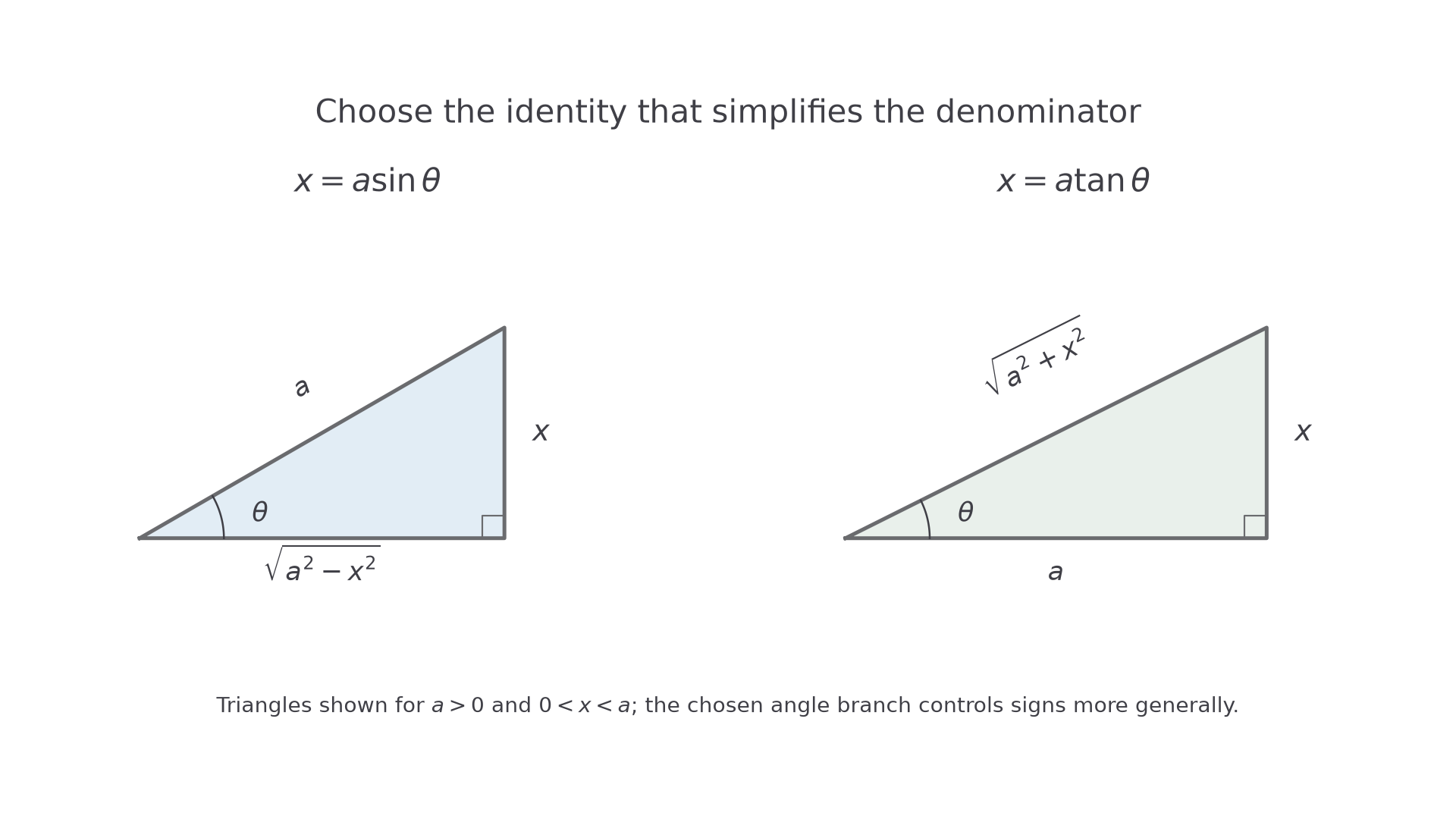
The familiar identities and then reduce squared trigonometric functions to integrable terms. These identities are assumed A-level Mathematics knowledge.
Worked example 5: integrating a semicircle height
Question. Use a trigonometric substitution to find , for .
Plan. Put , integrate , then return to .
Here and .
Why this substitution? It replaces the difference of squares by a squared cosine, whose sign is controlled by the chosen branch.
Answer.
Check. At , differentiating the first term gives and the second gives , totalling the integrand's value .
Worked example 6 uses the same square root in the denominator and changes the algebraic numerator to . The same substitution now gives a squared sine.
Worked example 6: a squared numerator
Question. Find , for , using .
Plan. Cancel the cosine factors from the root and differential, then integrate .
Why this step? The root and differential cancel, but the numerator becomes ; it must not disappear too.
Answer.
Check. Adding the integrands in Examples 5 and 6 gives . Their answers add to , exactly as the standard integral predicts.
Square roots can hide : using the same method with gives . This is also the area of a quarter of the unit circle. The algebraic and geometric answers meet at the same constant.
Watch out
Wrong: without controlling the angle. In general it is . Our principal substitution range makes the cosine non-negative, so the simpler expression is justified.
Change the radius in the next sine substitution.
Choosing a tangent substitution for a sum of squares
For , choose . Then and . Take , so is unambiguous.
This strategy is not listed in the formula booklet. Its value is that the differential cancels part of a denominator containing a power of .
Worked example 7: a squared denominator
Question. Use a trigonometric substitution to find .
Plan. Put , cancel secant factors, then integrate a squared cosine.
Since , .
Why tangent? Its differential contains , the same factor produced by the sum of squares.
Answer.
Check. At , the two derivative contributions are each, totalling , the original integrand's value.
Worked example 8 changes only the numerator to . The transformed integral becomes a squared sine instead.
Worked example 8: the numerator survives substitution
Question. Find using .
Plan. Transform the numerator as well as the denominator and differential, then simplify to .
Why this step? The numerator contributes , changing the coefficient from to .
Answer.
Check. Differentiation gives
For a definite integral, either change both limits into -values or return to before using the original limits. Mixing one variable's limits with another variable's antiderivative changes the problem.
Watch out
Wrong: from , write . The derivative of tangent is secant squared, so this would leave the wrong powers after cancellation. Right: .
The differential is part of choosing the substitution, so write it before transforming the fraction.
Problem-solving
Choose a substitution for the expression you want to simplify: for , and for . Write the differential immediately, then cancel factors.
Use the tangent method with a new scale.
A reciprocal difference of squares gives a logarithm
Removing the square root from changes the answer from arcsine to a logarithm. Factorising gives two linear denominators, which you can integrate using A-level Mathematics partial fractions.
For ,
The second fraction integrates with a negative sign because its denominator has derivative .
Reciprocal difference of squares
For and ,
In the formula booklet.
The fraction inside the logarithm is positive on this interval. On other intervals avoiding , the same derivation uses . The absolute-value version extends the displayed logarithmic formula; never integrate across a denominator's zero as an ordinary definite integral.
Worked example 9: the root is absent
Question. Find , for .
Plan. Split the difference of squares into linear fractions, integrate, and combine the logarithms.
Why a logarithm? Each fraction is the reciprocal of a linear expression; no square root remains to produce arcsine.
Answer. .
Check. Its derivative is .
Worked example 10 changes only the coefficient of . Keep the variable-scaling factor as well as the logarithmic formula's factor.
Worked example 10: a scaled difference
Question. Find , for .
Plan. Put , then use the preceding logarithmic integral.
Why this step? The factor comes from the substitution, independently of the factor in the standard logarithmic result.
Answer. .
Check. At , differentiation gives , matching the integrand.
The opening distinction can now be organised into three decisions.
| Denominator | Antiderivative type | Reason |
|---|---|---|
| Arcsine | Inverse-sine derivative | |
| Arctangent | Inverse-tangent derivative | |
| Logarithm | Two linear partial fractions |
Use the sign and the square root together; recognising only “a squared expression” is not enough.
Watch out
Wrong: . Arcsine differentiates to a reciprocal square root, which is absent here. Right: on , the integral is .
A derivative check distinguishes these two denominator structures immediately.
Quick Recap
- gives arcsine; gives arctangent, with an outside factor .
- Use for a difference under a root and for a sum of squares.
- Change the differential, control the angle branch, and return to the original variable or change both limits.
- gives a logarithm through partial fractions; retain interval restrictions.
- Differentiate your final expression to check every constant factor.
The opening two integrands differ by a square root: that is precisely why one gives an inverse angle and the other a logarithm.