FM2 3.2 - Equilibrium of rigid bodies
A rigid body can balance its forces yet still have a turning effect. You will use its centre of mass to solve suspension and contact problems, taking moments as well as resolving forces. You will also check that a calculated contact force can actually be supplied by the supporting surface.
A freely suspended body hangs with its centre below the support
Will a solid hemisphere and a thin hemispherical shell hang at the same angle from the same point on their rim? Their outside shapes match, but their centres differ. The solid hangs with its axis at about to the vertical; the open shell's angle is about . Surprisingly, these angles do not depend on the radius. The geometry below explains both the difference and the scale independence.
You already know
Replace a body's distributed weight by its total weight acting at its centre G. For laminas and frameworks, you used force balance and zero total moment. Composite mass moments and booklet centres now locate G in a three-dimensional body. From A-level Mathematics, static friction adjusts to the required value up to , where R is the normal reaction.
With a freely turning fixed support P and no force besides weight and the support reaction, equilibrium requires their lines of action to coincide. The stable hanging position has G vertically below P. A position with G above P is an unstable balance; if G coincides with P, weight supplies no restoring moment about P.
Rigid-body equilibrium
For coplanar forces in equilibrium,
Moments may be taken about any chosen point P. A freely suspended body acted on only by weight and its point-support force has PG vertical; the stable hanging position puts G below P. A smooth point support or freely turning hinge supplies no reaction couple.
Not in the formula booklet: learn it.
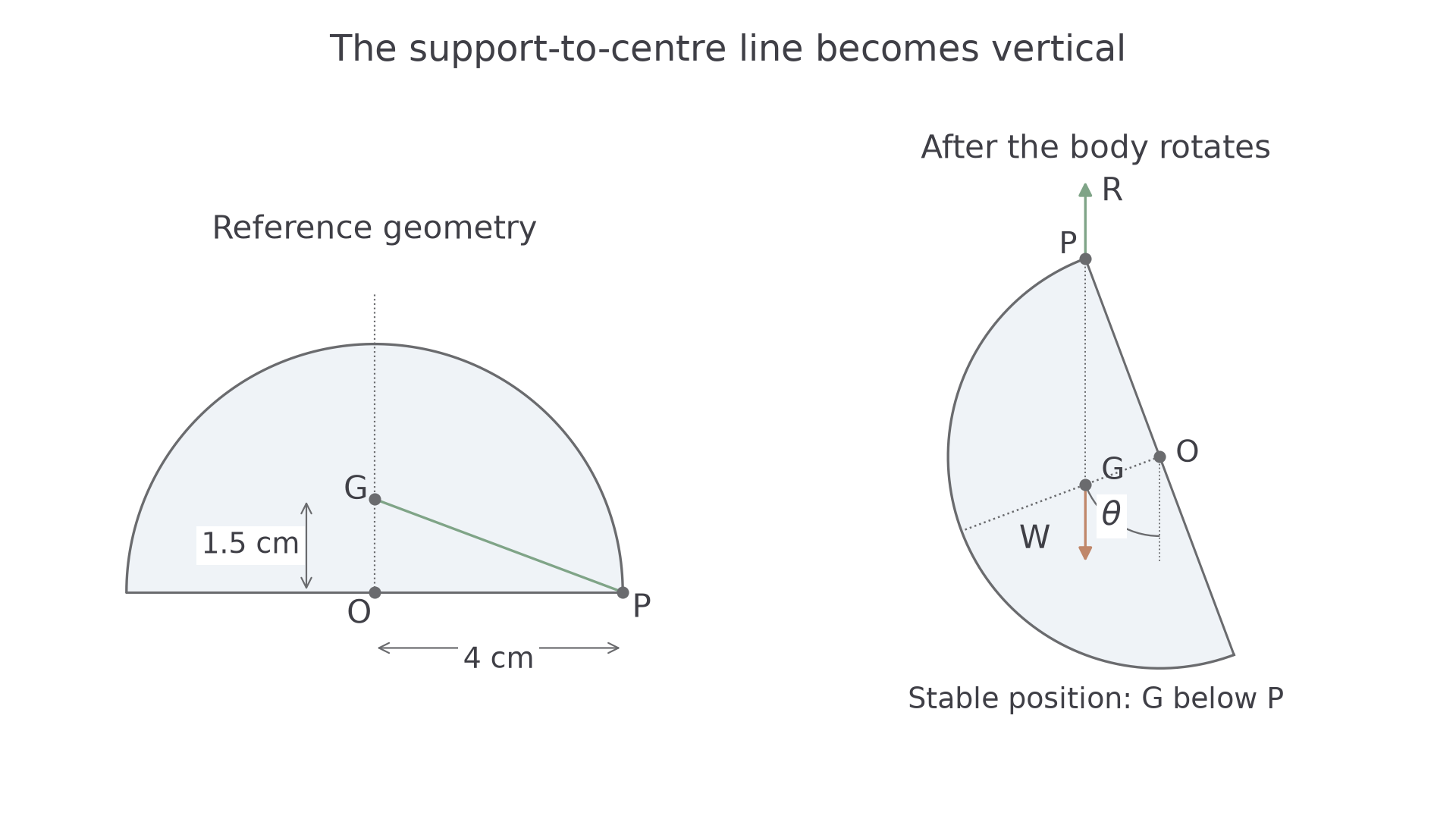
For a hemisphere, let O be the sphere centre, P a point on its rim, and the axis point towards its cap. In the section through P and the axis, is perpendicular to . The acute angle between the axis and the vertical satisfies , because PG becomes vertical. This geometric relation is derived here, not printed in the booklet.
[DIAGRAM: asset_name: A hemisphere suspended from its rim; asset_slug: 9fm0-fm155-rim-suspension; caption: The right triangle OPG determines the axis angle once PG is vertically down; description: A reference section shows a radius-four hemisphere with OP four and OG three halves, with PG joining the support to the centre. A second exact rotated section shows stable suspension with P above G, weight vertically down at G and support reaction vertically up at P. The symmetry axis and vertical form the acute angle theta.]
Worked example 1: suspend a solid hemisphere
Question. A uniform solid hemisphere of radius is freely suspended from a point P on its circular rim. Find the acute angle between its symmetry axis and the vertical in stable equilibrium.
Plan. Use the booklet centre and the right triangle OPG, remembering that PG is vertical when hanging.
Why this step? The vertical is PG, not the hemisphere's axis. Its mass centre must rotate underneath P, so the triangle between them determines the orientation.
Answer. , to three significant figures, with G below P.
Check. The booklet solid centre used here is , measured from O towards the cap. In general , so the angle is independent of radius.
Change only the mass distribution: use a uniform thin hemispherical shell with the same radius and rim support, excluding a flat base.
Worked example 2: suspend the matching shell
Question. A uniform open hemispherical shell of radius hangs freely from the same rim point. Find the acute angle between its axis and the vertical.
Plan. Replace the solid centre by the shell booklet centre , keeping the same geometry.
Why this step? The outer shape determines OP, but the actual material determines OG. Substituting the solid centre would describe the wrong body.
Answer. , with G below P.
Check. The centre is farther along the axis than for the solid, so PG lies closer to that axis. The angle decreases. The ratio again cancels the radius.
The two booklet centre results are printed. The suspension angle and stable-orientation argument must be established from the model; they are not printed centre formulae.
Watch out
Wrong: making the body's symmetry axis vertical automatically. Right: make the line from the support to its actual mass centre vertical, with G below P for stable suspension. Then identify the specific angle requested.
Change only the axial centre position, keeping the radius and support point.
Locate the resultant contact force on a horizontal base
A flat base touches the plane over an area, so its normal pressures need not be symmetric. Replace those pressures by a resultant normal reaction R at an initially unknown point C. In the section containing all the forces, C must lie within the contact interval. A negative pressure or a reaction acting beyond the base cannot be supplied by ordinary contact.
Admissible rough contact
For a rigid body supported by an ordinary rough plane,
Here f is the signed tangential friction force and is the coefficient of friction. The resultant normal reaction must act within the contact region. Equality in the friction bound is required only when sliding is impending, not in every equilibrium.
Not in the formula booklet: learn it.
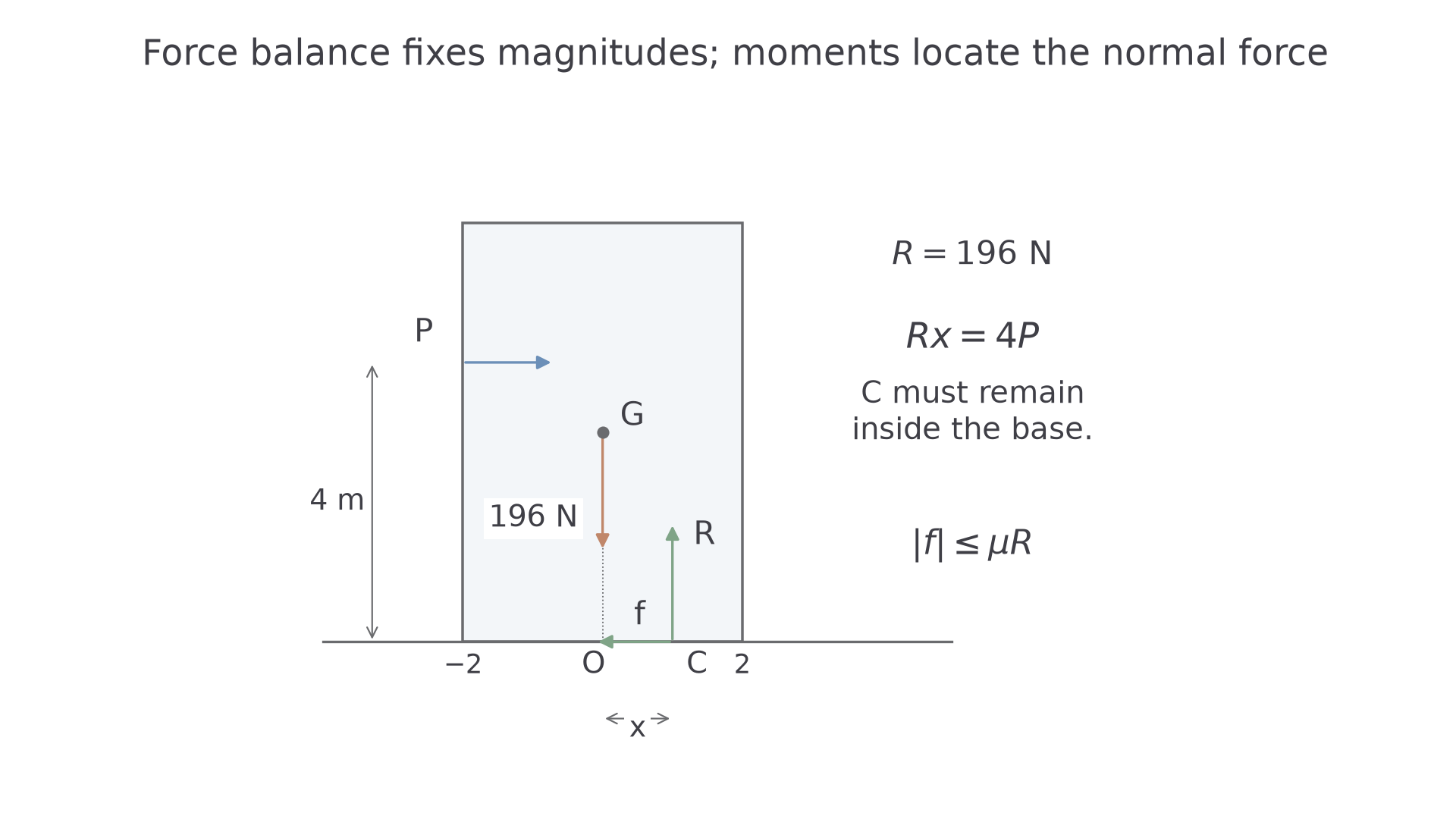
A moment equation locates C. Forces applied above the plane may move the normal resultant even though its magnitude remains the same. The following model uses an exact rectangular cross-section; the same reasoning works for a composite solid once G is known.
[DIAGRAM: asset_name: A shifted normal reaction on a horizontal base; asset_slug: 9fm0-fm155-horizontal-contact; caption: Horizontal force balance fixes friction while moments locate the normal reaction within the base; description: A uniform cuboid section has base from minus two to two metres and height six metres. Weight 196 newtons acts down at G zero three. A rightward force P acts at height four on the left face. Friction acts left and the normal reaction acts up at C with coordinate x. The reference base centre O and moment arms four and x are labelled.]
Worked example 3: a push shifts the supporting pressure
Question. A uniform cuboid has a rectangular section of width and height . It rests with its base horizontal and has weight . A horizontal force acts to the right at height . The coefficient of friction is . Find the normal reaction, friction, and the normal resultant's distance x to the right of the base centre. Check that equilibrium is possible.
Plan. Resolve vertically and horizontally, then take moments about the base centre O. Finally check friction and the location of C.
Why this step? Weight has zero moment about O because G is directly above it. Friction acts in the base plane, also giving zero moment about O. The displaced normal reaction balances the push's moment.
Answer. , friction leftwards, and rightwards. Equilibrium is possible since
Check. Both rotational and translational balance hold. Putting R at the base centre would leave an unbalanced clockwise moment.
Change only the applied force from to .
Worked example 4: a stronger push within the admissible range
Question. The same cuboid and plane now have , still acting at height . Find the contact forces and position of C, and check equilibrium.
Plan. Retain the vertical reaction and moment arm, but update the required friction and moment.
Why this step? The extra push changes where the pressure resultant must act. It does not change R because the push has no vertical component.
Answer. , friction leftwards, C right of O. Equilibrium remains possible because and .
Check. The larger rightward push moves C towards the right edge, increasing its anticlockwise moment.
This model separates three questions: how large R is, how much friction is required, and where the supporting pressure acts. Solving only the first two does not establish rigid-body equilibrium.
Watch out
Wrong: drawing the normal reaction through the base centre by symmetry after an external push breaks the symmetry of the forces. Right: leave its point of action unknown and use moments; then check that it lies on the base.
Change only the force magnitude again.
Continue this lesson.
You’re previewing NovaLearn without an account. Create a free account to read the rest.
Create free account