FM2 4.1 - Variable forces and gravitation
A force may change with time, speed or position, so Newton's second law produces a differential equation rather than a constant acceleration. You will build that equation from a signed force diagram, choose a suitable acceleration form, and use the initial motion to select a physical solution. Inverse-square gravity will lead to turning heights and escape speed.
Build the force equation before integrating
Gravity never switches off, so can a finite launch speed carry a particle away from a planet for ever? In the ideal inverse-square model, it can. The force weakens quickly enough that escaping requires a finite amount of work. The final part will identify the exact boundary between returning and escaping.
You already know
Choose an origin and positive direction. For signed straight-line motion, , , and on an appropriate position branch. Integrate with separate velocity and position conditions. From A-level Mathematics, the resultant force equals mass times acceleration; constant-acceleration formulae require constant acceleration.
The new step is modelling the resultant force. A given resistance is one force, not automatically the resultant. Include driving forces, weight components and any other force along the motion before substituting a derivative.
Newton's law with a variable force
For constant mass m in one-dimensional motion,
Use signed components along a fixed axis. Choose the derivative that matches the force law and the quantity required; for a position branch, retain the actual sign of velocity after integrating.
Not in the formula booklet: learn it.
On a smooth horizontal track, weight and the normal reaction cancel vertically. If the only horizontal force is a given time-dependent force, that force is the horizontal resultant. Its acceleration is still the force divided by mass.
Worked example 1: a changing horizontal force
Question. A particle of mass moves on a smooth horizontal track. Its horizontal force is in the positive direction, for , with t in seconds. Initially and . Find its velocity and displacement at .
Plan. Apply Newton's law, integrate for velocity, then integrate again for displacement with its own condition.
Why this step? Integrating the force itself would give momentum change, not velocity change. Dividing by the mass first keeps the quantities and units consistent.
Answer. Velocity , displacement .
Check. Differentiating x gives v, and . Both initial conditions hold. Velocity stays positive over this part of the model, so distance and displacement agree.
Change only the target time, from to .
Worked example 2: use the same model at a later time
Question. For the same force, mass and initial conditions, find velocity and displacement at .
Plan. Keep the established functions and substitute the new time.
Why this step? Initial conditions select a whole trajectory. A later target time changes the evaluation, not the integration constants.
Answer. Velocity , displacement .
Check. At this instant the resultant is , so acceleration is . It remains positive even though the force has decreased.
A resistance law should also have a stated direction. A magnitude depending on speed must be assigned a sign from the motion; after a reversal its direction reverses too.
Watch out
Wrong: set or substitute a changing acceleration into . Right: start with , then integrate the resulting acceleration over time.
Change only the target time once more, remaining inside the stated model interval.
Linear resistance produces a limiting speed
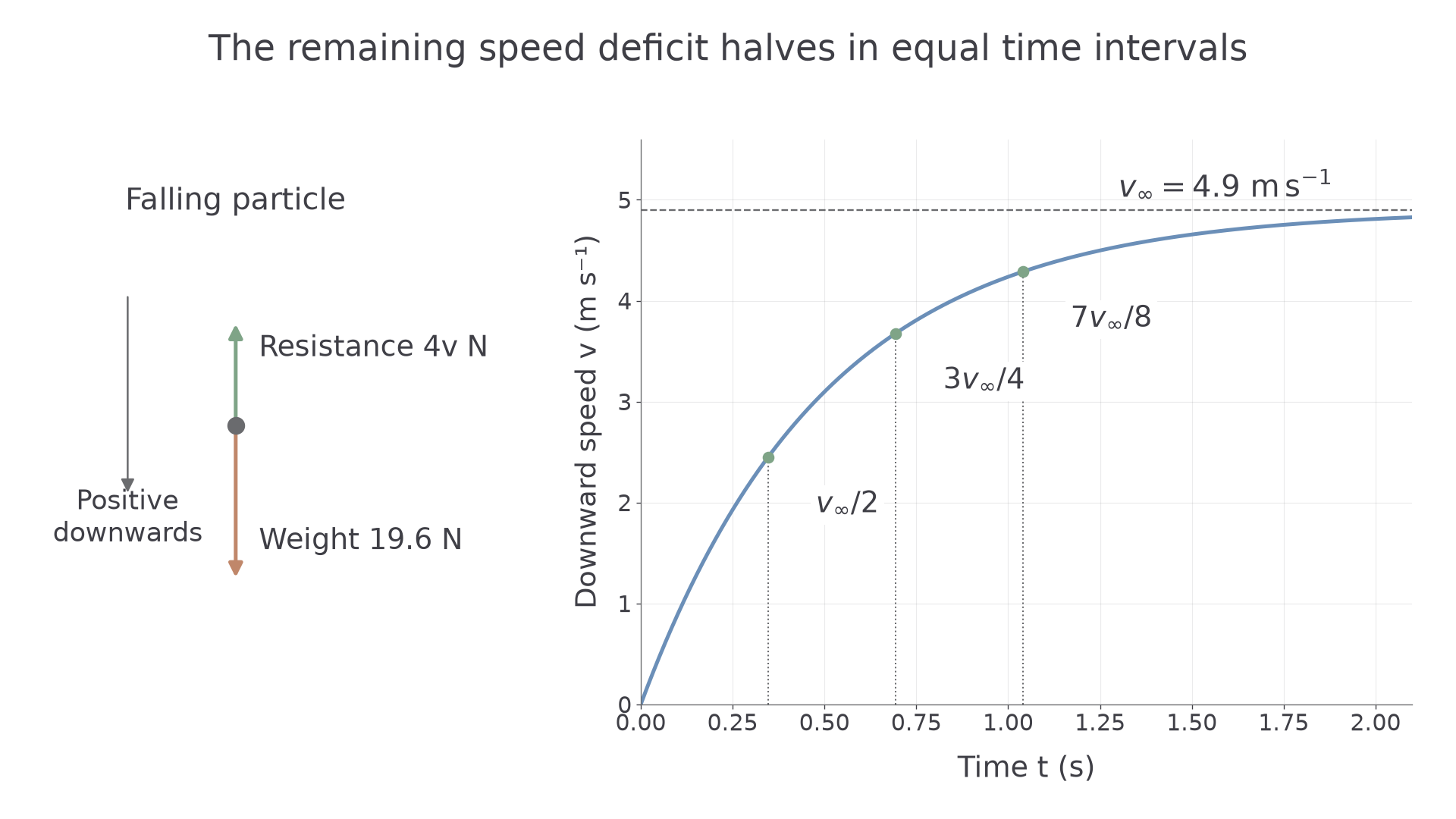
Take downward as positive for a falling particle. A linear resistance opposes its velocity, so a signed model is , with . For downward motion, is the upward resistance magnitude. The equilibrium velocity makes the resultant zero.
Separation on a branch with gives an exponential approach to that equilibrium. The constant solution is also valid and must not be discarded just because separation divides by . These conclusions follow from Newton's law and are not printed booklet results.
For the following pair, a particle of mass is released from rest under gravity with . Its resistance magnitude during downward motion is , with v measured in . The model ignores buoyancy and changes in g.
Worked example 3: reach half the limiting speed
Question. Find the terminal speed and the time taken to reach half of it.
Plan. Set the resultant to zero for the terminal value. Then solve Newton's equation from rest; do not assume that the terminal value is reached at a finite time.
On the branch from rest, . Using ,
For , , hence .
Why this step? Solving the equation shows how the speed approaches its force-balance value. Force balance alone gives the limiting speed but no time history.
Answer. Terminal speed ; half-speed time .
Check. The exponential is positive at every finite time, so . Differentiation gives .
Change only the target fraction from one-half to three-quarters.
Worked example 4: nearer the limiting speed
Question. In the same falling model, find the time to reach three-quarters of terminal speed.
Plan. Use the same initial-value solution and solve for the remaining speed deficit.
Why this step? The exponential describes the deficit from terminal speed. Reaching three-quarters means one-quarter of the initial deficit remains.
Answer. , at speed .
Check. A second equal interval halves the remaining deficit again. It does not add a fixed equal speed increment.
The explicit expression proves the inequality, not merely a numerical impression from a graph. Starting above terminal velocity would instead produce a decreasing approach towards the same equilibrium under the signed linear-drag model.
[DIAGRAM: asset_name: Terminal speed under linear resistance; asset_slug: 9fm0-fm158-linear-resistance; caption: Equal time intervals halve the remaining speed deficit rather than adding equal speed increments; description: A force diagram shows weight downward and linear resistance upward for a falling particle. Alongside it, the exact speed curve 4.9 times one minus exp minus two t rises from zero towards the horizontal terminal line4.9. Guides mark half, three-quarter and seven-eighth terminal speeds at successive half-ln-two time intervals.]
Watch out
Wrong: conclude that zero resultant is reached after “a long enough” finite time. Right: use the exponential to show the deficit remains positive for every finite t; terminal speed is approached from this initial condition.
Change only the target fraction again.
A quadratic resistance leads to partial fractions
For forward motion on a horizontal road, a driving force D and resistance magnitude give . Here v is positive. If the particle reversed, resistance would still oppose motion; the signed force is , not for every signed v.
For a vehicle of mass , constant driving force , and resistance ,
The forward terminal speed is . On the accelerating branch , separate and use
Therefore, starting from rest at ,
Both logarithm arguments are positive on this branch. These are derived model equations, not formula-booklet entries.
Worked example 5: a speed target below terminal
Question. The vehicle starts from rest. Find the time to reach .
Plan. Use Newton's equation and the separated integral with the correct initial and target speeds.
Why this step? The acceleration is a function of v, so separation integrates with respect to v. Substituting the final acceleration into a constant-acceleration equation would ignore the earlier force changes.
Answer. .
Check. At , resistance is , so the resultant is still forward. The target lies below the force-balance speed .
Change only the target speed from to .
Worked example 6: a target closer to force balance
Question. The same vehicle starts from rest. Find the time to reach .
Plan. Retain the force equation and integral, changing only the upper speed limit.
Why this step? The speed interval nearest terminal takes disproportionately long because the resultant force is becoming small.
Answer. .
Check. Exponentiating the general relation gives . Hence at every finite non-negative time. The candidate target is reachable, while is a limit.
Continue this lesson.
You’re previewing NovaLearn without an account. Create a free account to read the rest.
Create free account