FM1 1.1 - Impulse and conservation of momentum
A collision can change a velocity in a fraction of a second. Momentum lets you calculate that change without knowing every detail of the contact force. You will use signed velocities, connect impulse to force and time, and find unknown velocities when two spheres collide directly.
Momentum needs a direction
Can two moving particles have zero total momentum? A particle of mass moves right at , while another of mass moves left at . Neither is stationary. Yet there is a useful sense in which their motions cancel.
You already know
Velocity includes direction; speed is its magnitude. Choose a positive direction before writing a one-dimensional equation. Newton's second law uses the resultant force, and Newton's third-law forces act on different particles.
Take right as positive. Multiplying mass by signed velocity gives for the first particle and for the second. Their sum is zero. Adding their speeds would destroy this cancellation.
Momentum
The momentum of a particle is its mass multiplied by its velocity. Momentum is a vector. Along a chosen line, use its signed component: positive in the chosen positive direction and negative in the opposite direction. Its SI unit is .
A particle moving left at has momentum when right is positive. Its momentum has magnitude . A negative component does not mean a negative mass or a negative speed.
Momentum along a line
For a particle of mass and signed velocity ,
The magnitude of its momentum is . Add signed momenta to find the total momentum of several particles along the same line.
Not in the formula booklet: learn it.
There is a genuine surprise here: zero total momentum does not require zero motion. It requires cancellation. Later in the lesson you will see what this predicts if the opening pair collide and remain together.
Key idea
Add momenta with their directions included; two non-zero momenta can have a zero sum.
Test the difference between the momentum of a system and the momentum of one particle.
Impulse is a change in momentum
A force acting for a short time can produce a large change in velocity. The quantity that records its accumulated effect is impulse.
For a particle of constant mass, Newton's second law gives along a chosen line. Over the interaction,
The left-hand side is the resultant impulse; the right-hand side is final momentum minus initial momentum. When only one force has a significant impulse in the chosen direction, its impulse equals this change.
Impulse
The impulse of a force over a time interval is its integral with respect to time. It has the direction of the force when that direction is constant. The resultant impulse on a particle is the sum of the impulses of all forces on it. Its SI unit is the newton second, , equivalent to .
You can therefore find the impulse from the velocities even when the contact force itself is unknown.
The impulse-momentum principle
For constant mass , initial signed velocity , final signed velocity and resultant signed impulse ,
Use one positive direction for , and .
Not in the formula booklet: learn it.
Begin with a particle that slows down without reversing.
Worked example 1: slowing down
Question. A particle of mass moves right at . After an impulse, it moves right at . Find the magnitude and direction of the resultant impulse.
Plan. Take right as positive and subtract initial momentum from final momentum.
Why this step? The particle still moves right, but its rightward momentum decreases, so the impulse points left.
Answer. The impulse has magnitude , directed left.
Check. Initial momentum is . Adding gives , which is .
Change only the final direction. The final speed is still , but the impulse must now remove the original rightward momentum and create leftward momentum.
Worked example 2: reversing direction
Question. A particle of mass initially moves right at . After an impulse, it moves left at . Find the magnitude and direction of the resultant impulse.
Plan. Keep right positive, so the final velocity is negative, then use .
Why this step? Reversal makes , rather than the difference of the two speeds.
Answer. The impulse has magnitude , directed left.
Check. , the momentum of moving left at .
The subtraction is the same in both examples; only the signed value of changed.
Watch out
Wrong for a reversal: . The value is the final speed, whereas the final velocity is . Right: . Report the magnitude as positive and give its direction separately.
Try another reversal, stating both pieces of the requested answer.
Force, duration and the area under a graph
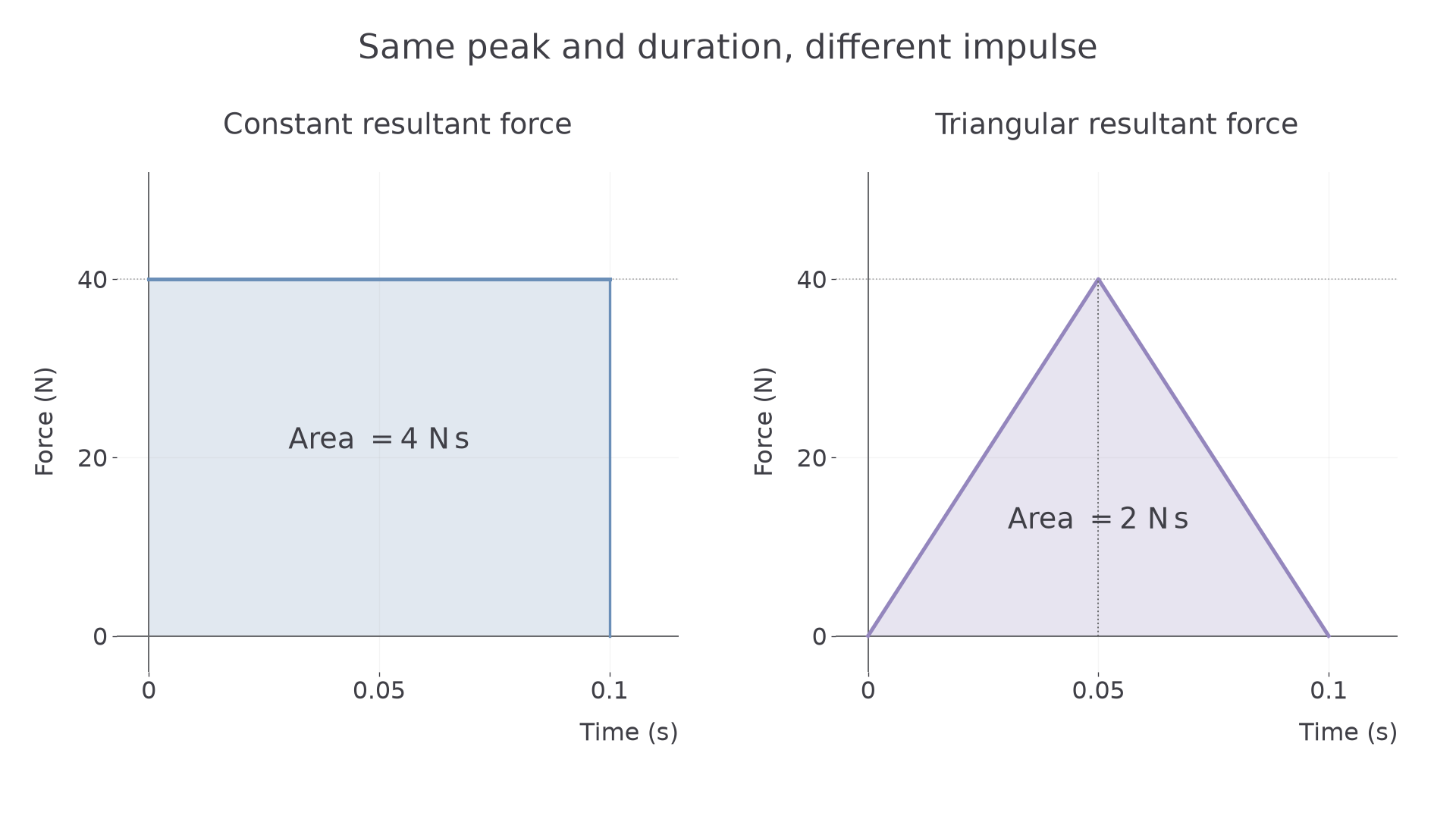
Impulse combines the strength of a force with how long it acts. A constant force of acting for supplies . A triangular force pulse with the same peak and duration supplies only half as much.
[DIAGRAM: asset_name: Equal peak forces can deliver different impulses; asset_slug: 9fm0-fm136-force-time; caption: Impulse is signed area, so the triangular pulse delivers half the impulse of the rectangular pulse; description: Two force-time graphs share axes from zero to 0.1 seconds and zero to 40 newtons. The left graph has a constant 40 newton force and a shaded rectangular area labelled 4 newton seconds. The right graph rises linearly from zero to 40 newtons at 0.05 seconds then falls to zero at 0.1 seconds, with its triangular shaded area labelled 2 newton seconds.]
Finding impulse from force
For the resultant force component along a fixed line,
This is signed area: portions below the time axis contribute negatively. If the force is constant, . For a varying force, its mean value over the interval is
Here .
Not in the formula booklet: learn it.
Once you have the area, the impulse-momentum calculation is unchanged. The following forces are resultant forces along the line of motion.
Worked example 3: a constant force
Question. A particle of mass moves right at . A constant resultant force of acts rightwards for . Find its final velocity and the mean force over the interval.
Plan. Find the rectangular area under the force-time graph, then use it as the change in momentum.
Why this step? The area supplies impulse, which is a momentum change; dividing that impulse by mass gives the velocity change.
Answer. The final velocity is rightwards, and the mean force is rightwards.
Check. , so .
Change only the force profile to the triangular pulse in the diagram. Keep its peak, duration and the particle's initial motion unchanged.
Continue this lesson.
You’re previewing NovaLearn without an account. Create a free account to read the rest.
Create free account