FM1 3.2 - Elastic potential energy
An elastic string or spring can store energy and release it into motion. You will derive its stored energy from Hooke's law, track the difference between two elastic states, and combine elastic energy with kinetic energy, height changes and friction. You will use those balances to find speeds and turning points without treating the elastic force as constant.
Elastic energy is a force-distance area
If you stretch a spring twice as far, does its stored energy merely double? Its final force doubles, but the force also acts through a greater extension. The force-distance picture reveals how those two changes combine.
You already know
Hooke's law gives for extension . Work by a varying force is a force-distance integral. The previous energy lesson balanced kinetic energy, gravitational potential energy and work against resistance.
To stretch an ideal elastic object slowly from natural length to extension , the opposing force rises from zero to . The work you do against that force is the triangular area under the force-extension graph:
In the ideal model this energy is stored and can be recovered as the object returns towards its natural length.
Elastic potential energy
Elastic potential energy is the recoverable energy stored by deforming an ideal elastic string or spring from its natural length. Its value is zero at natural length. A slack ideal string also stores zero elastic energy; a compressed spring can store positive elastic energy.
The squared deformation makes the energy positive whether a spring is stretched or compressed. The force direction still has to be found separately.
Stored elastic energy
For a light ideal Hooke's-law string stretched by , or a spring stretched by ,
For a spring compressed by , use . Here is the natural length, not the current length, and in the final expression is the force magnitude at extension . Energy is measured in joules. For a slack string use , not the square of a negative length difference.
Not in the formula booklet: learn it.
Begin with a spring whose current length is greater than its natural length.
Worked example 1: energy in an extended spring
Question. A light elastic spring has natural length and modulus . Find its elastic potential energy when its length is .
Plan. Find the extension, then substitute it into the stored-energy formula.
Why this step? The numerator squares the extension. Using the full length would assign energy even to the undeformed part.
Answer. The stored elastic potential energy is .
Check. The final force magnitude is . The triangular area is .
Change only the current length to . The spring has the same deformation magnitude, now as compression.
Worked example 2: energy in a compressed spring
Question. The same light spring has natural length and modulus . Find its elastic potential energy when compressed to length .
Plan. Find the positive compression and use the same squared-deformation energy formula.
Why this step? Both extension and compression require positive work to deform the spring from natural length. Their restoring forces have opposite directions, but their stored energies can be equal.
Answer. The stored energy is .
Check. The compressive force magnitude is . Again, . A string with endpoints this close would instead be slack and store zero energy.
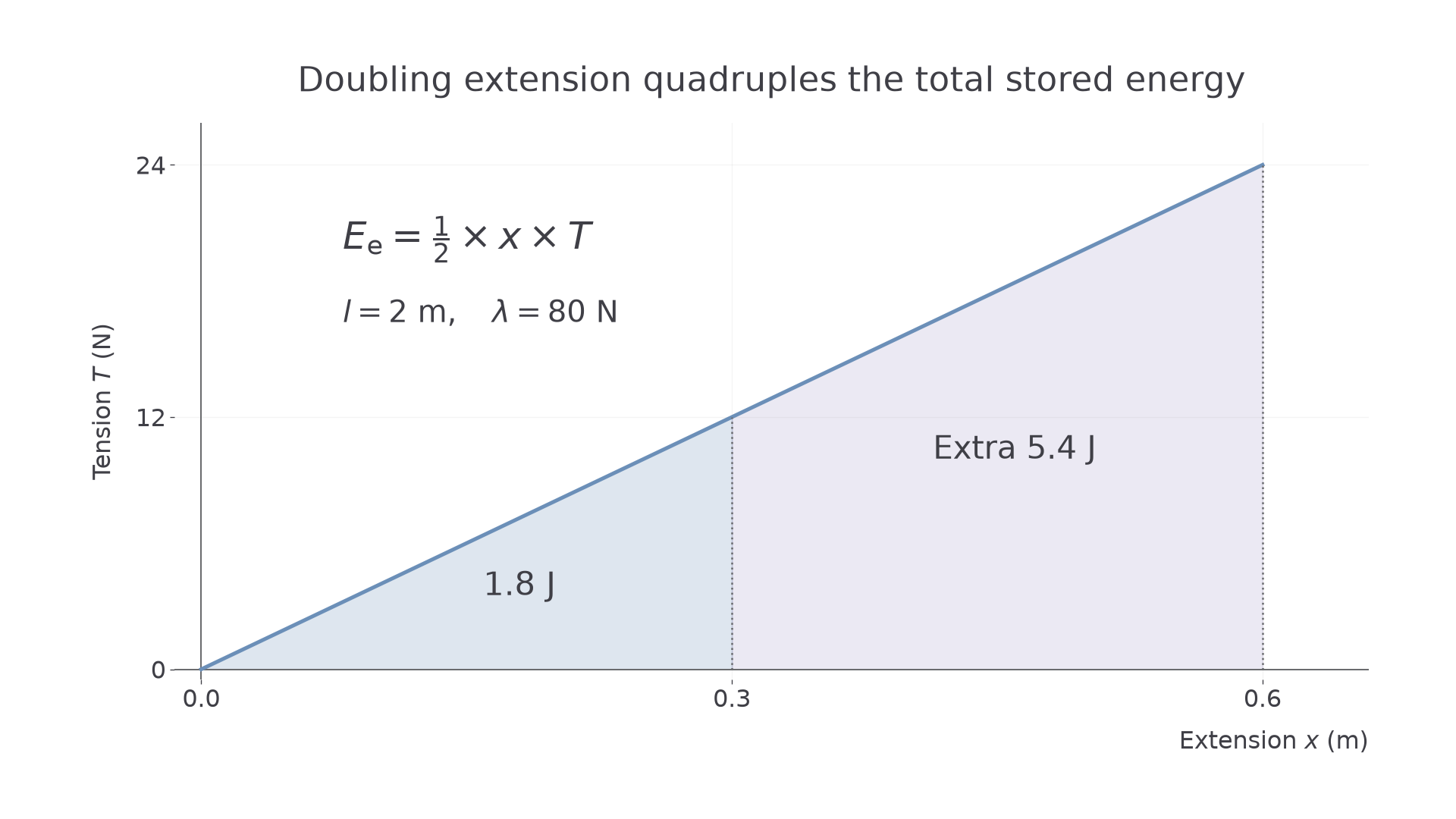
Now answer the opening question with numbers. Increasing extension from to changes the stored energy from to : four times as much. The second of extension alone requires , three times the work needed for the first .
[DIAGRAM: asset_name: Elastic energy grows quadratically with extension; asset_slug: 9fm0-fm141-elastic-area; caption: Equal extension increments do not require equal work; description: A linear tension-extension graph T equals forty x has marked extensions 0.3 and 0.6 metres and tensions twelve and twenty-four newtons. The triangular area from zero to 0.3 is shaded blue and labelled 1.8 joules. The additional area from 0.3 to 0.6 is shaded lavender and labelled extra 5.4 joules. The natural length two metres, modulus eighty newtons and triangular-area formula are shown.]
Watch out
Wrong: , using the final tension throughout the stretch. Right: , because the tension rises linearly from zero. Also, the energy denominator contains , with the natural length.
Change only the compressed length from Worked example 2.
Use both the initial and final elastic energies
An elastic object need not start at its natural length. If it is already stretched, its initial energy is part of the balance. The energy released is a difference of two stored energies, not the stored energy of the change in extension.
Elastic energy transferred into motion
For the same ideal Hooke's-law object in two stretched states,
This is the work done by its elastic force on the attached particle. On a smooth horizontal plane with a fixed support and no other force doing work,
Use zero energy for a slack string, and a squared compression for a compressed spring.
Not in the formula booklet: learn it.
The following string stays taut while the particle moves towards the support, until it reaches natural length.
Worked example 3: some elastic energy remains
Question. A particle lies on a smooth horizontal plane and is attached to a fixed point by a light elastic string of natural length and modulus . The string is initially stretched to , and the particle is released from rest. Find its speed when the string's length is . Neglect air resistance.
Plan. Calculate both extensions and equate the elastic energy lost to the kinetic energy gained.
Why this step? The string is still stretched at the final point, so it retains . Only the released becomes kinetic energy.
Answer. The speed is .
Check. The final kinetic energy is . Adding the remaining recovers the initial .
Change only the final point to natural length. The string now releases all its initial elastic energy.
Worked example 4: reaching natural length
Question. The same particle is released from rest with the , string stretched to on a smooth horizontal plane. Find its speed when the string first reaches natural length. Neglect air resistance.
Plan. Retain the initial elastic energy but set the final elastic energy to zero.
Why this step? At natural length the tension and stored energy are both zero, but the particle can still be moving. After the string becomes slack, it cannot exert a pushing force.
Answer. The speed at natural length is .
Check. This speed exceeds the previous , because more elastic energy has been released. All is now kinetic energy.
The force can vanish at an instant when the speed is substantial. Energy and force describe different aspects of the motion.
Watch out
Wrong: the elastic energy lost is . Right: it is . In Worked example 3 the correct difference is , not .
Choose a different final extension while keeping the initial state unchanged.
Gravity, elastic energy and a later rest point
A falling particle can lose gravitational potential energy while gaining elastic energy. The fall distance is the change in its position, which need not equal its final extension. Draw the initial and final states before forming the equation.
Mechanical energy with an elastic store
For an ideal light string or spring, with fixed support and no dissipative work,
Gravitational potential energy is , using a fixed height reference. At a turning point set the speed to zero, but do not set the resultant force to zero.
Not in the formula booklet: learn it.
The next diagram follows one release from natural length. The point where forces balance and the first later rest point are different positions.
Continue this lesson.
You’re previewing NovaLearn without an account. Create a free account to read the rest.
Create free account