FP1 5.3 - Points, lines and planes in 3-D
Use the vector product to describe lines, construct plane normals and calculate perpendicular distances (FP1 5.3). You will also use direction ratios and direction cosines, including the cases where more than one line fits the angle information.
A line written with a vector product
Can one equation describe every point on a line without a parameter? A point is on the line through in direction exactly when its displacement is parallel to . A zero vector product records that condition.
You already know
A line has form , with . A plane normal is perpendicular to every direction in that plane. Core Pure found perpendicular distances by locating feet or projecting onto a normal; the vector product now supplies useful normals directly.
The anchor is a position vector, while is a direction. Their roles cannot be exchanged.
Cross-product equation of a line
For , the line through parallel to is
This includes , because its displacement is . A zero direction vector would instead make the equation true for every point, so it cannot define a line.
Not in the formula booklet: learn it.
The booklet supplies the symmetric Cartesian line form . Use that quotient form only for non-zero denominators; a zero direction component means the corresponding coordinate is constant.
Worked example 1: cross-product and Cartesian forms
Question. Write the line through , parallel to , in cross-product and Cartesian forms. Check whether lies on it.
Plan. Put the anchor inside the displacement brackets, then compare the three Cartesian parameter values.
Why this step? Each quotient is the same line parameter; checking just two coordinates could admit a point off the three-dimensional line.
Answer. The displayed equations describe the line, and lies on it.
Check. , so its vector product with is .
Change only the last direction component to zero. The line now has constant height, and a quotient with that zero component must be replaced.
Worked example 2: a zero direction component
Question. Keep , but use direction . Give both line forms and decide whether lies on the new line.
Plan. Retain the cross-product equation, expand it if useful, and express the constant coordinate explicitly.
Why this step? Writing would be undefined; the vector product instead shows directly that must equal .
Answer. The displayed forms describe the new line. does not lie on it because its height is .
Check. A general point satisfies both Cartesian conditions and the zero cross product.
Different non-zero scalar multiples of a direction describe the same line. The product equation fixes parallelism, rather than a chosen speed along the line.
Watch out
Wrong: , or an unfinished expression with no equality. Right: subtract a position on the line, cross with its non-zero direction, and include .
Change the final direction component once more.
Direction ratios and direction cosines
A direction ratio describes relative components; a direction cosine is a component of a unit direction vector. Normalisation connects them.
For a chosen orientation , its direction ratios are . Multiplying all components by the same non-zero scalar gives the same unoriented line. The direction angles are the angles of the chosen direction with the positive coordinate axes, each between and .
Direction cosines
Consequently,
The three cosines are the components of the chosen unit direction vector. Reversing its orientation negates all three cosines but describes the same line.
Not in the formula booklet: learn it.
The individual expressions follow by taking scalar products with ; the identity follows because a unit vector has squared length one. For example, ratios give cosines , so the chosen direction makes an obtuse angle with the positive -axis.
Worked example 3: two possible final components
Question. Find both Cartesian lines through the origin whose chosen directions make angles with both the positive - and positive -axes.
Plan. Use the squared-cosine identity to find both possible -components, then scale the unit directions into convenient ratios.
Why this step? Squaring the third cosine loses its sign. Restoring both signs produces two distinct lines, rather than two orientations of one line.
Answer. The lines are and .
Check. Each direction has length , and its first two components divided by that length are . Their ratios are not proportional to each other, so the lines are distinct.
Change only the angle with the positive -axis from to .
Worked example 4: new angle, new pair of lines
Question. Find both Cartesian lines through the origin whose chosen directions make angles with the positive -axis and with the positive -axis.
Plan. Keep the first cosine, update the second and again retain both signs of the third.
Why this step? Negating only the final component gives a different line; negating all three components would merely reverse one line's orientation.
Answer. and .
Check. Each direction has length , giving cosines ; their squares sum to one.
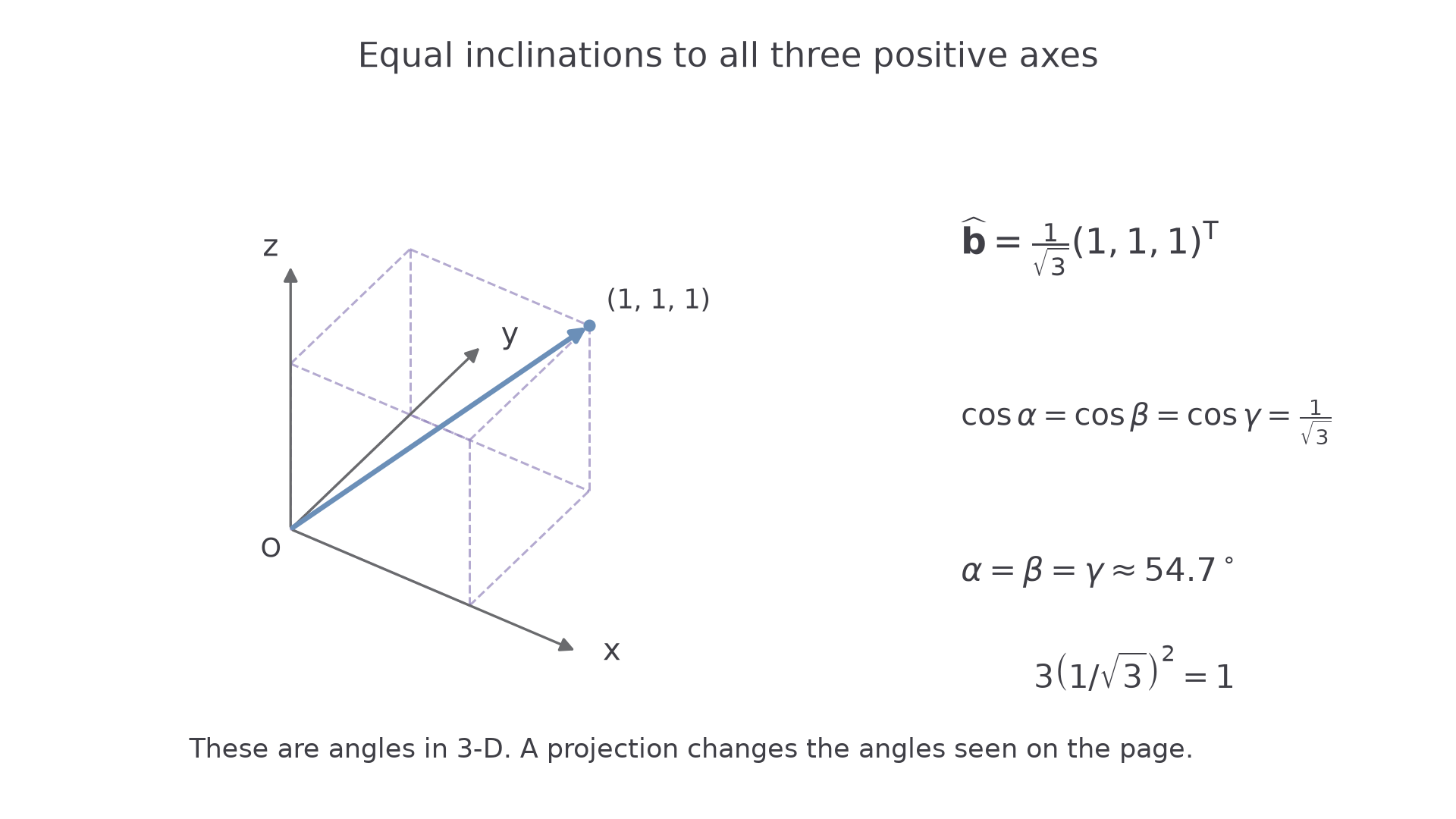
There is a neat spatial fact here: a direction equally inclined to all three positive axes makes angle , approximately , with each. Three angles of would give squared cosines totalling , so they are impossible. This follows from the identity, rather than a separate booklet result.
[DIAGRAM: asset_name: Equal inclinations to three positive axes; asset_slug: 9fm0-fp1-direction-cosines; caption: Equal direction cosines are one over root three, so the three equal angles are about 54.7 degrees; description: An exact projected three-dimensional coordinate diagram shows positive x, y and z axes and the arrow from the origin towards (1,1,1). Light component guides locate (1,1,1). A side panel gives the unit direction (1,1,1) divided by root 3, its three equal direction cosines and the squared-cosine sum 1. The annotation specifies that these are actual three-dimensional angles, not angles measured on the page.]
Watch out
Wrong: choose any three angles independently. Right: their squared cosines must sum to one. If the first two squares sum to more than one, no real direction exists; if they sum to one, the third component is zero and the two sign choices coincide.
The next pair of angles reaches that zero-component boundary.
A plane normal from two directions
The vector product replaces two simultaneous perpendicularity equations with one calculation. For two non-parallel directions in a plane, their product is a non-zero normal.
Use displacements from a common point when the plane is specified by vertices. A normal alone fixes the plane's orientation; a point on it fixes its position.
Constructing a plane with a vector product
If the plane passes through and is parallel to non-parallel , take
Its Cartesian equation is . The Cartesian point-normal form is supplied in the booklet; this combined cross-product construction and scalar-product form are not printed.
Not in the formula booklet: learn it.
Multiplying a normal by a non-zero scalar, including , changes neither the plane nor its equation's solution set.
Worked example 5: a normal gives a Cartesian plane
Question. Find the Cartesian equation of the plane through , parallel to and .
Plan. Cross the two directions and insert the given point into the normal equation.
Why this step? Using a direction vector instead of the position vector in the constant term would place the plane incorrectly.
Answer. .
Check. satisfies the equation, and , .
Change only the final component of from to . The plane tilts about the line through in direction .
Worked example 6: simplify the normal's scale
Question. Keep , but take . Find the new Cartesian plane equation.
Plan. Recalculate the product, simplify its common factor and use the same anchor.
Why this step? If the normal is divided by , the entire equation, including its constant, must use that same scale.
Answer. .
Check. Its normal has zero products with and ; gives .
If the proposed plane directions are parallel, their product is zero. That information describes only one direction and cannot determine a unique plane through the anchor.
Watch out
Wrong: accept as a plane normal. Right: a normal must be non-zero. Check the spanning directions before treating a zero product as an equation for a plane.
Vary the same final component again.
The direction of a plane intersection
A line in two non-parallel planes is perpendicular to both normals. Their vector product therefore supplies the line direction; finding one point shared by the planes completes its equation.
Continue this lesson.
You’re previewing NovaLearn without an account. Create a free account to read the rest.
Create free account