FP2 2.2 - Arc length and surface area
Calculate arc length and curved surface area from Cartesian, parametric and polar equations. Choose a once-only trace, identify the distance from the rotation axis, and retain the correct positive square root and integration bounds.
Add small sloping lengths, rather than horizontal widths
Can a sphere have exactly the same area as the curved cylinder fitted tightly around it? Its curved profile and the cylinder's straight profile have different lengths, but each produces area by sweeping circles of changing radius. We will derive the two areas and explain why they agree.
You already know
Core Pure volumes use circular slice areas; polar areas use small sectors. Here we measure a curve's length and the curved surface it sweeps. Parametric equations give in terms of one parameter; polar coordinates use , with and admissible angles. Recall the hyperbolic identity and the inverse-hyperbolic radical integrals.
Join nearby curve points by a short straight segment. Pythagoras gives . In the limit, for a curve ,
when integrating with increasing . The slope measures how much longer the sloping piece is than its horizontal projection.
Arc length
Arc length is distance measured along the curve, rather than the straight chord between its endpoints. It has length units, not square units. Trace the required curve portion once; retracing adds length again if included in the integral.
For a piecewise smooth curve, add the lengths of its pieces. Choose an increasing interval of the integration variable so that a geometric length is positive.
Cartesian arc length
For , traced once from to , with ,
Use a differentiable description on the interval's interior and check any singular endpoints by a limit or a regular parametrisation.
In the formula booklet.
When is given as a function of , interchange the coordinate roles and integrate with respect to increasing . This follows from the same distance calculation; it is not printed as a separate formula.
Worked example 1: a hyperbolic identity simplifies the speed
Question. Find the exact length of from to .
Plan. Differentiate, simplify the square root using the hyperbolic identity, and integrate the positive result.
Why this step? A square root is nonnegative. The known positivity of justifies dropping the absolute value after taking the root of its square.
Answer. length units.
Check. The horizontal distance is , less than ; the curved path cannot be shorter than its horizontal projection.
Keep the curve and lower endpoint fixed; change only the upper endpoint to .
Worked example 2: extend the same curve
Question. Find the exact length of , .
Plan. Use the same simplified length element, but apply the new upper bound.
Why this step? The formula for the length element has not changed. The longer interval changes the accumulated length, not the differentiation.
Answer. length units.
Check. It exceeds the previous because a positive additional curve segment has been included.
These particular curve lengths are derived values, not entries in the formula booklet.
Watch out
Wrong: use to measure the curve, or integrate just . Right: include both coordinate changes through .
Extend the same curve again.
Use both coordinate derivatives for a parametric curve
For , the small horizontal and vertical changes are and . Pythagoras combines them into a speed. A negative coordinate derivative does not make that speed negative.
Parametric arc length
For a once-only trace with increasing parameter ,
The square root is the nonnegative speed along the curve.
In the formula booklet.
Consider , , one arch of a cycloid. Its derivatives both vanish at each end, but its speed is continuous and its length is finite. The diagram identifies the half and whole traces.
[DIAGRAM: asset_name: Half and whole cycloid arches; asset_slug: 9fm0-fp293-cycloid-arc; caption: Parameter bounds select a half arch or a full arch without eliminating the parameter; description: An equal-scale Cartesian plot shows x equals two times the quantity t minus sin t, and y equals two times the quantity one minus cos t, for t from zero to two pi. The first half, zero to pi, is blue and the second half, pi to two pi, is sage. Endpoints (zero, zero), (two pi, four) and (four pi, zero) are labelled in dark ink with their parameter values. The legend is outside the curve. A note gives half-arch length eight and full-arch length sixteen.]
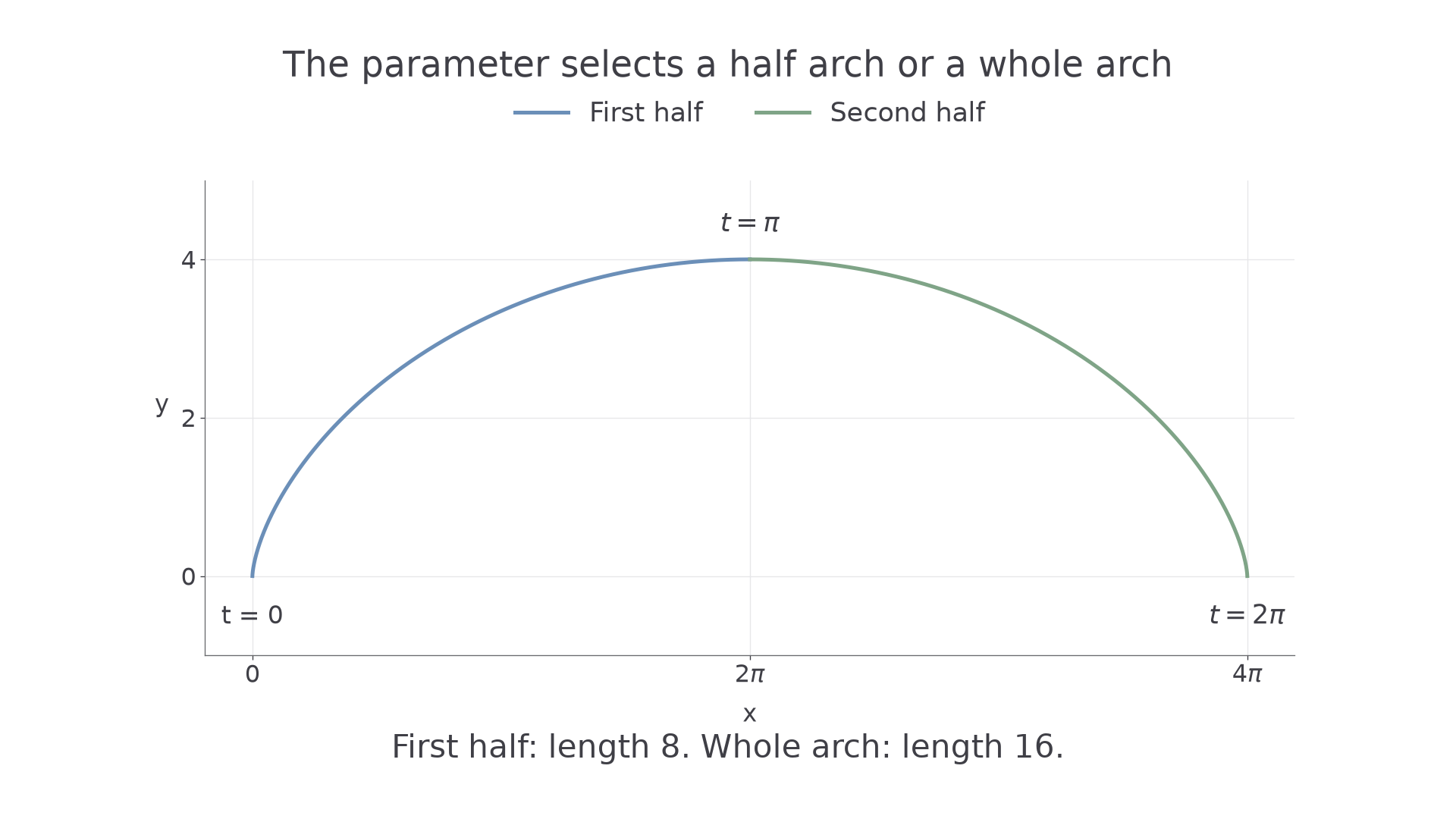
The speed simplifies because . Keep its absolute value until the parameter interval fixes the sign.
Worked example 3: half an arch
Question. Find the arc length for this cycloid from to .
Plan. Differentiate both coordinates, simplify the speed and use the half-arch bounds.
Why this step? On this interval , so equals the expression used. Neither nor alone is the speed.
Answer. length units.
Check. The endpoint chord has length , consistent with a curved path.
Keep the equations and lower bound fixed; change only the upper parameter bound to .
Worked example 4: a full arch
Question. Find the length of the whole cycloid arch, .
Plan. Retain the same speed, checking its sign over the extended interval.
Why this step? Although changes sign halfway through the arch, the speed remains nonnegative. Descending along a curve still adds positive length.
Answer. length units.
Check. Reflection symmetry gives two equal halves of length . The total also exceeds the endpoint separation .
The cycloid lengths are derived, not printed. If a parametrisation travels over the same curve portion repeatedly, use only the trace requested; the speed integral counts each traversal.
Watch out
Wrong: use , or keep only one derivative. Right: square both coordinate derivatives, add them, then take the positive square root before integrating.
Use a shorter first portion of the same arch.
Include both radial change and angular travel
For a polar curve, increasing the angle moves the point even if its radius stays constant. Differentiate ; adding the squared derivatives cancels the cross-terms and gives .
Polar arc length
For a once-only admissible trace , ,
Use radians, differentiate the given radius and choose bounds from the actual curve portion.
In the formula booklet.
For , the upper half is traced once by , ending at the pole. Its radius is nonnegative. The pole endpoint causes no difficulty for length; check the speed rather than dividing by .
[DIAGRAM: asset_name: Upper-half and shorter cardioid traces; asset_slug: 9fm0-fp293-cardioid-traces; caption: The angle interval decides how much of the nonnegative-radius curve is measured; description: An equal-scale Cartesian cardioid r equals two times the quantity one plus cos theta is shown. The first segment, theta from zero to pi over two, is sage; the remainder of the upper half to theta pi is blue; the lower half is a thin grey dashed reference curve. Points (four, zero), (zero, two) and the pole are labelled with angles zero, pi over two and pi. A vertical dashed ray marks theta pi over two. Legends are outside the plotting area. Notes give upper-half length eight and first-segment length four root two.]
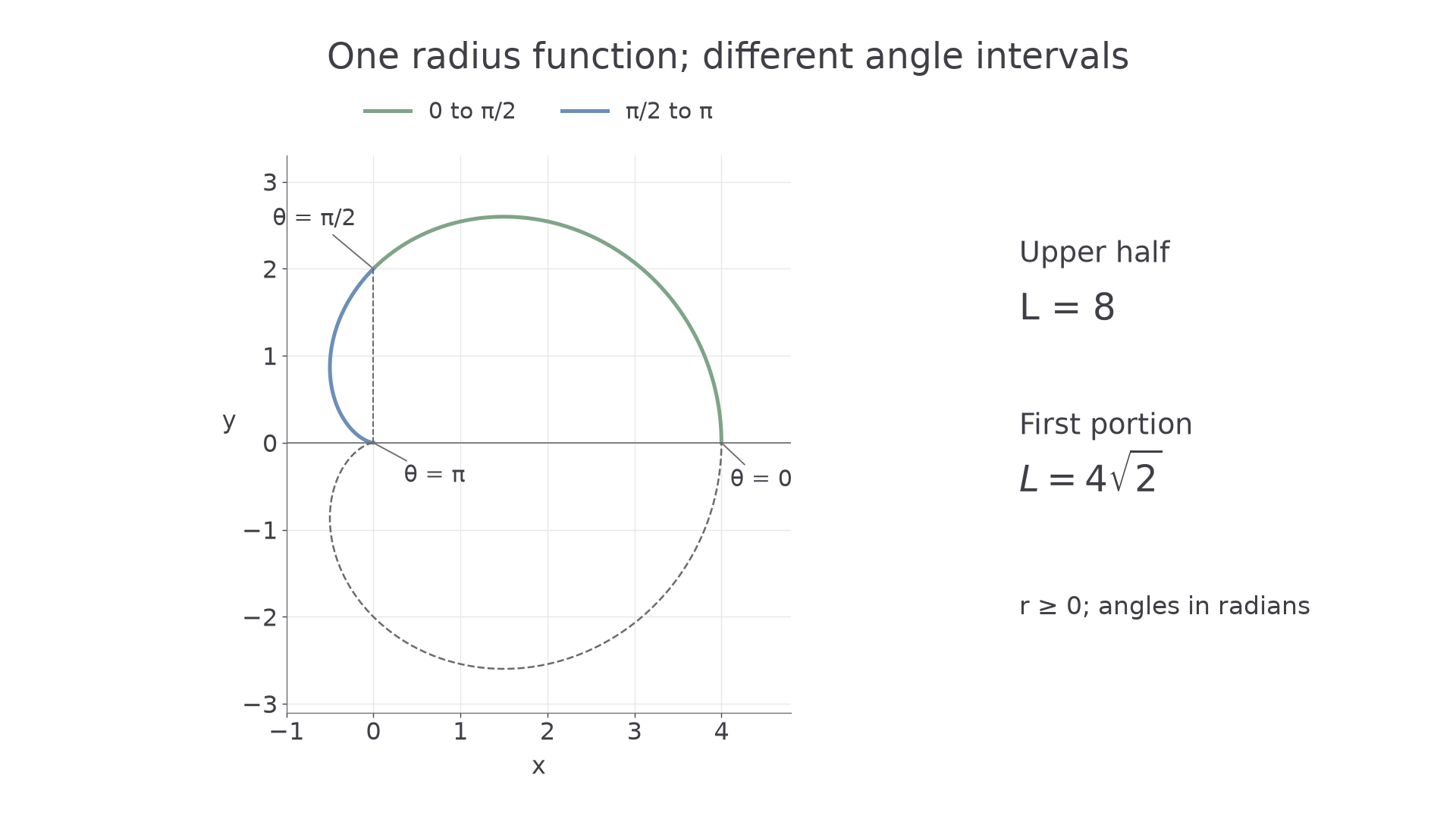
The square root will contain . Its sign is known on the selected upper-half interval, but would change during a full angular turn.
Worked example 5: the upper cardioid arc
Question. Find the exact length of , .
Plan. Differentiate , simplify the radical, and check the half-angle sign before integrating.
Why this step? The radial derivative alone would miss angular motion; the squared radius supplies that second contribution.
Answer. length units.
Check. The arc connects to the pole, so its length must exceed the chord length . The result does.
Keep the radius function and starting angle fixed; change only the upper angle to .
Worked example 6: stop at the positive vertical axis
Question. Find the exact length of the same cardioid for .
Plan. Use the previously simplified nonnegative speed on the shorter interval.
Why this step? The curve's endpoint is now , not the pole. The same algebraic speed is integrated over a different geometric trace.
Answer. length units.
Check. The chord is , smaller than , which in turn is smaller than the upper-half length .
These particular lengths are not in the formula booklet. A full cardioid would require , split where its sign changes, rather than the upper-half simplification over the whole turn.
Watch out
Wrong: use as a speed on , where it becomes negative. Right: keep or split the interval at .
Stop at a different admissible ray.
Multiply each sloping length by the circumference it sweeps
A short curve segment at distance from an axis sweeps a narrow frustum band. Its area approaches circumference times slant length, , for a full turn. Thus curved surface area is accumulated from , rather than from the disc area used for volume. This unifying band rule is derived here, not printed separately in that form.
The radius is a distance from the stated axis. About the -axis it is ; about the -axis it is . A curve may sweep an open-ended surface: end discs are not included unless the question asks for them.
Cartesian surface area about the x-axis
For a full turn of , , generating the required surface once,
This gives the curved surface only.
In the formula booklet.
The printed form uses the positive radius . If the curve is below the axis, use . About the -axis, replace the radius factor by , keeping the same length element. These distance/axis extensions follow from the band reasoning; they are not printed as separate formulas.
Continue this lesson.
You’re previewing NovaLearn without an account. Create a free account to read the rest.
Create free account