CP 2.7 - Loci in the Argand diagram
Turn complex equations into geometric sets of points: circles, perpendicular bisectors and rays. This lesson covers the equality loci in CP 2.7; you will interpret their centres, directions and endpoints, and use a diagram to find points satisfying two conditions together.
A fixed distance gives a circle
Which complex number is exactly three units from and lies directly above it? In complex notation the conditions are and . You will solve them by drawing a circle and a ray.
First look at the expression inside the modulus. If , then , whose modulus is . The subtraction gives the displacement from the fixed point to , and the modulus measures its length.
You already know
The arrow from the point for to the point for represents , and its length is . From A-level Mathematics, a circle with centre and radius has equation ; a perpendicular bisector passes through a segment's midpoint at right angles to it.
A condition on can describe many points rather than a single answer.
Locus
A locus is the set of all points satisfying a stated condition. For example, the points at distance from a fixed point form a circle's circumference. The interior is not part of that fixed-distance locus: its points are closer than .
Since measures a displacement from , the fixed point becomes the centre of the circle.
A circle in complex notation
For fixed and real ,
The locus is the circle with centre and radius . If , the locus is the single point ; if , it is empty.
Not in the formula booklet: learn it.
The sign inside the bracket is best read by rewriting it as , rather than by trying to spot a centre from individual signs.
[DIAGRAM: asset_name: A circle centred away from the origin; asset_slug: 9fm0-locus-circle; caption: The modulus of z minus a is the distance from a to z; description: Equal-scale Argand axes show a circle with centre A at (2,minus 1) and radius 3. A point Z on the circle is at (2 plus 3 over root 2, minus 1 plus 3 over root 2). A blue arrow from A to Z is labelled z minus a, and its length is labelled 3. A is labelled a equals 2 minus i.]
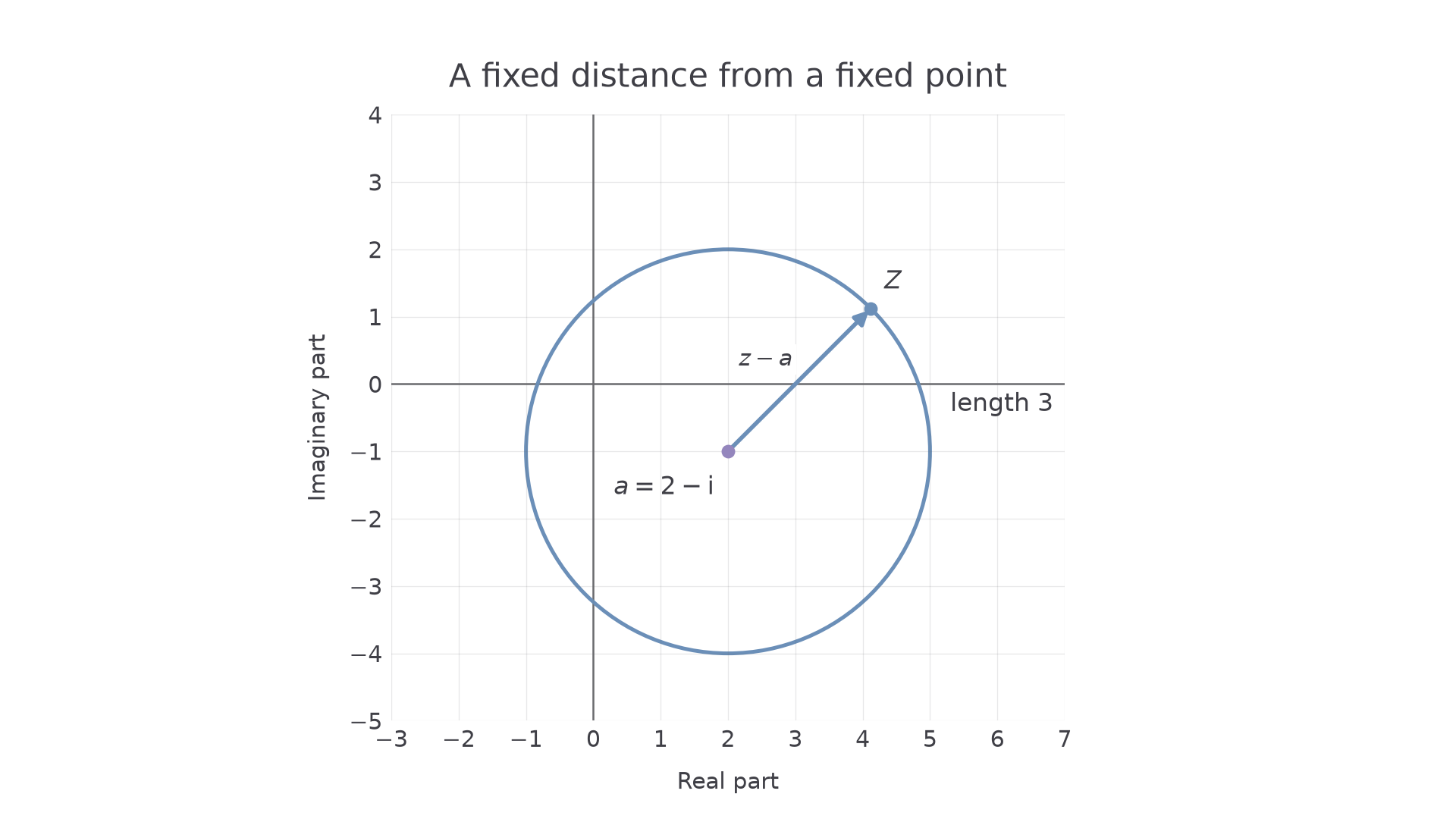
Worked example 1: finding the centre and radius
Question. Describe the locus and give its Cartesian equation.
Plan. Read the fixed complex number as the centre, then write inside the modulus.
Why this step? The centre is the number being subtracted, , so its coordinates are .
Answer. A circle with centre , radius , and equation .
Check. The rightmost point is ; subtracting gives , whose modulus is .
Change only the sign before the fixed number. The radius stays the same, but the centre moves to the negative of the old centre.
Worked example 2: a plus sign inside the modulus
Question. Describe and give its Cartesian equation.
Plan. Rewrite the expression as , then read its centre and expand the squared distance.
Why this step? A plus sign before a bracket changes the entire fixed number when you rewrite it as a subtraction, including its imaginary part.
Answer. A circle with centre and radius , with equation .
Check. At , the expression inside the modulus is , so this rightmost point lies on the circle.
The radius is a distance rather than a squared distance.
Watch out
Wrong: “ has radius .” The modulus already is the distance, so the radius is . Its Cartesian equation has on the right. Take a square root only if the original condition is .
Read the centre carefully in this unbracketed expression.
Equal distances give a perpendicular bisector
Points equally far from two distinct fixed points lie on their perpendicular bisector, so an equality of two moduli usually describes a straight line.
Let represent and represent . The equation says . The midpoint of satisfies it, and every point on the perpendicular line through that midpoint does too. Conversely, the isosceles triangle puts on that line.
An equidistance locus
For distinct fixed complex numbers and ,
is the perpendicular bisector of the segment joining their points. Its Cartesian equation follows by squaring both non-negative distances and expanding. If , every complex number satisfies the equation instead.
Not in the formula booklet: learn it.
Here is the pleasant surprise in the algebra: both squared distances contain , so those terms cancel. Two expressions that look quadratic leave a linear equation. The geometry predicted the cancellation before you expanded a bracket.
[DIAGRAM: asset_name: Equal distances and a perpendicular bisector; asset_slug: 9fm0-locus-bisector; caption: Every point on the bisector is equally far from the two fixed points; description: Equal-scale Argand axes show A at (1,1), B at (5,3) and their midpoint M at (3,2). The blue segment AB has a sage perpendicular bisector 2x plus y equals 8. A sample point Z at (2,4) on the bisector is joined to A and B by equal clay dashed segments. A small right-angle marker is placed at the midpoint.]
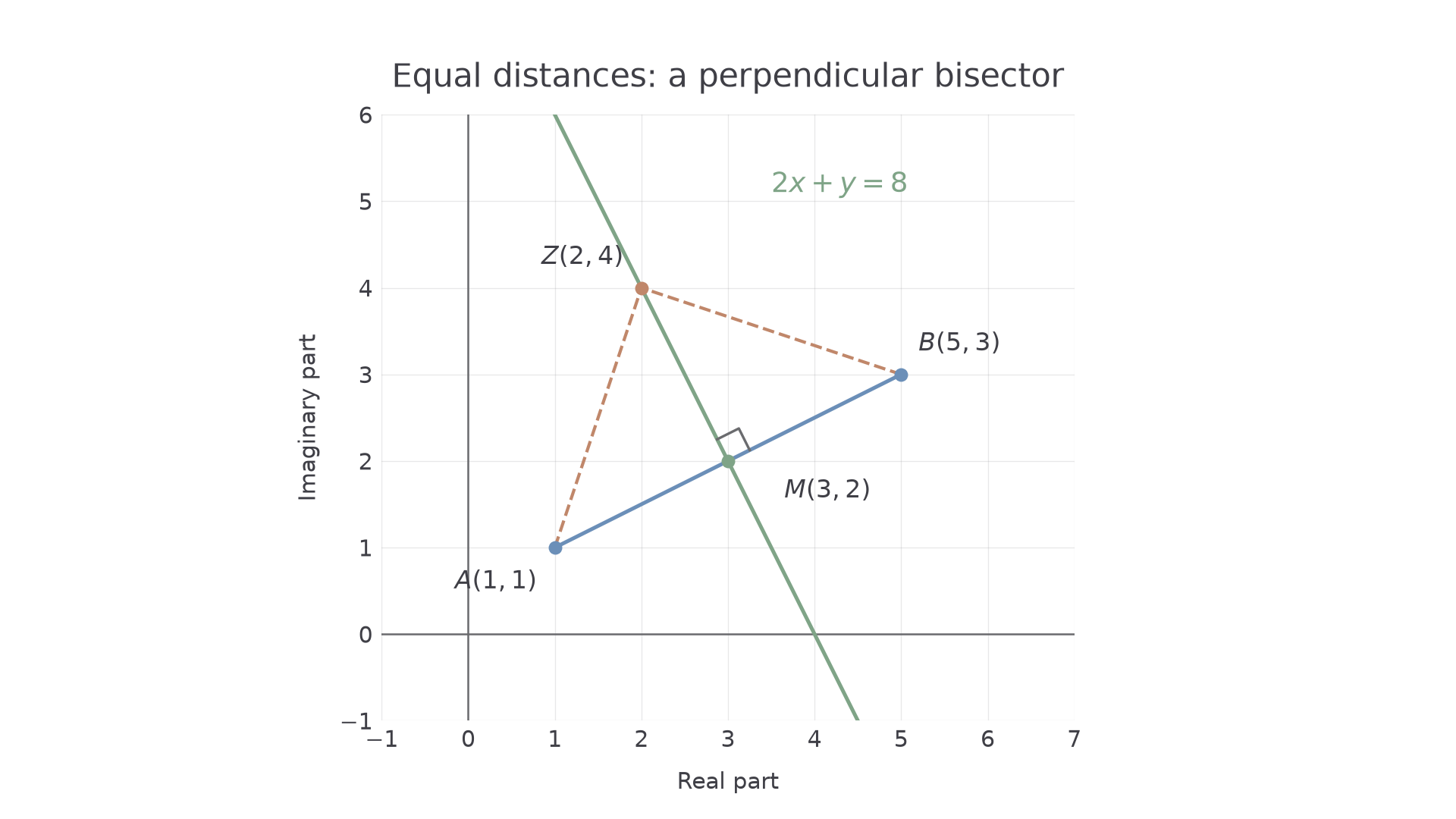
Worked example 3: a sloping bisector
Question. Find the Cartesian equation of , and describe the locus.
Plan. Square both distances, expand and cancel the quadratic terms.
Why this step? Both moduli are non-negative, so squaring preserves their equality and removes the square roots.
Answer. The line , the perpendicular bisector of the segment from to .
Check. The midpoint satisfies . The segment has gradient ; the line has gradient , so they are perpendicular.
Now change only the imaginary part of the second fixed point, making both fixed points level. The bisector becomes vertical, so a slope formula would be inconvenient.
Worked example 4: a vertical bisector
Question. Find and describe the locus .
Plan. Square the distances and cancel the identical vertical terms.
Why this step? Squared-distance algebra handles a vertical line without ever dividing by a gradient or a coordinate difference.
Answer. The vertical line , through the midpoint and perpendicular to the horizontal segment joining the fixed points.
Check. At , the displacements from the fixed points are and , both with modulus .
Checking only the midpoint proves that one point is equidistant; it does not by itself establish the whole locus. Use the perpendicular-bisector description or the Cartesian equation for that.
Watch out
Wrong: “ is the line joining and .” Most points on that joining line are closer to one endpoint. The correct locus crosses it at right angles through its midpoint.
Use the cancellation again for this pair of fixed points.
A fixed direction gives a ray
A fixed argument specifies a direction from a fixed point, so its locus is a ray with its starting point excluded.
For , the arrow starts at , the point for . It points at angle from the positive real direction. Its length can be anything positive. At , the displacement is zero and has no argument, so the starting point never belongs to this locus.
Ray
A ray follows one direction from a fixed point, rather than continuing both ways as a whole line does. In an argument locus , the fixed point is excluded. For example, gives the positive horizontal ray to the right of , not the whole real axis.
You can describe the ray without using a gradient, which also works for a vertical direction.
An argument locus
For fixed and ,
The angle is measured from a horizontal line pointing right at . The restriction selects the correct direction and excludes .
Not in the formula booklet: learn it.
If a gradient is convenient, write the supporting line using , then select the correct half of it. Tangent repeats after , so the line equation alone loses the distinction between opposite rays.
[DIAGRAM: asset_name: Opposite argument rays on the same line; asset_slug: 9fm0-locus-rays; caption: Opposite directions give different rays even when the supporting line is the same; description: Equal-scale axes show an open point A at (2,minus 1). From it a blue ray points northeast at pi over 4 and a clay ray points southwest at minus 3pi over 4. Both lie on y equals x minus 3. Labels identify x greater than 2 on the blue ray and x less than 2 on the clay ray; the starting point is excluded.]
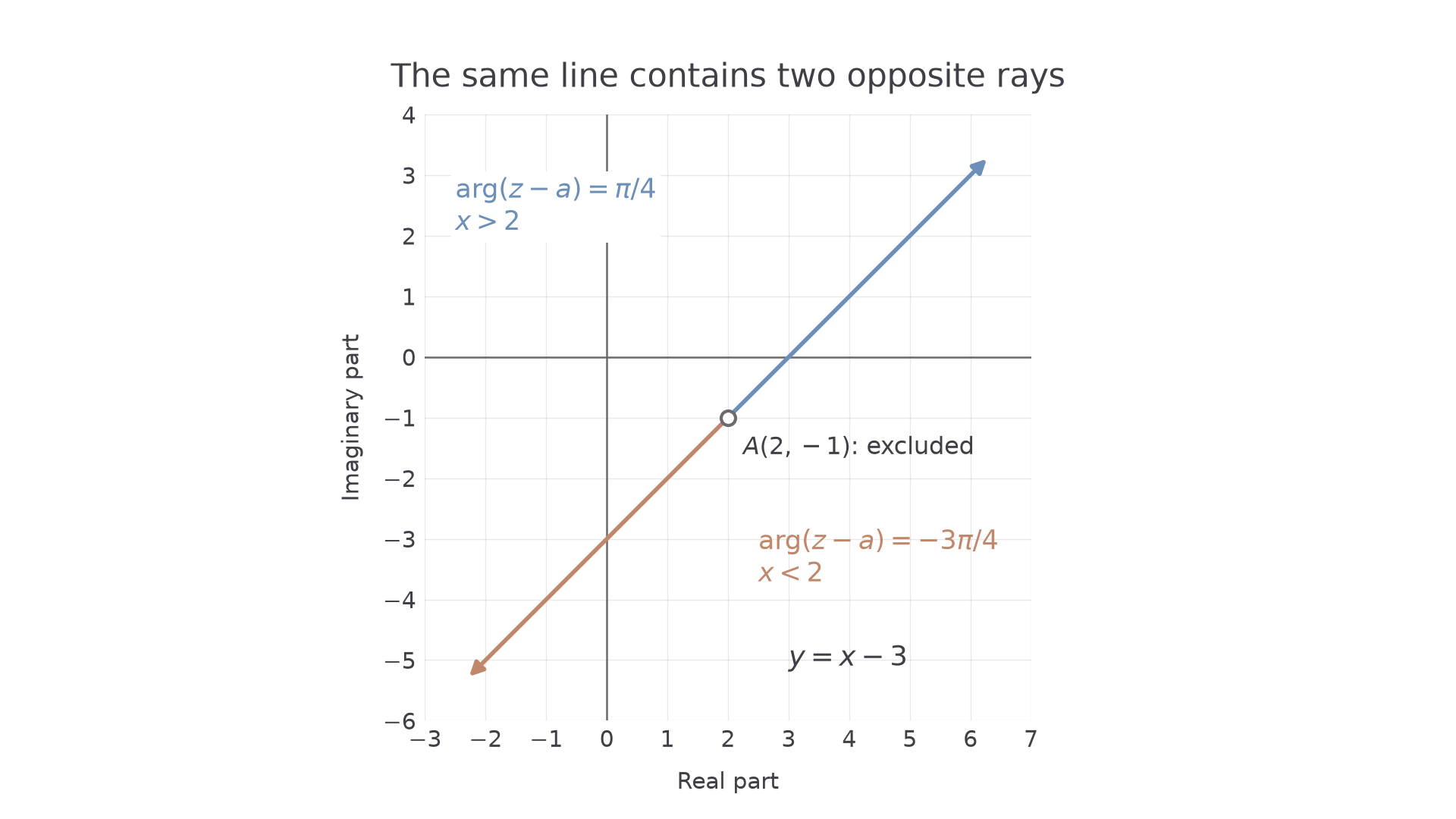
Worked example 5: a ray with positive slope
Question. Describe the locus , giving a Cartesian equation and the restriction that selects the ray.
Plan. Start at , use gradient , then select the northeast direction.
Why this step? The inequality chooses the half-line at angle ; the opposite half has argument .
Answer. The ray , , beginning at the excluded point and pointing northeast.
Check. At , the displacement is , whose argument is .
Change only the argument by , to the opposite direction. The supporting line stays the same, but the inequality reverses.
Worked example 6: the opposite ray
Question. Describe in Cartesian terms.
Plan. Keep the supporting line and select points southwest of the fixed point.
Why this step? The signs of both components of must now be negative, despite the positive gradient.
Answer. The ray , , excluding .
Check. At , the displacement is , whose principal argument is .
The supporting line must still be restricted to the stated direction.
Watch out
Wrong: gives the whole line . The opposite half has argument . The correct locus is ; the starting point is excluded because its argument is undefined.
Axis directions are even simpler: argument zero gives a ray to the right, gives one to the left, gives one upwards, and gives one downwards. All start at and exclude it.
For the opening puzzle, means and . On the circle, , so or . The upward ray keeps only : the required number is . A sketch stops the unwanted intersection surviving the algebra.
Exam tip
Show an argument locus as a ray, indicate its direction and leave an open starting point. If you give a Cartesian line equation, add the restriction selecting the correct half-line.
Choose the correct side of the fixed point in this second-quadrant direction.
Quick Recap
- is the distance from to ; gives a circle centred at .
- For distinct , gives their perpendicular bisector; quadratic terms cancel when you find its equation.
- gives a ray from , measured from the positive real direction, with excluded.
- When conditions are combined, keep only the points on both loci and check any directional restrictions.
The opening circle meets the upward ray at ; the lower circle intersection is discarded because it points downwards.