6.3.2(e) - Managing environmental resources and human impacts
Human populations need environmental resources: land, water, food, fuel, space, building materials and places to work or visit. The biological problem is that using those resources can change ecosystems and alter plant and animal populations. In this lesson, you will learn how to explain those effects, how management can control them, and how decisions balance conservation or preservation with human needs.
Resource Use Creates Conflict
An environmental resource is any part of the environment that humans use. It may be biological, such as fish, timber, crops or grazing land. It may also be a physical resource, such as water, soil, space for housing, or a landscape used for tourism.
The conflict in this lesson begins when the same ecosystem has two demands placed on it:
- humans need resources, income, food, access, employment or safety;
- plant and animal populations need habitats, breeding sites, food sources, low pollution, and conditions within their tolerance range.
Management decisions balance human needs with conservation or preservation. Conservation means active management to maintain biodiversity, often while allowing some sustainable human use. Preservation means protecting species or habitats by minimising human interference. A reserve may combine a preserved core with surrounding areas managed for sustainable access or harvesting.
Sustainable Management
Sustainable management uses environmental resources in a way that meets present human needs without causing long-term loss of ecosystem function, biodiversity or future resource availability.
For example, a wetland may support rare plants, nesting birds and invertebrates. It may also provide grazing land, water storage, tourism income and local employment. A one-sided decision can fail biologically or socially. Total unrestricted access may damage the habitat; total exclusion of people may remove local support and income. A better decision asks: what pressure is the human activity creating, which populations are affected, and which control reduces the pressure while keeping human needs in view?
From Human Activity To Population Change
Human activity affects plant and animal populations through cause and effect. A strong answer does not stop at "humans damage the environment". It explains the route from the activity to the population change.
The route usually looks like this:
- A human activity changes a biotic or abiotic condition.
- That change affects survival, reproduction, competition, predation, disease, food supply or habitat availability.
- Birth rate, death rate, immigration, emigration, distribution or carrying capacity changes.
- The population size or distribution changes.
[DIAGRAM: human_impact_control_map: Lesson 173: Managing environmental resources and human impacts - diagram 01; asset_slug: 173_m06_3_2_managing_environmental_resources_and_human_impacts__diagram_01; recommended_method: drawn_biology; description: A clean three-column flow diagram linking human activity pressures to population effects and matched control responses.]
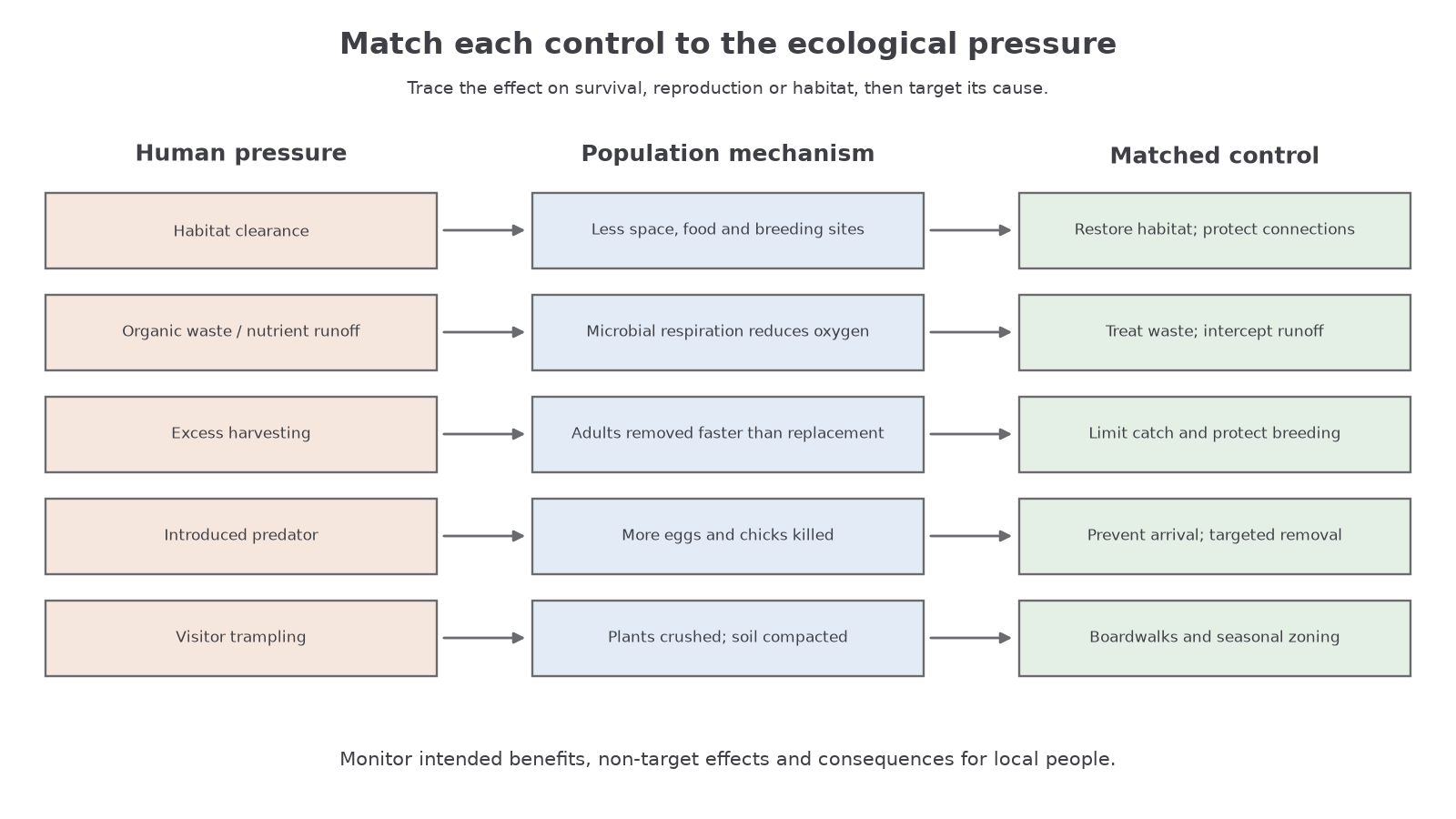
Common human pressures include changes in land or sea use, pollution, direct exploitation, introduction of invasive alien species, climate change and heavy disturbance. These are not separate facts to memorise as a list; they are starting points for biological explanations.
| Human activity | Possible effect on populations | Biological link |
|---|---|---|
| clearing woodland for farming or housing | fewer woodland plants, insects, birds or mammals | habitat area and food resources decrease |
| releasing untreated sewage or fertiliser runoff | fewer oxygen-sensitive aquatic animals | decomposition and algal growth can reduce oxygen concentration |
| overharvesting wild organisms | fewer breeding adults | death or removal rate exceeds replacement by reproduction |
| introducing a non-native predator, grazer or plant | native populations decline | new predation, grazing, competition or disease pressure |
| high visitor pressure in a sensitive habitat | plants damaged and animals disturbed | trampling, erosion, noise or nest disturbance reduce survival or reproduction |
Untreated sewage adds organic matter on which decomposer microorganisms feed. Fertiliser runoff can supply nitrate or phosphate ions that stimulate algal growth; dead algae and plants then supply more organic matter. Aerobic decomposition uses dissolved oxygen in respiration. Lower dissolved oxygen can restrict aerobic respiration in oxygen-sensitive animals, reducing energy available for survival or reproduction and causing their populations to decline.
The same activity can affect plants and animals in different ways. Trampling can directly kill seedlings or compact soil, reducing plant growth. It can indirectly affect animals by removing plant cover, reducing food, exposing nests or changing the structure of the habitat. Pollution may kill an animal directly, but it may also reduce plant growth, change water chemistry, or alter the invertebrate population that birds and fish depend on.
Use population language: abundance, distribution, birth rate, death rate, reproductive success, carrying capacity and survival. Vague phrases such as "the ecosystem gets worse" rarely earn much credit on their own.
Algal growth initially increases photosynthesis near the surface, but shading can kill submerged plants. Respiration by algae, plants and decomposers consumes oxygen, including at night. The oxygen decline is therefore not caused simply by algae “using oxygen for photosynthesis”. Biochemical oxygen demand (BOD) measures oxygen consumed by microorganisms decomposing organic matter over a stated time under standard conditions. An undiluted water sample falling from 8.2 to 3.4 mg dm⁻³ dissolved oxygen during the specified dark incubation has an oxygen demand of 4.8 mg dm⁻³. Keep temperature and duration constant; dilution, where used, must be included in the calculation. High BOD indicates a large potential oxygen demand, not a high oxygen concentration.
Matching Controls To Pressures
Management controls are strongest when they target the cause of the population change. A control is not just "protect it" or "ban it". It is a specific action that reduces a specific pressure.
If the pressure is habitat loss, the control may be habitat restoration, habitat corridors, zoning, planning restrictions or protected areas. The biological aim is to increase suitable habitat, reconnect separated populations, raise carrying capacity, or improve survival and reproduction.
If the pressure is pollution, the control may be waste treatment, emission limits, reduced fertiliser runoff, buffer strips beside water, or safer disposal of chemicals. The biological aim is to keep abiotic conditions within the tolerance range of the organisms and to prevent indirect effects through food webs.
If the pressure is overexploitation, the control may be permits, quotas, seasonal restrictions, minimum size limits, protected breeding areas, enforcement against illegal harvesting, or reducing demand for products from threatened species. The biological aim is to keep enough individuals alive to reproduce and replace those removed.
If the pressure is an invasive alien species, the control may be biosecurity, quarantine, cleaning equipment, early detection, rapid response, physical removal, trapping, targeted chemical control, or habitat restoration after removal. The biological aim is to prevent introduction where possible, then reduce competition, predation, grazing or disease pressure on native populations.
If the pressure is visitor disturbance, the control may be marked paths, boardwalks, visitor limits, seasonal closures, wildlife viewing distances, information signs, wardens, or restricted access to breeding sites. The biological aim is to reduce trampling, erosion, nest disturbance and repeated stress while still allowing some human benefit.
Matching a control to a pressure
A coastal reserve contains a rare nesting bird. Visitor numbers are high in spring. Some visitors walk close to nests, causing adults to leave the nest more often.
Weak answer: "Protect the birds."
Stronger answer: "Create a seasonal exclusion zone around nesting areas during the breeding season, with marked paths and wardens. This reduces disturbance near nests, so adults are less likely to abandon eggs or chicks and reproductive success should increase."
Continue this lesson.
You’re previewing NovaLearn without an account. Create a free account to read the rest.
Create free account