4.1.1(l) - Vaccination programmes and epidemics
Vaccination is not only about protecting one person from one pathogen. In this lesson you will connect the immune memory made after vaccination to the population-level decisions that reduce the chance of an epidemic. You will also practise the kind of data reasoning used when vaccination programmes are changed, targeted, or evaluated.
The principle of vaccination
A vaccine prepares the immune system before the real pathogen is encountered. It contains, or makes the body produce, antigen that is harmless enough not to cause the disease in a healthy vaccinated person, but similar enough to the pathogen's antigen to trigger an immune response.
Vaccine
A preparation that exposes the immune system to harmless pathogen antigen, so memory lymphocytes are produced without the person having to suffer the disease.
The antigen may come from a weakened pathogen, an inactivated pathogen, a fragment of a pathogen, or an inactivated toxin. The exact technology varies between vaccines, but the biological principle is the same: antigen is presented to lymphocytes, the specific lymphocytes are selected, and memory cells remain after the primary response.
Vaccination is a form of artificial active immunity. It is artificial because the antigen is deliberately introduced by medical intervention, and active because the person's own immune system responds. This matters because memory B-lymphocytes and memory T-lymphocytes can make a later response faster and stronger if the real pathogen enters the body.
The protective sequence is:
| Step | What happens | Why it matters |
|---|---|---|
| 1 | Vaccine antigen enters the body | It is recognised as foreign |
| 2 | Specific lymphocytes are selected and divide | The response is specific to that antigen |
| 3 | Plasma cells and antibodies may be produced | Antigen can be neutralised or marked for destruction |
| 4 | Memory cells remain | A later secondary response is faster and larger |
Keep antigen and antibody distinct. Antigen is the foreign molecule or marker that triggers the response; antibody is a protein produced by B-lymphocyte-derived plasma cells.
A vaccine does not usually treat a person who is already ill with that infection. It reduces the chance of disease after future exposure because the secondary immune response begins before the pathogen has multiplied enough to cause serious symptoms.
How programmes prevent epidemics
An epidemic occurs when the number of cases of a disease rises above the level normally expected in a population, place and time. Whether an introduced pathogen causes a few cases or a large epidemic depends partly on how many susceptible hosts it can reach.
Vaccination programme
An organised plan to offer vaccines to a defined population at suitable times, so enough people are protected before they are likely to meet the pathogen.
Routine vaccination programmes protect individuals, but their larger purpose is to reduce transmission across a community. If a high proportion of people are immune, an infected person is less likely to meet a susceptible person. Chains of transmission break more often, so the pathogen is less likely to spread exponentially.
[DIAGRAM: community_immunity_epidemic_curves: Lesson 077: Vaccination programmes and epidemics - diagram 01; asset_slug: 077_m04_1_1_vaccination_programmes_and_epidemics__diagram_01; recommended_method: drawn_biology; description: Deterministic 16:9 line graph comparing an epidemic curve in a low-vaccination-coverage population with a smaller outbreak curve in a high-vaccination-coverage population, with a dashed example epidemic threshold.]
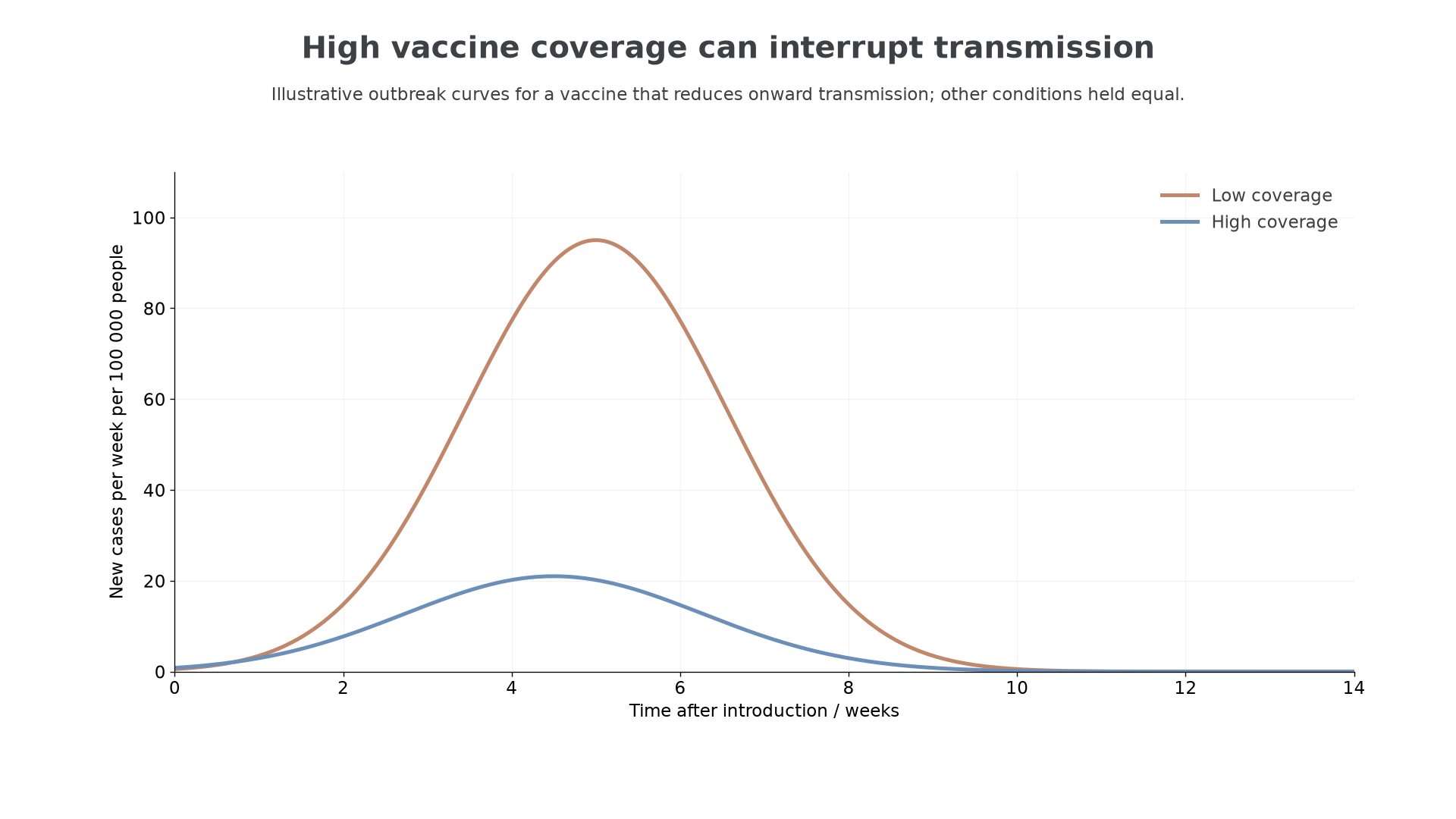
This indirect protection is called herd immunity. It occurs when high coverage leaves fewer susceptible hosts, so there are fewer successful pathogen transmissions. This can protect people who cannot be vaccinated, such as some babies, some people with serious allergic reactions to a vaccine ingredient, or some people with weakened immune systems.
Routine programmes are planned around when protection is most useful. Infant programmes protect children before many severe infections are likely; adolescent programmes such as HPV vaccination protect before likely exposure; older-adult or risk-group programmes such as influenza vaccination protect people at higher risk of severe disease. You do not need to memorise every age or trade name in a current schedule, but you should understand why programmes are scheduled and monitored.
Community protection requires vaccination to reduce infection or onward transmission of a pathogen that spreads between hosts. A vaccine that mainly reduces severe symptoms may have a smaller effect on transmission. Tetanus, acquired from environmental bacterial spores, does not spread from person to person, so one person's vaccination does not interrupt a chain to others.
No single coverage percentage guarantees community protection for every disease: it depends on transmissibility, vaccine effectiveness, duration of immunity and how people mix. Pockets of susceptible people can sustain transmission even when a national average is high.
Using vaccination data
Vaccination programmes are evaluated using data. Public health scientists may compare disease cases before and after a vaccine is introduced, compare vaccination coverage between regions, or monitor whether uptake is high enough in particular age groups.
Coverage means the proportion of the target group that has received the vaccine. For example, if 9,200 out of 10,000 children in a target group have received a vaccine, coverage is 92%. Coverage data should always be linked to a denominator: 92% of 10,000 children is more informative than "many children".
Data interpretation needs care. A fall in cases after a vaccine is introduced supports the idea that vaccination helped, especially if the fall follows rising coverage. It is still better scientific reasoning to consider other factors, such as changes in diagnosis, reporting, hygiene, travel, or public-health restrictions.
Percentage decrease
Continue this lesson.
You’re previewing NovaLearn without an account. Create a free account to read the rest.
Create free account