4.2.1(h)-(i) - Conservation methods and conservation agreements
Conservation is the active management of species, habitats and genetic resources so that biodiversity is maintained. In this lesson, you will learn how conservation can happen inside a natural habitat, outside it, and through agreements that change human behaviour. The aim is not to memorise a catalogue of schemes; it is to choose and justify the right conservation approach for a species or habitat.
Choosing The Conservation Method
Conservation methods are usually chosen after asking one central question: can the species or habitat still be protected where it naturally occurs?
If the answer is yes, the first choice is often in situ conservation.
In situ conservation
Maintaining biodiversity by protecting species in their natural habitat.
In situ conservation keeps organisms within the ecosystem where they normally interact with other species and abiotic conditions. This means it can protect more than one species at once: pollinators, predators, prey, parasites, soil organisms and the physical habitat may all be maintained together.
If the answer is no, or if the wild population is so small that it needs emergency support, conservation may need to happen away from the natural habitat.
Ex situ conservation
Maintaining biodiversity by protecting organisms or genetic material away from the natural habitat.
Ex situ conservation can act as an insurance population or gene store. It may keep a species alive while threats in the wild are reduced, or provide material for research, breeding and possible reintroduction.
A common error is to think that in situ means "no human intervention". It does not. A wildlife reserve, for example, may involve fencing, habitat management, control of invasive species or restrictions on visitors. The key point is that the organisms remain in their natural habitat.
In Situ Methods
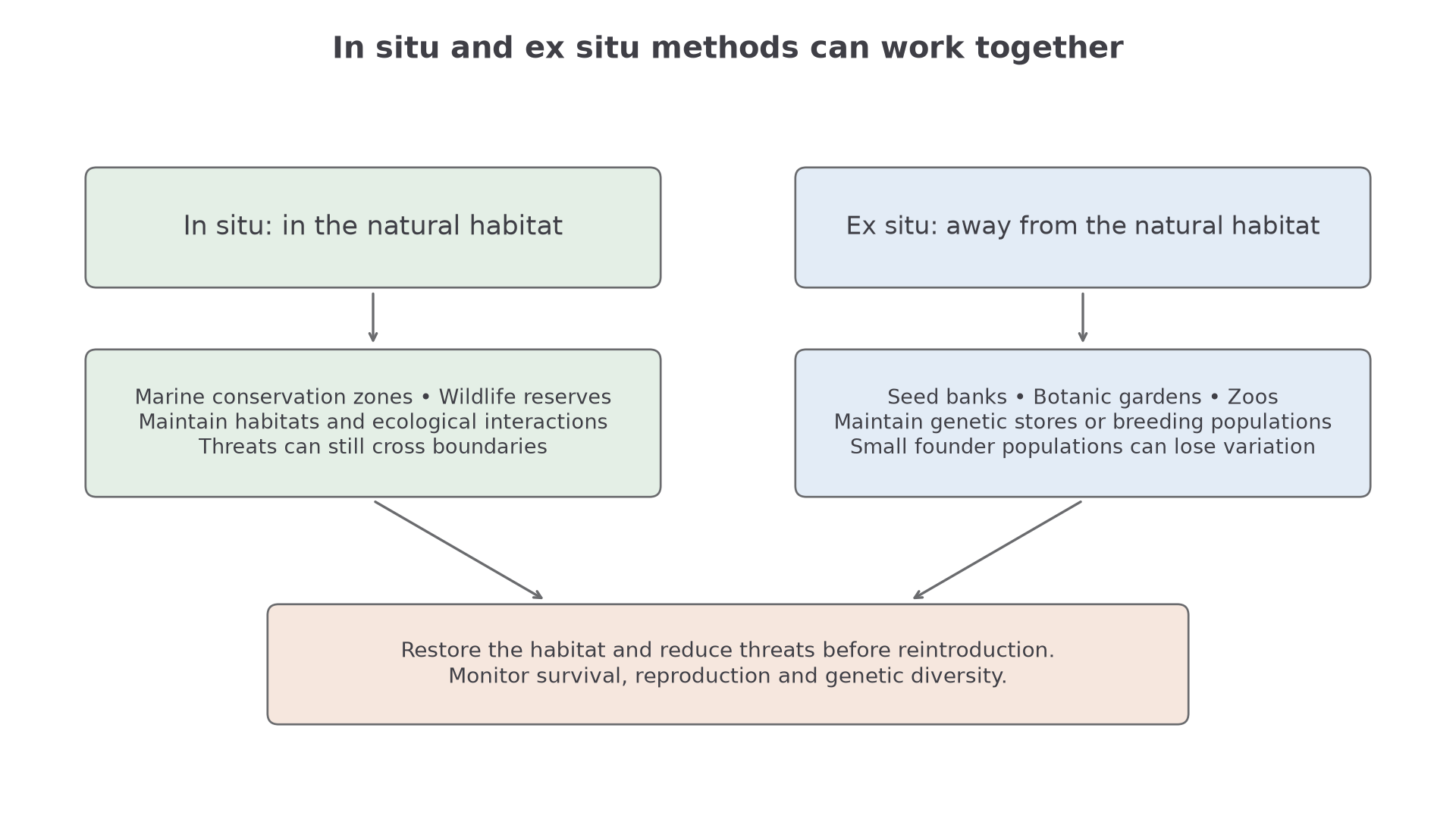
The named in situ examples for this lesson are marine conservation zones and wildlife reserves.
A marine conservation zone is an area of sea protected because it contains important marine species, habitats or geological features. The conservation target might be a seagrass bed, reef, sediment habitat, shellfish bed or a species that depends on these habitats. Management can include restricting damaging activities, monitoring protected features, and setting conservation objectives for recovery.
A wildlife reserve is a protected or managed area of land, freshwater or coast where habitats and species are conserved. A reserve may protect woodland, wetland, heathland, grassland, dunes or other habitats. Management may include grazing, mowing, coppicing, controlling invasive species, maintaining water levels, limiting access during breeding seasons, or restoring habitat corridors.
In situ conservation has several biological strengths:
| Strength | Why it matters for biodiversity |
|---|---|
| Protects the whole habitat | Other species and ecological interactions are maintained, not only the target species. |
| Allows natural selection to continue | The population remains exposed to the normal selection pressures of that habitat. |
| Can maintain larger populations | Larger, connected populations usually retain more genetic diversity than small captive populations. |
| Supports ecosystem processes | Pollination, seed dispersal, nutrient cycling, predation and competition can continue. |
There are also limitations. A protected area may be too small, isolated or poorly enforced. Some threats, such as pollution, climate change or illegal harvesting, may cross reserve boundaries. Conservation can also create conflict if restrictions affect fishing, farming, tourism or local livelihoods.
Protecting habitat supports the interactions that maintain biodiversity, provided the protected area is large and connected enough for the target species.
Active management can repair damage caused by people: a boardwalk routes visitors away from delicate plants, and maintaining fences can prevent trampling. Conservation combines protection with sustainable use; preservation aims to leave an area undisturbed. A temporary access restriction may support a wider conservation programme, but banning all human activity is not itself an example of active habitat management.
To evaluate a reserve, record a baseline and repeat comparable surveys of species abundance, richness and breeding success. Include similar unmanaged reference sites where possible and keep season, sampling method and effort consistent. An increase after designation is encouraging but could also reflect weather or immigration. Monitoring should test whether the original threat has decreased, rather than count visitors alone.
Ex Situ Methods
The named ex situ examples for this lesson are seed banks, botanic gardens and zoos.
A seed bank stores seeds under controlled conditions so that plant genetic material is preserved. Seeds can be dried and kept at low temperature, then tested for viability and germinated later if needed. Seed banks are useful because many seeds can be stored in a small space, and samples from different populations can help preserve genetic diversity.
Seed banks do not work equally well for every plant. Some species produce seeds that do not survive drying or freezing, and a seed bank cannot conserve the whole habitat around the plant. That is why seed banks are best seen as a backup to habitat protection, not a replacement for it.
A botanic garden can keep living plant collections, propagate rare plants, research germination and growth conditions, educate the public, and provide plants for reintroduction or habitat restoration. It is ex situ because the plant is being maintained away from its natural habitat, even if the final goal is to support wild populations.
A zoo can contribute to conservation when it runs a managed breeding programme, maintains studbook records, avoids close inbreeding, supports research or education, and may provide individuals for reintroduction. A zoo is not automatically a conservation method just because it holds animals; the conservation value depends on whether the population is genetically managed and linked to species protection.
Ex situ conservation is most useful when wild numbers are extremely low, when a species is at immediate risk in its habitat, or when genetic material needs to be stored before further loss occurs. Its limitations are important: captive populations can be small, expensive to maintain, vulnerable to inbreeding, and exposed to artificial selection in captivity. Reintroduced individuals may also struggle if the original habitat has not been restored.
[DIAGRAM: conservation_method_comparison: Lesson 084: Conservation methods and conservation agreements - diagram 01; asset_slug: 084_m04_2_1_conservation_methods_and_conservation_agreements__diagram_01; recommended_method: drawn_biology; description: A clean comparison flowchart showing in situ conservation through marine conservation zones and wildlife reserves, ex situ conservation through seed banks, botanic gardens and zoos, and the idea that both approaches can support biodiversity when chosen for the species context.]
A seed collection should sample many parent plants across the species’ range, with permission, without removing so many seeds that wild regeneration is harmed. Label origin and collection date, test a representative subsample for germination, and regenerate stock before viability becomes too low. For example, 72 germinating seeds out of 80 tested gives 90% viability. Testing different temperatures with equal sample sizes, moisture and light can identify germination requirements; repeated batches show variation.
Continue this lesson.
You’re previewing NovaLearn without an account. Create a free account to read the rest.
Create free account