4.2.1(e) - Genetic biodiversity calculations
Genetic biodiversity is variation within a species, not the number of species in a habitat. In this lesson you will learn how genetic biodiversity can be assessed in isolated populations by counting polymorphic gene loci and turning that count into a proportion or percentage. This matters in contexts such as zoo breeding programmes, rare breeds and pedigree animals, where a small or separated population may have lost some allele variation.
The Unit Of Variation
Genetic biodiversity is the variety of alleles within a species or population. An allele is a version of a gene or DNA sequence. A gene locus is the position of a gene or DNA region in a genome; the plural is loci.
This calculation is usually applied to an isolated population. That means a population with little gene flow from other populations, such as a captive zoo population, a rare livestock breed, or a pedigree animal line. The calculation asks how many of the loci studied show variation.
Polymorphic gene locus
A gene locus is polymorphic in a population if more than one allele is found at that locus among the individuals studied.
Monomorphic gene locus
A gene locus is monomorphic in a population if only one allele is found at that locus among the individuals studied.
The important word is population. One individual usually carries only one or two alleles at a locus, but the population may contain several alleles across different individuals. If every sampled individual has only allele A at a locus, that locus is monomorphic in the sampled population. If some individuals carry allele A and others carry allele a, that locus is polymorphic.
A common error is to count the total number of allele copies. This specification calculation does not do that. It counts how many loci are polymorphic, then divides by the total number of loci studied.
The Polymorphic-Loci Formula
The official calculation is:
Proportion Of Polymorphic Gene Loci
The formula gives a proportion. If a question asks for a percentage, multiply the proportion by 100.
[DIAGRAM: polymorphic_loci_calculation_panel: Lesson 082: Genetic biodiversity calculations - diagram 01; asset_slug: 082_m04_2_1_genetic_biodiversity_calculations__diagram_01; recommended_method: drawn_biology; description: 16:9 deterministic NovaLearn calculation panel comparing monomorphic and polymorphic loci in an isolated population and showing the proportion-to-percentage calculation from a 12-locus dataset.]
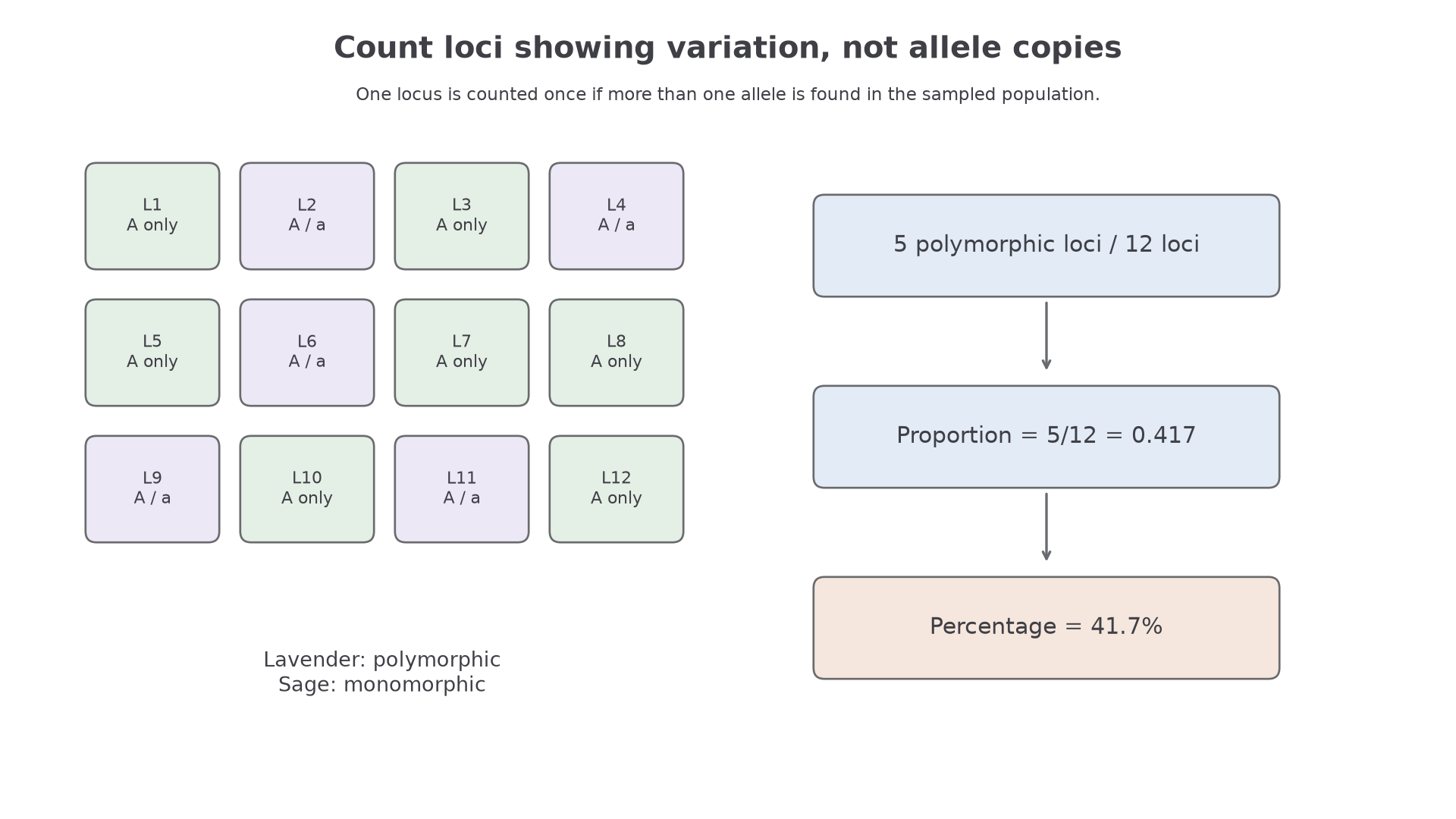
The diagram shows the sequence you should use: identify polymorphic loci, count them, divide by total loci, then convert to a percentage if needed.
Calculating Proportion And Percentage
A captive population is screened at 12 gene loci. Five of the loci are polymorphic.
Proportion of polymorphic gene loci = 5 / 12
Proportion = 0.4167
Percentage of polymorphic gene loci = 0.4167 × 100 = 41.67%
To three significant figures, this is 0.417 or 41.7%.
Use an appropriate number of significant figures. If the raw values are whole-number counts, it is usually sensible to give a proportion to two or three significant figures, or a percentage to the number of significant figures requested.
The formula can be rearranged: number of polymorphic loci = proportion × total loci. For example, 30% of 40 loci is polymorphic loci, leaving monomorphic loci. Loci are counted as whole numbers; a fractional result usually signals rounded input data, so do not invent part of a locus.
From Calculation To Biological Meaning
A higher proportion of polymorphic loci means a greater proportion of the loci studied contain more than one allele in the population. That is evidence of higher genetic biodiversity within that population.
For example, suppose two isolated populations of the same animal species are screened at the same 80 loci.
| Population | Polymorphic loci | Total loci studied | Proportion | Percentage |
|---|---|---|---|---|
| Zoo population A | 12 | 80 | 0.15 | 15% |
| Zoo population B | 38 | 80 | 0.475 | 47.5% |
Continue this lesson.
You’re previewing NovaLearn without an account. Create a free account to read the rest.
Create free account