3.1.3(f) - Translocation in phloem
Plants make sugars in some places and use or store them in others. This lesson explains how assimilates, especially sucrose, are transported through phloem from sources to sinks. The key idea is that translocation is not just diffusion along a tube: loading at the source and removal at the sink create the pressure difference that moves phloem sap.
Sources, Sinks and Assimilates
Translocation is the movement of assimilates through the phloem from a source to a sink.
Assimilate
An assimilate is a substance made by the plant and transported to another part of the plant for use or storage. In this lesson, the main assimilate is sucrose.
Sucrose is the important OCR example because it is the main sugar transported in phloem. It is better to say “sucrose” or “products of photosynthesis” than “glucose”, because glucose made in photosynthesis is commonly converted before long-distance transport.
A source is a region where assimilates are loaded into the phloem. A mature leaf is a typical source because it produces sugars by photosynthesis. A sink is a region where assimilates are removed from the phloem for use or storage. Growing roots, meristems, developing fruits, developing seeds and storage organs can act as sinks.
Source and sink are roles, not fixed labels. A storage organ can be a sink while it is filling with stored carbohydrate, but later it can become a source if stored material is converted into transportable sucrose and exported to growing shoots.
Phloem translocation moves assimilates, especially sucrose, between sources and sinks; the direction depends on where sucrose is being loaded and where it is being removed.
Use that role-based language in the check below.
Active Loading at the Source
In the active-loading model, sucrose reaches the phloem from photosynthetic cells through cell walls/intercellular spaces (apoplast) or connected cytoplasm (symplast). It can enter the phloem even when its concentration inside is already high. That means loading is an active process: it uses metabolic energy from ATP to move sucrose against a concentration gradient.
The usual sequence is:
- Photosynthesising cells in a leaf produce sugars and convert them to sucrose.
- Companion cells use ATP to pump hydrogen ions out of the cell.
- Hydrogen ions move back into the companion cell down their electrochemical gradient through co-transport proteins.
- Sucrose is carried into the companion cell with the hydrogen ions, against the sucrose concentration gradient.
- Sucrose then moves into sieve tube elements through plasmodesmata.
The details matter because they explain why translocation depends on respiration. If respiration is inhibited, less ATP is available for active loading, so less sucrose is loaded into phloem and the pressure-flow mechanism is weakened.
For this specification point, "energy-requiring" mainly refers to active loading at the source and active removal at some sinks. Do not describe phloem as if sucrose simply diffuses from leaf to root along the whole plant.
Now apply that energy idea to the source-loading step.
Pressure Flow Through Phloem
Once sucrose is loaded into sieve tube elements at the source, the water potential inside the phloem becomes more negative because the solute concentration has increased. Water then moves from nearby xylem into the phloem by osmosis.
This water entry raises the hydrostatic pressure in the phloem near the source. Hydrostatic pressure is the pressure exerted by a fluid. In phloem, a high-pressure region at the source and a lower-pressure region at the sink create a pressure gradient, so phloem sap moves by mass flow.
[DIAGRAM: source_sink_pressure_flow: Lesson 070: Translocation in phloem - diagram 01; asset_slug: 070_m03_1_3_translocation_in_phloem__diagram_01; recommended_method: drawn_biology; description: 16:9 grey line diagram showing a leaf source, root/meristem sink, xylem water movement into source phloem and out near sink, sucrose loading/removal, high hydrostatic pressure at source, low hydrostatic pressure at sink, and bulk flow through a sieve tube.]
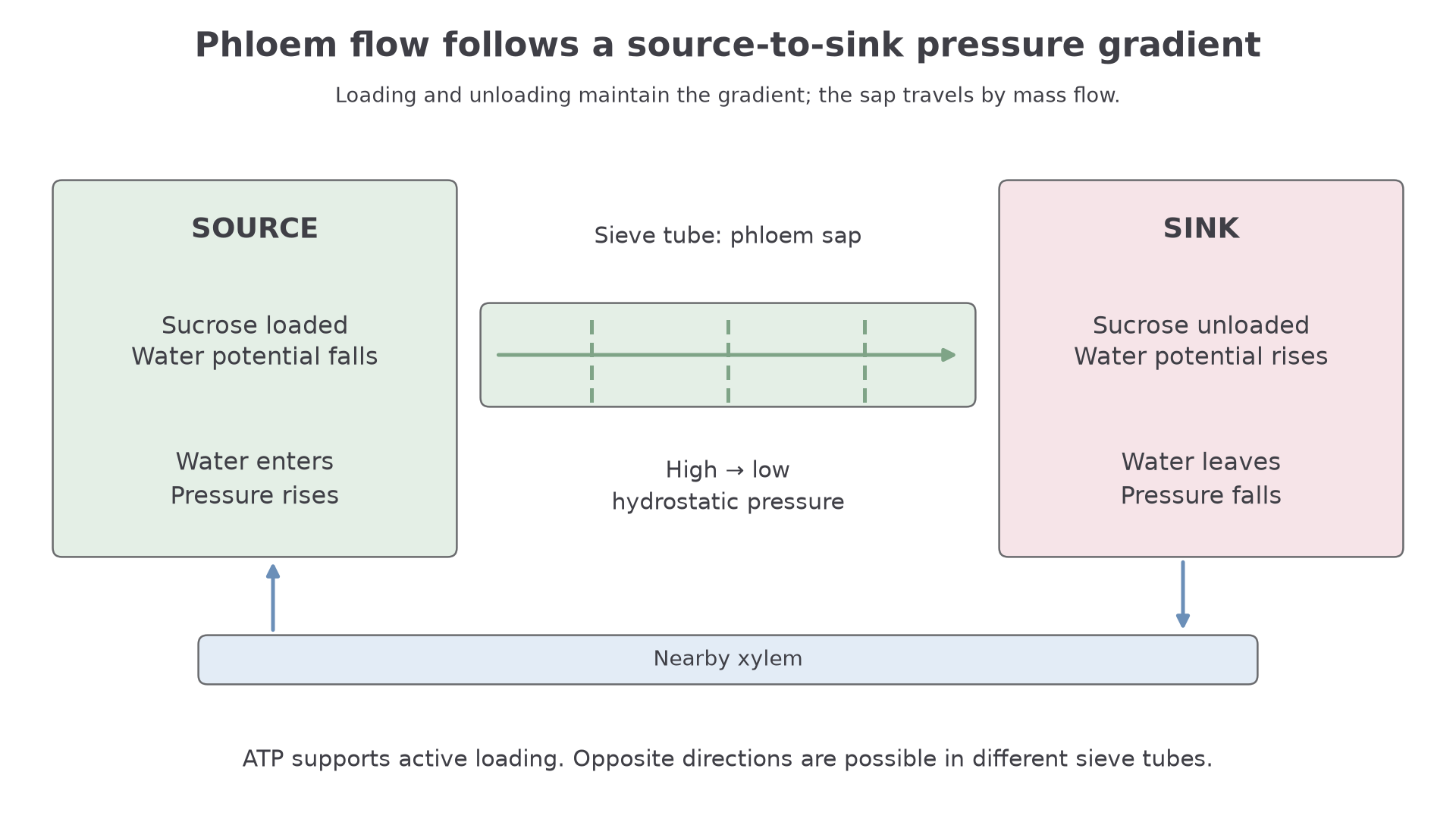
This model is often called pressure-flow or mass flow. The word “mass” here does not mean that phloem tissue is heavy; it means the phloem sap moves as a body of fluid. The sucrose is carried with the moving sap.
Continue this lesson.
You’re previewing NovaLearn without an account. Create a free account to read the rest.
Create free account