6.1.2(a)(i)-(ii) - Phenotypic variation and sexual reproduction
Variation is why individuals in the same species are not identical. In this lesson you will separate phenotypic variation caused by genes, phenotypic variation caused by the environment, and genetic variation generated by sexual reproduction. The aim is to explain the chain clearly: genes and environment affect the phenotype, while meiosis and fertilisation create new allele combinations within a species.
Phenotype and variation
A phenotype is an observable characteristic of an organism. It may be visible, such as height or leaf colour, but it can also be physiological, biochemical or behavioural.
Phenotypic variation means differences in phenotype between individuals in the same species. For example, two animals of the same species may differ in body mass, and two plants of the same species may differ in stem length or leaf colour.
Phenotype is not the same as genotype. A genotype is the alleles an organism has. Those alleles influence which proteins can be made and how cells function, but the environment can also affect how the characteristic develops or is expressed.
Phenotypic variation
Differences in observable characteristics between individuals in the same species, caused by genetic factors, environmental factors, or both.
Different genotypes can also produce the same phenotype: for a completely dominant allele, both a homozygote and a heterozygote show the dominant characteristic. Phenotype alone therefore need not identify genotype.
A useful first split is:
| Contribution | What it means | Example direction |
|---|---|---|
| Genetic factor | Alleles inherited from parents affect the characteristic | Alleles may affect pigment production, enzymes, hormones or development |
| Environmental factor | Conditions experienced by the organism affect the characteristic | Diet, light, temperature or disease may alter growth or appearance |
The phrase "contribution" matters. A characteristic does not have to be purely genetic or purely environmental. Many phenotypes are affected by both.
Genetic and environmental examples
Genetic factors influence phenotype because alleles affect cell products and cell processes. An allele might code for a different version of a protein, alter how much of a product is made, or affect a developmental pathway. If that change affects a characteristic, it can contribute to phenotypic variation.
Environmental factors influence phenotype because organisms develop and function in conditions that vary. The environment does not need to change the DNA sequence to alter the phenotype.
In animals, diet is a clear environmental example. An animal with high genetic potential for growth still needs enough energy, minerals and amino acids to build tissue. A poor diet may reduce body mass or growth rate, while a suitable diet may allow more of the genetic potential to be expressed.
In plants, etiolation is an environmental example. A seedling grown in low light may become pale and elongated. The low-light environment changes the expressed phenotype: the seedling grows long, weak shoots and has reduced chlorophyll development compared with a seedling grown in adequate light.
[DIAGRAM: phenotype_inputs: Lesson 140: Phenotypic variation and sexual reproduction - diagram 01; asset_slug: 140_m06_1_2_phenotypic_variation_and_sexual_reproduction__diagram_01; recommended_method: drawn_biology; description: Flow diagram showing genotype and environmental factors contributing to phenotype, with examples of diet in animals and etiolation in plants.]
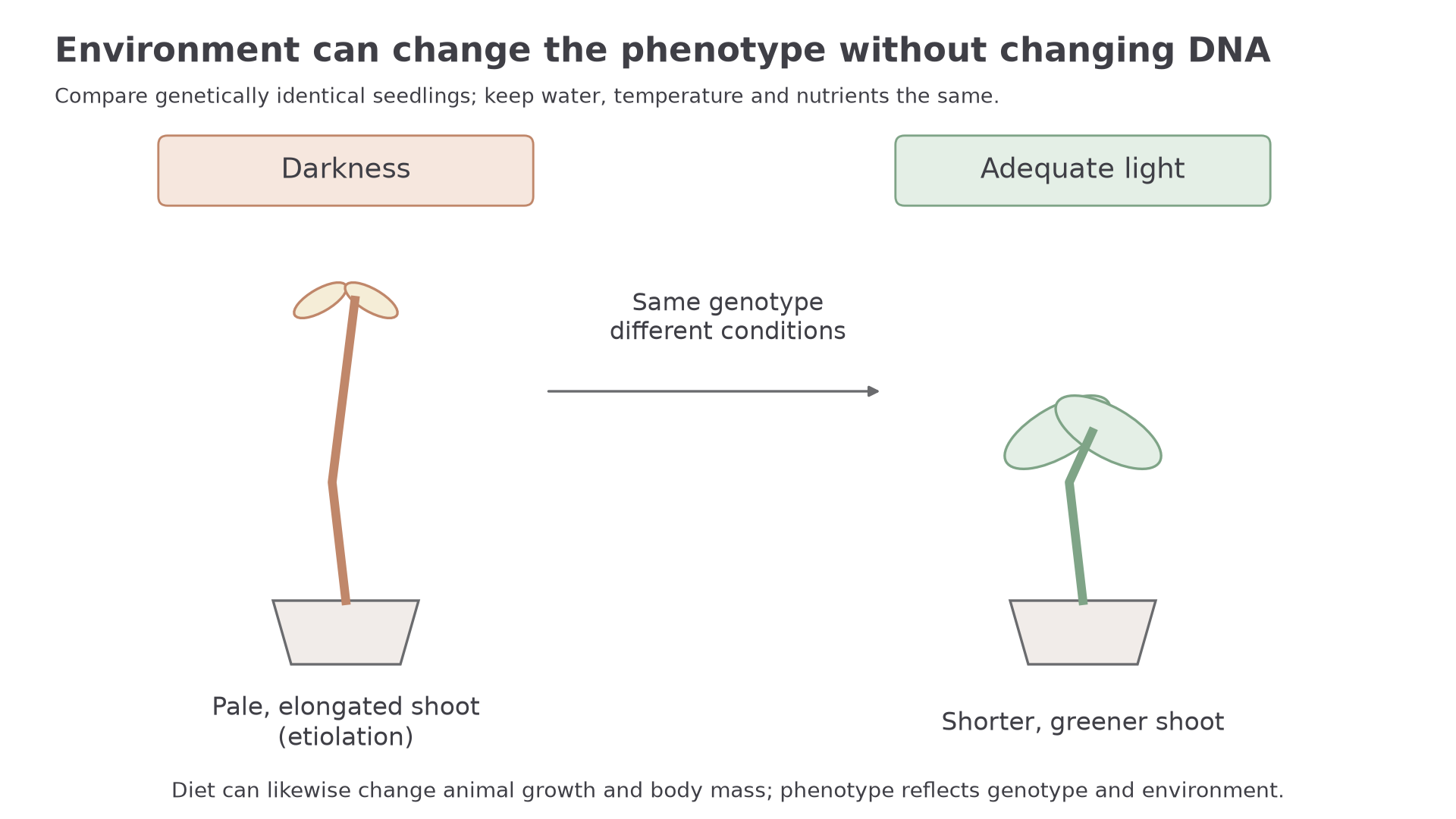
The diagram is not saying that every characteristic has equal genetic and environmental input. It is showing the reasoning route: identify the phenotype, then ask whether inherited alleles, environmental conditions, or both contribute to the observed variation.
To distinguish these causes experimentally, grow genetically identical plants in different controlled conditions, or compare different genotypes in the same conditions. Replicate each group. Merely comparing plants of the same species or variety does not establish that their genotypes are identical.
Now apply that precision to the plant example: identify the observed difference, name the environmental factor, then link the factor to the changed phenotype.
Continue this lesson.
You’re previewing NovaLearn without an account. Create a free account to read the rest.
Create free account