4.1.1(j)-(k) - Immunity categories and autoimmune disease
This lesson is about classifying immunity precisely. You will separate active from passive immunity, natural from artificial immunity, and then use that same idea of immune recognition to understand what an autoimmune disease is. The named example here is arthritis, treated carefully as autoimmune arthritis rather than every possible cause of joint pain.
Two Classification Questions
Immunity is protection against a disease-causing organism, toxin, or other antigen. In this part of the immune system, an antigen is a molecule or molecular region recognised by specific immune receptors; self antigens also exist.
Immunity is classified by two independent features:
- Active or passive? Ask whether the person's own immune system made the protective antibodies and memory cells.
- Natural or artificial? Ask whether the exposure or antibody transfer happened without deliberate medical intervention, or because of a medical intervention.
Active immunity
Protection produced when a person's own immune system responds to an antigen, producing antibodies and memory cells.
Passive immunity
Protection produced when a person receives ready-made antibodies from another source, without making their own memory cells to that antigen.
Natural immunity is acquired through ordinary biological exposure, such as infection or antibody transfer from mother to baby. Artificial immunity is acquired through deliberate medical intervention, such as vaccination or an injection of antibodies.
[DIAGRAM: immunity_categories_autoimmune_flow: Lesson 076: Immunity categories and autoimmune disease - diagram 01; asset_slug: 076_m04_1_1_immunity_categories_and_autoimmune_disease__diagram_01; recommended_method: drawn_biology; description: 2x2 matrix comparing natural/artificial and active/passive immunity, plus an autoimmune disease flow ending with arthritis as an example.]
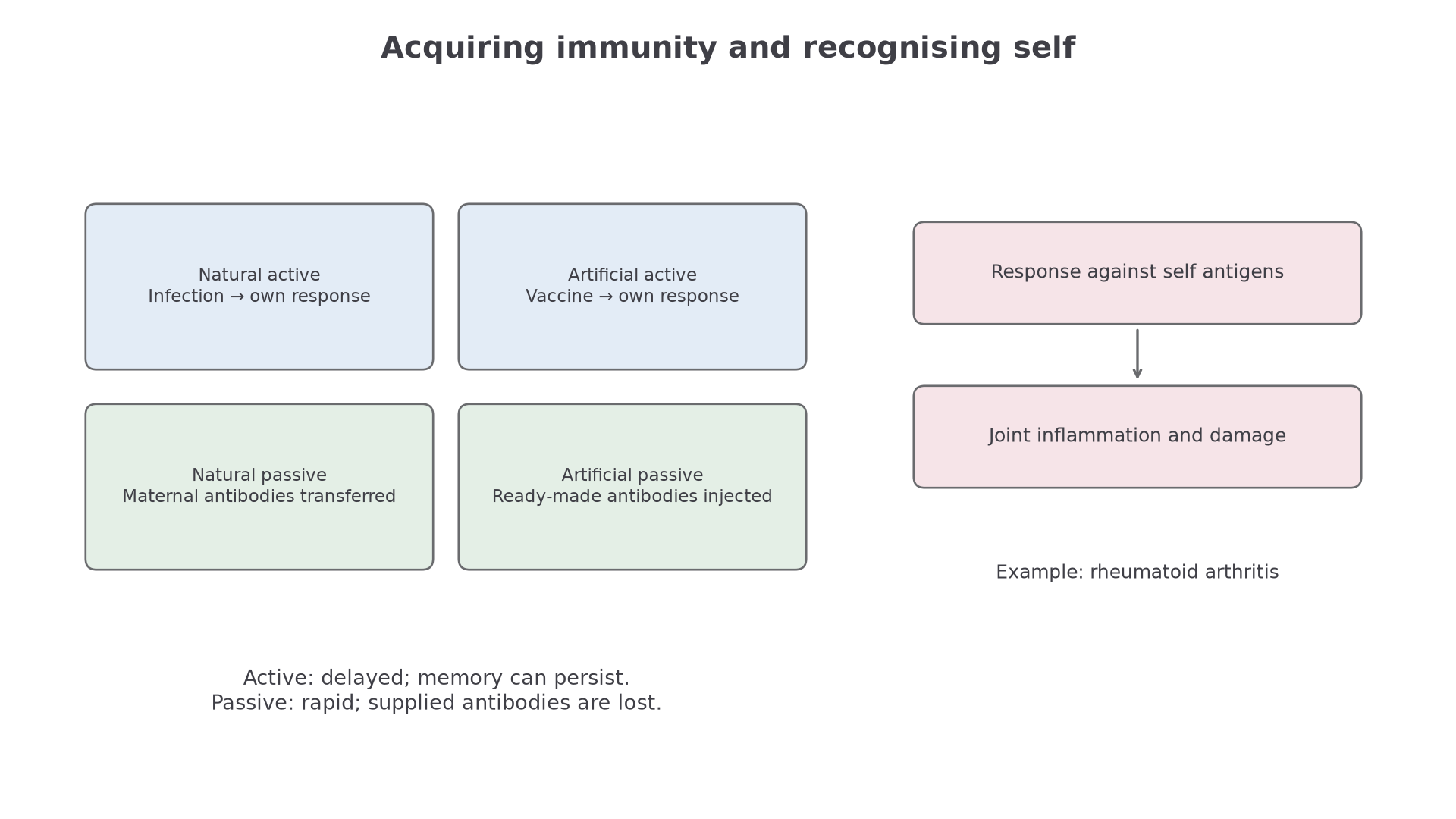
The diagram is useful because the two axes are independent. Active does not automatically mean natural, and passive does not automatically mean artificial.
Active Immunity
In active immunity, the antigen is present inside the body and the person's own lymphocytes respond. B lymphocytes can become plasma cells that secrete antibodies, and some B or T lymphocytes become memory cells. That is why active immunity usually takes time to develop but may last for a long time.
Natural active immunity happens after infection. For example, if a person is infected by a pathogen and recovers, their immune system may have produced antibodies and memory cells against antigens from that pathogen.
Artificial active immunity happens after vaccination. A vaccine introduces antigenic material in a controlled medical context so that the person's own immune system responds and forms memory cells. The detailed principles and programmes of vaccination are for a neighbouring lesson; here the important classification is that the response is active because the person makes the immune response themselves, and artificial because the antigen is introduced deliberately.
When classifying active immunity, look for the person's own antibody production and memory-cell formation. Do not describe it as passive just because an injection was involved; vaccination is usually artificial active immunity.
Protection is delayed because matching lymphocytes must first be selected, expand and differentiate. Memory allows a faster response later, but the duration of protection varies with the antigen, vaccine and individual; “active” does not mean lifelong protection is guaranteed.
Passive Immunity
In passive immunity, the person receives antibodies that were made by another organism or another person's immune system. The protection can be rapid because the antibodies are already present, but it is temporary because those antibodies are eventually broken down and the recipient has not made memory cells against that antigen.
Natural passive immunity happens when maternal antibodies are transferred to a baby, for example across the placenta before birth or in breast milk after birth. The baby receives antibodies, but the baby's lymphocytes have not been activated to make memory cells against that antigen.
Artificial passive immunity happens when ready-made antibodies are given medically. Examples include injected antibodies, antitoxin, or antiserum used when immediate protection is needed. This is not the same as vaccination: the patient receives antibody molecules directly rather than being given antigen to trigger their own immune response.
Passive immunity is quick but short-lived because antibodies are supplied directly and no immune memory is made by the recipient.
Continue this lesson.
You’re previewing NovaLearn without an account. Create a free account to read the rest.
Create free account