4.2.2(e) - Evidence for evolution by natural selection
Evolution by natural selection is a scientific explanation supported by historical, molecular and experimental evidence. In this lesson, you will learn how Darwin and Wallace contributed to the theory, then how fossils, genomic DNA and molecular comparisons support it. The key skill is not just naming evidence, but explaining what the evidence shows and where its limits are.
Theory And Contributors
A scientific theory is a broad explanation that is supported by evidence and can be tested against new observations. The theory of evolution by natural selection explains how populations of organisms can change over many generations because individuals with heritable features that give an advantage are more likely to survive and reproduce.
This lesson is about evidence for that theory. The detailed mechanism by which selection changes the characteristics of a population is taught later; here, the focus is how biologists know that evolution by natural selection is a strong explanation.
Evolution
Evolution is a change in the inherited characteristics of a population over generations.
Charles Darwin and Alfred Russel Wallace both developed the idea that natural selection could explain how species change. Their work was important because it turned scattered observations about organisms, fossils and distributions into a biological explanation: organisms are not fixed forever, and adaptation can arise through natural processes acting over time.
Darwin and Wallace independently connected variation, the production of more offspring than can survive, and differential survival and reproduction. Their ideas were jointly presented in 1858; Darwin developed the argument in On the Origin of Species in 1859. Their observations of adaptation, geographical distributions and fossils predated knowledge of DNA. Molecular biology later supplied an inheritance mechanism and new ways to test common ancestry.
Fossil Evidence
Fossils are preserved remains, traces or impressions of organisms from the past. They are usually found in sedimentary rocks, where layers can give evidence about relative age: deeper layers are often older than layers above them, provided the rock sequence has not been disturbed.
Fossil evidence supports evolution because it shows that life on Earth has changed over geological time. Fossils from older rocks are often different from fossils in younger rocks, and some fossils show combinations of features that help link major groups. These are often called transitional fossils.
[DIAGRAM: evidence_streams_map: Lesson 088: Evidence for evolution by natural selection - diagram 01; asset_slug: 088_m04_2_2_evidence_for_evolution_by_natural_selection__diagram_01; recommended_method: drawn_biology; description: A deterministic evidence map showing fossil, genomic DNA and molecular evidence streams converging on the supported theory of evolution by natural selection, with Darwin and Wallace as the historical formulation.]
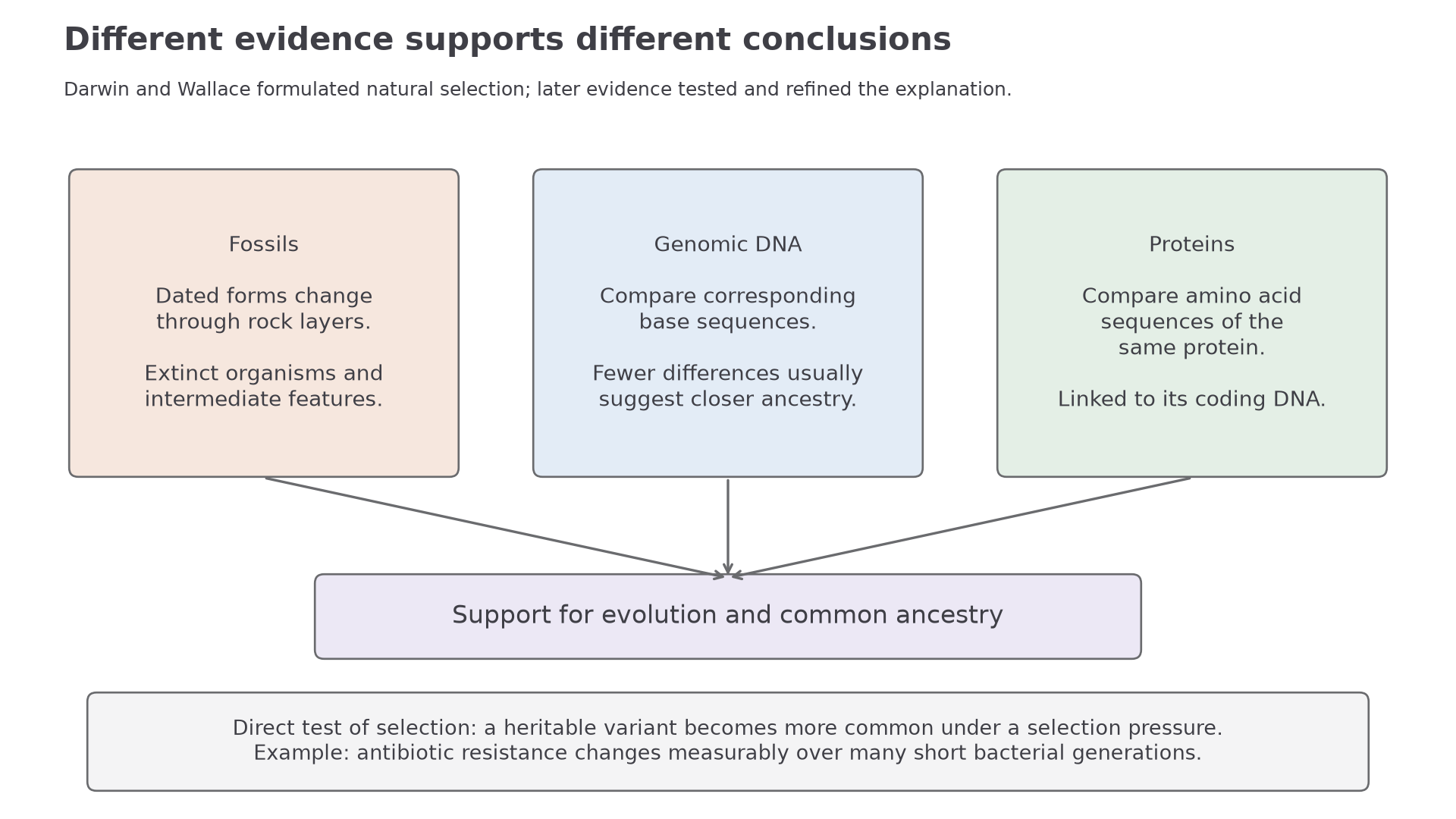
The diagram distinguishes the conclusions supported by different evidence: fossils are not the only evidence, but they provide a historical record. If fossils in successive rock layers show a sequence of changing features, the simplest biological interpretation is that populations have changed over time and related groups share ancestry.
Fossil evidence must still be evaluated. Fossilisation is rare, soft tissues are less likely to be preserved than hard parts, and many organisms lived in environments where fossil formation was unlikely. This means the fossil record is incomplete. Incompleteness weakens some detailed claims, but it does not remove the value of fossil sequences that are found.
Fossils support evolution by showing that organisms in the past were not always the same as organisms today, and by showing sequences or intermediate combinations of features over time.
Genomic DNA Evidence
Genomic DNA means DNA from the genome of an organism. Comparing corresponding genomic DNA sequences tests relationships because the sequences are inherited. Compare homologous regions of equal aligned length; unrelated regions cannot be interpreted by merely counting matching letters.
DNA evidence supports evolution because related organisms inherit DNA from common ancestors. Over time, mutations accumulate in DNA. If two species share a recent common ancestor, there has usually been less time for differences to accumulate, so their DNA sequences tend to be more similar.
The reasoning is comparative:
| Comparison | What it suggests |
|---|---|
| very similar genomic DNA sequences | the organisms are likely to be closely related |
| many DNA sequence differences | the organisms are likely to have shared a common ancestor longer ago |
| agreement with fossil or molecular evidence | the evolutionary explanation is stronger |
Continue this lesson.
You’re previewing NovaLearn without an account. Create a free account to read the rest.
Create free account