6.1.1(d) - Mitosis and apoptosis in body form
Body form is not produced by cell division alone. During development, some cells are added, some cells are kept alive, and some cells are deliberately removed. In this lesson, you will see how mitosis and apoptosis work together as controlled mechanisms, and how genes regulating these processes can respond to signals from inside and outside the cell.
Body form needs addition and removal
An organism's body form includes its overall shape, the shape of organs, and the arrangement of tissues within those organs. To build that form, development must control where cells are produced, where cells survive, and where cells are removed.
Two processes do much of this cell-number control:
- Mitosis increases cell number by producing genetically identical daughter cells.
- Apoptosis decreases cell number in a controlled way by causing selected cells to die.
[DIAGRAM: body_form_control_map: Lesson 139: Mitosis and apoptosis in body form - diagram 01; asset_slug: 139_m06_1_1_mitosis_and_apoptosis_in_body_form__diagram_01; recommended_method: drawn_biology; description: Deterministic control-flow diagram showing internal and external stimuli feeding gene-regulated cell-cycle/apoptosis decisions, leading to mitosis adding cells or apoptosis removing cells, with balanced development producing body form.]
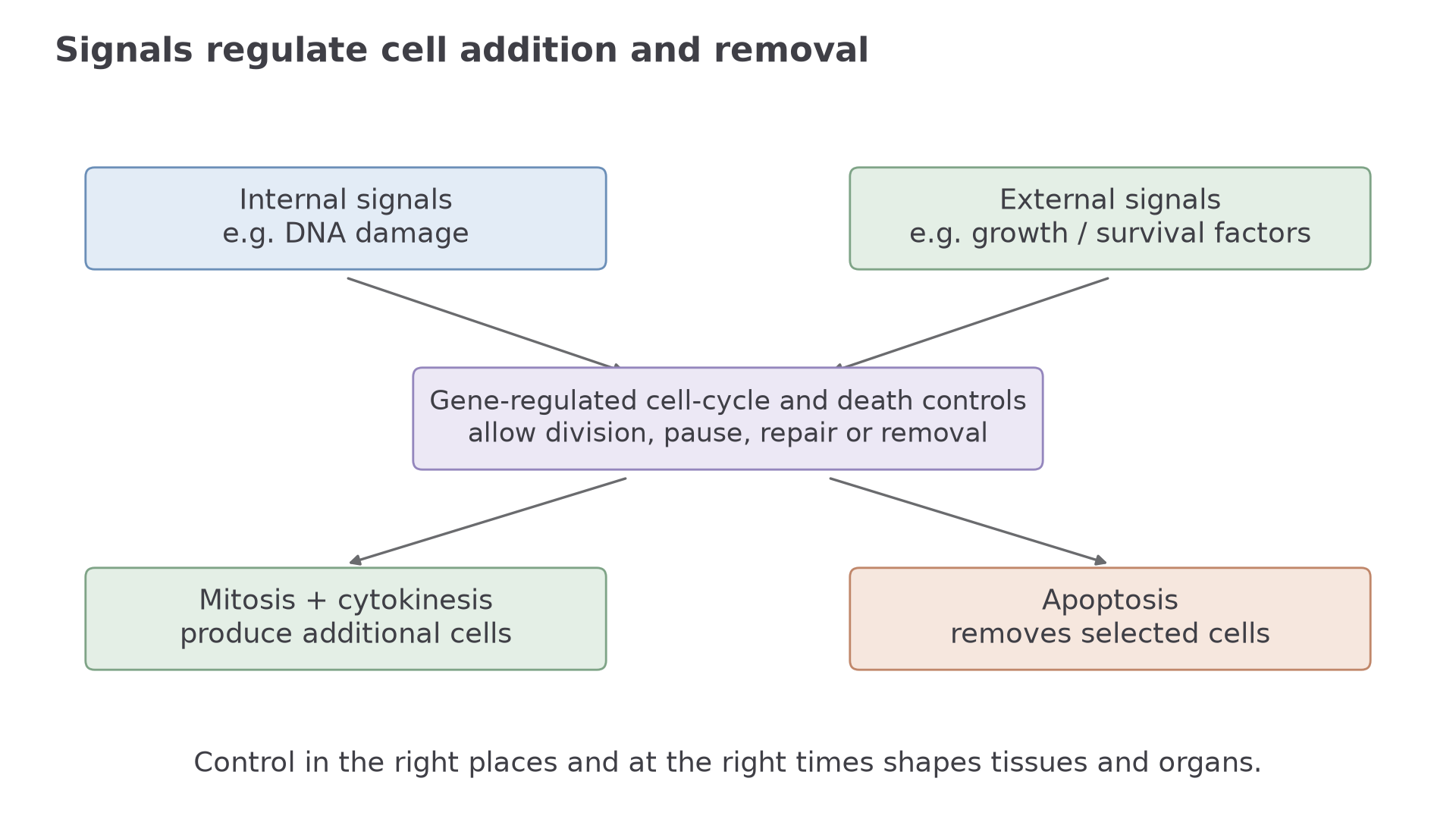
The important idea is not "more cells is always better". A growing limb, for example, needs mitosis to add enough cells, but it also needs apoptosis to remove cells from some regions so a clear shape can appear. Development is controlled by the balance and position of cell production and cell removal.
Apoptosis
Controlled cell death in which a cell follows an internally regulated death programme, allowing unwanted or damaged cells to be removed without the uncontrolled damage associated with cell injury.
Mitosis and apoptosis are therefore opposite in immediate effect but complementary in development. Mitosis supplies cells for growth and tissue formation. Apoptosis removes cells that are no longer needed, are in the wrong place, or have received signals that they should not survive.
Mitosis builds form
Mitosis is nuclear division that produces two genetically identical nuclei. When it is followed by cytokinesis, one cell becomes two daughter cells. In development, this matters because tissues and organs need many cells in the right places.
Controlled mitosis followed by cytokinesis increases cell number; it does not mean that each individual cell becomes larger. If cells in one region of an embryo or tissue divide more often than cells in another region, that region can grow more rapidly. This helps produce differences in size, length, thickness and shape.
For example, a developing organ may begin as a small group of cells. If cells in that region receive signals that allow the cell cycle to continue, mitosis can increase the cell population. More cells can then contribute to tissue growth and to the formation of a larger structure.
Using mitosis precisely
A student writes: "Mitosis makes body form."
A more precise answer is: "Mitosis increases cell number in specific regions during development. This allows tissues and organs to grow, helping to produce body form when it is controlled by developmental signals."
The word controlled is doing important work. Uncontrolled mitosis would not build a correct body form; it would disrupt tissue organisation. Body form depends on regulated patterns of mitosis, not just rapid division everywhere.
Apoptosis sculpts form
Apoptosis is often described as programmed cell death, but do not treat that as meaning "random death". It is controlled. The cell is triggered to follow an organised process: enzymes break down cell components, the cell shrinks and fragments into membrane-bound bodies, and phagocytes engulf the fragments. Keeping the contents enclosed limits damage to neighbouring cells.
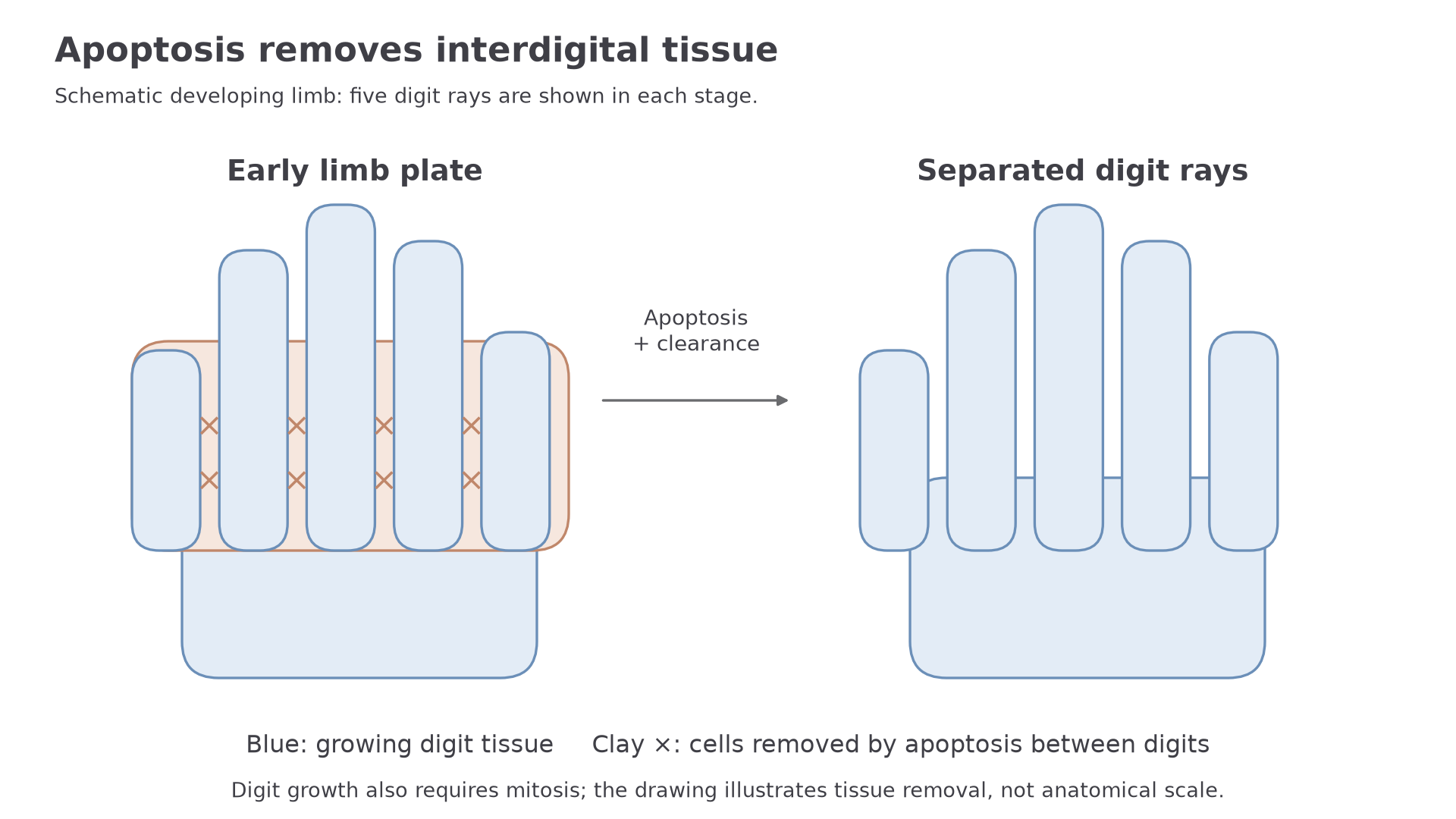
During development, apoptosis can shape a structure by removing cells from selected regions. A classic example is digit separation. Early in limb development, tissue may exist between the future digits. Apoptosis in the interdigital regions removes cells, so separate fingers or toes can form.
[DIAGRAM: digit_sculpting_schematic: Lesson 139: Mitosis and apoptosis in body form - diagram 02; asset_slug: 139_m06_1_1_mitosis_and_apoptosis_in_body_form__diagram_02; recommended_method: drawn_biology; description: Deterministic schematic of a developing limb plate with mitosis adding cells in growing digit regions and apoptosis removing cells between digits to reveal separated digits.]
Continue this lesson.
You’re previewing NovaLearn without an account. Create a free account to read the rest.
Create free account