5.1.5(i) - Reflex actions and survival value
Reflex actions are rapid, automatic responses that protect the body before there is time for a conscious decision. In this lesson you will use the knee jerk reflex to see how a reflex arc links a stimulus to a response, why a short pathway has survival value, and how repeated measurements can support a conclusion.
What Makes An Action Reflex
A reflex action is a fast, automatic and involuntary response to a stimulus. It is automatic because the same stimulus tends to produce the same response without the person choosing it. It is involuntary because the immediate response does not depend on conscious decision-making.
Reflex action
A rapid, automatic and involuntary response to a stimulus.
A useful reflex has a biological purpose. It reduces the time between detecting a stimulus and making a response, so the body can limit damage, keep balance, or restore a safer state. Pulling a hand away from a hot surface, blinking when an object moves towards the eye, and the knee jerk reflex are all examples of responses where speed matters.
The pathway followed by impulses in a reflex is called a reflex arc. In a simple reflex arc:
| Stage | Role in the reflex |
|---|---|
| Stimulus | A change in the internal or external environment |
| Receptor | Detects the stimulus and starts nervous impulses |
| Sensory neurone | Carries impulses towards the central nervous system |
| Spinal cord or brainstem | Coordinates the immediate response |
| Motor neurone | Carries impulses to an effector |
| Effector | A muscle or gland that carries out the response |
The key idea is not that the brain never receives information. The key idea is that the immediate response can be coordinated through a shorter route before conscious awareness and deliberate choice are needed.
The Knee Jerk Reflex Pathway
The knee jerk reflex is a spinal reflex. It is triggered when a light tap just below the kneecap stretches the quadriceps muscle at the front of the thigh. Stretch receptors called muscle spindles detect this stretch.
[DIAGRAM: knee_jerk_reflex_arc: Lesson 117: Reflex actions and survival value - diagram 01; asset_slug: 117_m05_1_5_reflex_actions_and_survival_value__diagram_01; recommended_method: drawn_biology; description: A clean labelled pathway showing a patellar tendon tap, stretch receptor in the quadriceps, sensory neurone entering the spinal cord, a short synapse to a motor neurone, quadriceps contraction and lower leg extension.]
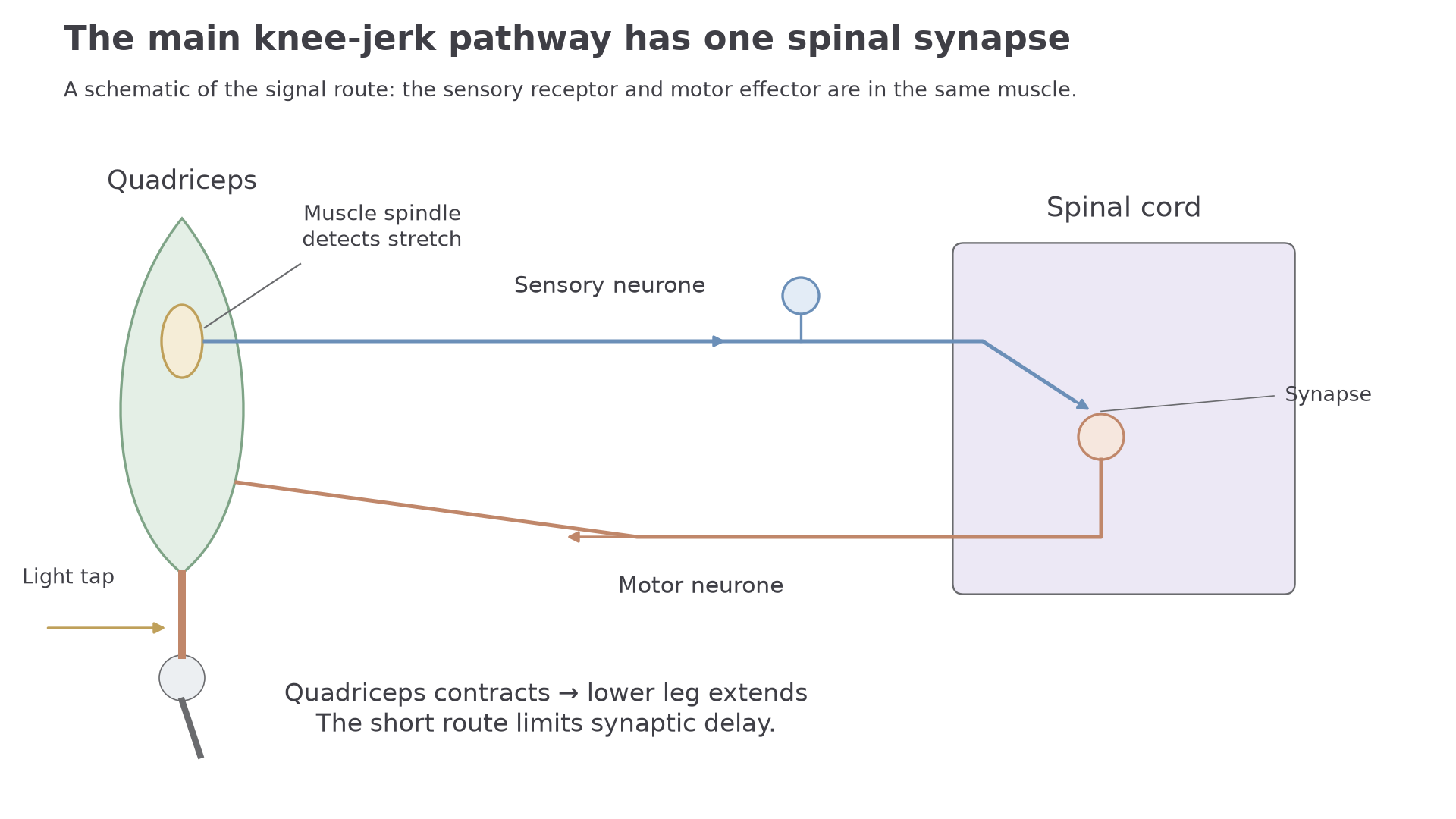
The sequence is:
- A tap on the patellar tendon stretches the quadriceps muscle.
- Muscle spindle receptors detect stretch and generate nervous impulses.
- A sensory neurone carries impulses into the spinal cord.
- In the main knee jerk pathway, the sensory neurone synapses directly with a motor neurone.
- The motor neurone carries impulses back to the quadriceps.
- The quadriceps contracts, so the lower leg extends.
The knee jerk is often used to show why reflex arcs can be fast. The main pathway has very few neurones and very few synapses. Each synapse adds a small delay because neurotransmitter has to be released, diffuse across the synaptic cleft, and trigger a response in the next neurone. Fewer synapses means a shorter delay.
If a question asks why the knee jerk reflex is fast, link the route to the spinal cord and the small number of synapses. Do not write only "it does not use the brain"; that is too imprecise because sensory information can still reach the brain after the response has begun.
When you describe the pathway, keep the order clear: stimulus, receptor, sensory neurone, spinal cord, motor neurone, effector.
Survival Value Of Reflexes
The survival value of a reflex is the advantage it gives to an organism in staying alive, avoiding damage, or maintaining function. Reflexes are valuable because they are fast, predictable and protective.
Speed is the obvious advantage. If a hot object damages skin cells, a withdrawal reflex can begin before conscious thought. That reduces the time tissues are exposed to damage. The knee jerk is less about escaping a predator and more about keeping posture and balance: it helps resist sudden stretching of a muscle, so the body can stabilise a joint.
Continue this lesson.
You’re previewing NovaLearn without an account. Create a free account to read the rest.
Create free account