6.1.3(a) - DNA sequencing principles and new techniques
DNA sequencing is the set of methods used to find the order of bases in DNA. In this lesson you will learn the principle behind Sanger sequencing, why newer high-throughput approaches changed the scale of biology, and how to handle the simple rate calculations that often sit beside this topic. These methods connect DNA synthesis, fragment separation and computational interpretation.
What Sequencing Means
A DNA sequence is the order of nucleotide bases along a DNA strand. It is usually written using the letters A, T, C and G.
DNA sequencing
DNA sequencing is the process of determining the order of nucleotide bases in a length of DNA.
A sequence records bases or nucleotides. Sequencing reads DNA. A separate interpretation step can use the genetic code to predict the amino acid sequence of a polypeptide, after identifying the correct strand, reading frame and coding regions. Introns must be removed from a eukaryotic primary transcript; some exon sequence forms untranslated regions, so not every exon base is translated. Codons within the translated region specify amino acids or stop signals.
It is also better to avoid defining sequencing as the order of "base pairs". Base pairs are useful when measuring the length of double-stranded DNA, for example in base pairs or kilobase pairs. A sequence itself is normally written as the order of bases on one strand.
For a definition, say "order of bases" or "order of nucleotides". A vague answer about genes, amino acids or base pairs is not precise enough.
Sanger Chain Termination
Sanger sequencing is a first-generation DNA sequencing method based on controlled DNA synthesis. It uses the same basic idea as DNA replication: a primer binds to a template strand, then DNA polymerase adds complementary nucleotides to make a new strand in the 5' to 3' direction.
The clever step is to include two kinds of nucleotide:
| Nucleotide type | Role in the reaction |
|---|---|
| dNTPs | Normal DNA nucleotides that allow the strand to keep growing. |
| ddNTPs | Dideoxynucleotides that terminate the strand when they are incorporated. |
A ddNTP lacks the 3' hydroxyl group needed to form the next phosphodiester bond. Once a ddNTP is added, no further nucleotide can join onto that strand. Because ddNTPs are included in small amounts, different copies of the new strand stop at different positions. This produces many fragments of different lengths, each ending at a known base.
Modern Sanger sequencing uses fluorescently labelled ddNTPs. Each base has a different fluorescent label, so when fragments are separated by length, the final base on each fragment can be detected.
[DIAGRAM: sanger_chain_termination: Sanger chain termination and sequence orientation; asset_slug: 149_m06_1_3_dna_sequencing_principles_and_new_sequencing_techniques__diagram_01; recommended_method: drawn_biology; description: Complementary template and new strand with primer and five labelled chain termination fragments read shortest to longest.]
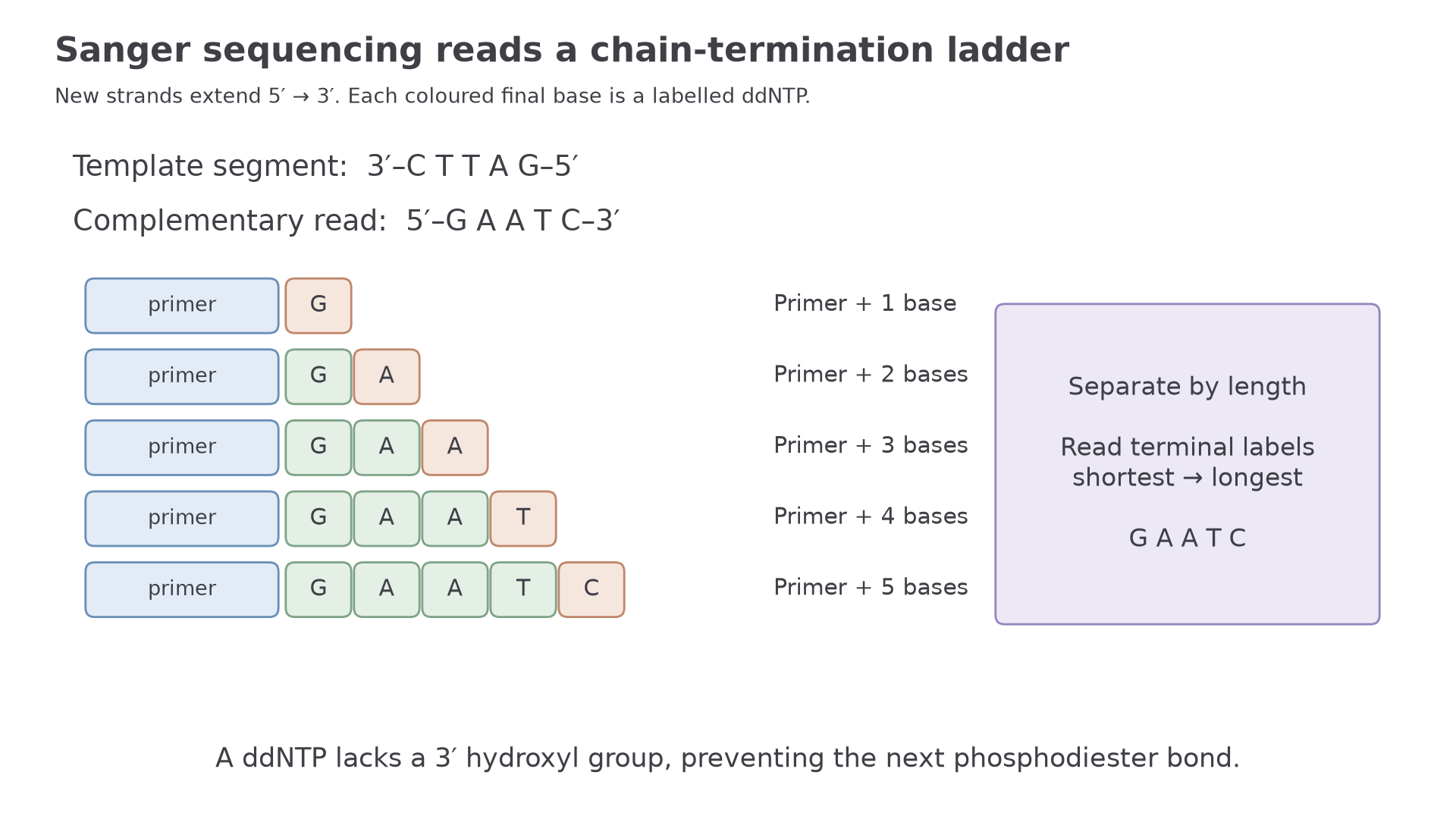
Sanger sequencing turns the order of bases into a ladder of DNA fragments. The length of each fragment and its labelled terminal base reveal the sequence.
Reading A Sequence
The fragments produced in Sanger sequencing are separated by length, traditionally by gel electrophoresis and in automated systems by capillary electrophoresis. Smaller fragments move through the separating medium first. The detector records the fluorescent label on each fragment as it passes.
Imagine a detector sees fragments in this order from shortest to longest:
| Fragment order | Terminal labelled base |
|---|---|
| 1 | G |
| 2 | A |
| 3 | A |
| 4 | T |
| 5 | C |
Continue this lesson.
You’re previewing NovaLearn without an account. Create a free account to read the rest.
Create free account