3.1.1(a)-(b) - Need and features of specialised exchange surfaces
Every living cell must exchange substances with its surroundings: useful substances such as oxygen and nutrients move in, while waste substances such as carbon dioxide move out. This lesson explains why a simple body surface is enough for some organisms but not for others, and how specialised exchange surfaces solve the problem. The key idea is not just "large surface area"; it is surface area relative to volume, combined with short diffusion distances and maintained concentration gradients.
The Exchange Problem
Exchange happens across a surface. For a single cell, that surface is the cell surface membrane. The cytoplasm inside the cell is the volume that must be supplied with substances and cleared of wastes.
Exchange Surface
A surface across which substances move between an organism and its environment, or between one body compartment and another.
A very small single-celled organism can often rely on diffusion across its cell surface because each part of its cytoplasm is close to the outside. The diffusion pathway is short, so substances do not have far to travel. Its surface area is also large compared with its volume, so there is plenty of exchange surface for each unit of living material.
As organisms become larger and multicellular, the problem changes. The volume of living tissue increases, more cells need supplies, and many cells are buried far from the external environment. Diffusion across only the outer body surface would be too slow to meet the needs of all the internal cells. Larger multicellular organisms therefore need specialised exchange surfaces.
The need for a specialised exchange surface depends on the balance between exchange supply at the surface and metabolic demand in the volume.
Surface Area To Volume Ratio
Surface area to volume ratio, written as SA:V, compares the amount of exchange surface with the amount of living material that must be supplied.
Surface Area To Volume Ratio
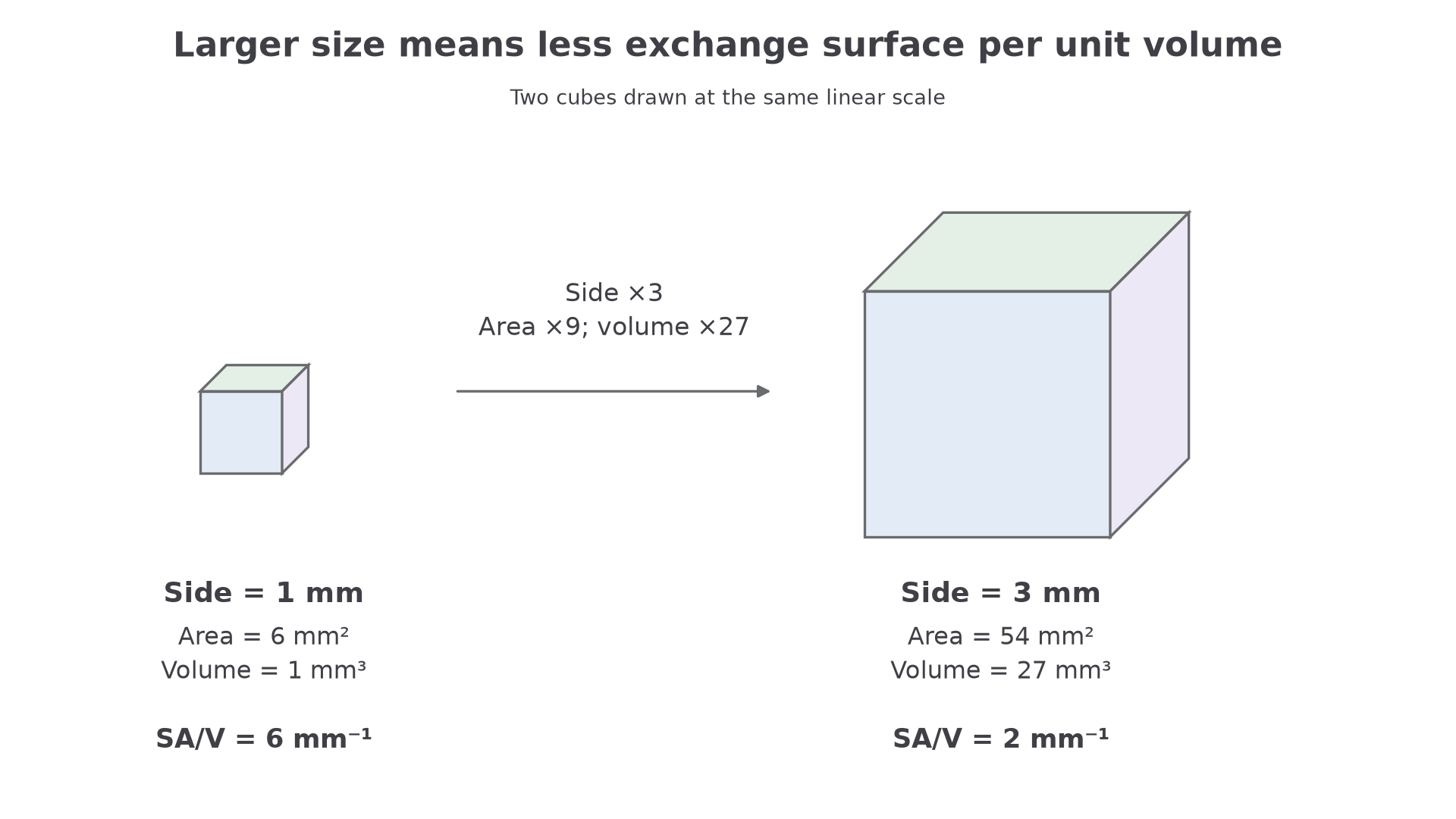
The important pattern is that when a shape gets larger, volume increases faster than surface area. For a cube, surface area depends on the square of the side length, but volume depends on the cube of the side length. That is why a larger cube can have a bigger total surface area but a smaller SA:V ratio.
[DIAGRAM: asset_name: Lesson 053: Need and features of specialised exchange surfaces - diagram 01; asset_slug: 053_m03_1_1_need_and_features_of_specialised_exchange_surfaces__diagram_01; recommended_method: drawn_biology; description: Deterministic cube comparison showing how surface area to volume ratio decreases as linear size increases, with worked values for 1 mm and 3 mm cubes.]
Calculating SA:V For Cubes
A cube has side length 3 mm.
Surface area of a cube = , where is the side length.
Surface area = mm²
Volume of a cube = .
Volume = mm³
SA:V = 54 : 27 = 2 : 1
With lengths measured in millimetres, the numerical area-to-volume ratio is 2:1; the quotient SA/V has units mm⁻¹. Keep the length unit consistent when comparing shapes. A 1 mm cube has SA:V = 6 : 1, so the 3 mm cube has less exchange surface relative to its volume.
Biological structures are not always cubes. Select a shape that approximates the structure, then state the limits of the model. The following formulae let you compare cells and tubes without assuming that every living structure is geometrically regular.
| Model and example | Surface measurement | Volume and biological interpretation |
|---|---|---|
| Rectangular prism: tissue block 4 × 2 × 1 mm | Surface area = 2(lw + lh + wh) = 28 mm² | Volume = lwh = 8 mm³; SA/V = 3.5 mm⁻¹. Include all six exposed faces. |
| Sphere: rounded cell of radius 10 µm | Surface area = 4πr² ≈ 1257 µm² | Volume = 4πr³/3 ≈ 4189 µm³; SA/V = 3/r = 0.30 µm⁻¹. Doubling radius halves SA/V. |
| Cylinder: a tube of radius 0.50 mm and length 10 mm | Curved area = 2πrl ≈ 31.4 mm²; total area including both ends = 2πrl + 2πr² ≈ 33.0 mm² | Volume = πr²l ≈ 7.85 mm³. Use curved area for exchange through the tube wall, and include ends only if they exchange too. |
For that tube, the circular cross-section has circumference 2πr ≈ 3.14 mm and area πr² ≈ 0.785 mm². Circumference × length gives the curved wall area; cross-sectional area × length gives the volume. This distinction also underlies potometer measurements.
Convert lengths before squaring or cubing: 1 mm = 1000 µm, but 1 mm² = 10⁶ µm² and 1 mm³ = 10⁹ µm³. The spherical cell above has radius 0.010 mm and SA/V = 300 mm⁻¹, the same physical relationship as 0.30 µm⁻¹. Compare values only after making their units consistent. In standard form, 0.010 mm is 1.0 × 10⁻² mm; retain both significant figures when converting.
Estimate before trusting a calculator: a cube with side 3.1 mm is close to the 3 mm example, so its SA/V should be near 2 mm⁻¹. Calculating 6/3.1 gives 1.94 mm⁻¹, consistent with that estimate; 19.4 mm⁻¹ would signal an error.
Before you answer a calculation check, pause on the order of the ratio. The first number must represent surface area, and the second number must represent volume.
Keep the ratio the right way round. SA:V means surface area divided by volume, not volume divided by surface area. OCR may credit ratios such as 6:1 or 2:1, but reversed ratios lose the biological meaning unless clearly labelled.
Continue this lesson.
You’re previewing NovaLearn without an account. Create a free account to read the rest.
Create free account