6.1.3(h) - Gene therapy in medicine
Gene therapy is one medical use of manipulating genomes: the aim is to change gene expression in a patient's cells so that a disease is treated. In this lesson, you will learn the core principle, why delivery to the right cells matters, and how somatic cell gene therapy differs from germ line cell gene therapy. You will also practise the kind of benefits-and-risks reasoning needed when society decides whether a new therapy should be used.
The Core Principle
Gene therapy means treating disease by adding, replacing, editing, inactivating or otherwise altering genetic information in cells. The genetic material must reach cells that can produce the required therapeutic effect. For an intracellular protein, the affected cells generally need to be modified; for a secreted protein, another suitable tissue can sometimes produce it for transport in the blood.
Gene Therapy
Gene therapy is the treatment of disease by altering genetic material or gene expression in cells.
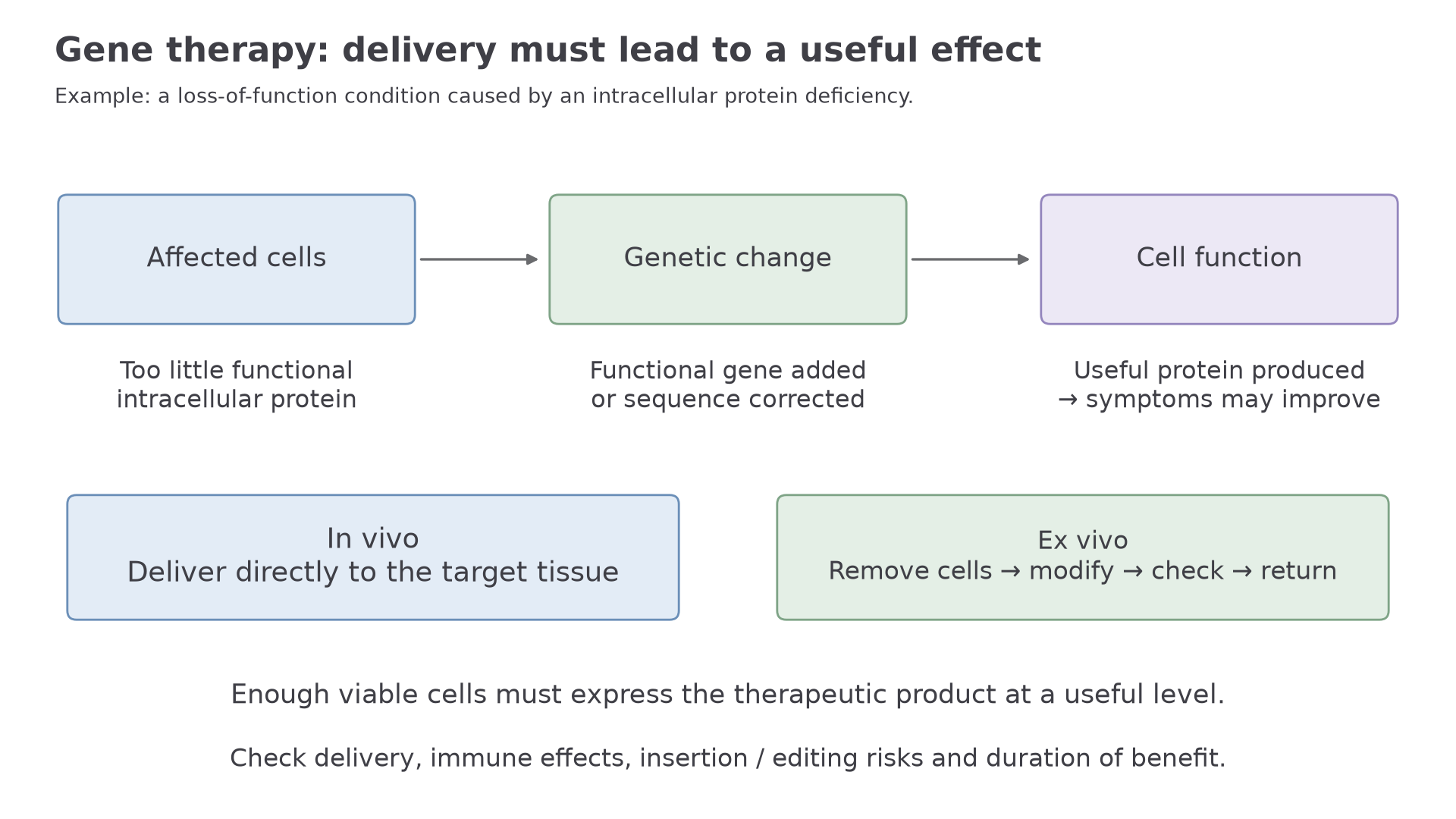
For a loss-of-function genetic condition, a mutation may mean that a cell cannot make enough functional protein. A therapeutic gene can give the cell instructions for a functional protein. If enough target cells take up and express that gene, the patient's symptoms may be reduced.
[DIAGRAM: gene_therapy_principle: Lesson 155: Gene therapy in medicine - diagram 01; asset_slug: 155_m06_1_3_gene_therapy_in_medicine__diagram_01; recommended_method: drawn_biology; description: A deterministic 16:9 workflow showing the principle of medical gene therapy: affected target cells, therapeutic gene or edited cells, delivery by vector or ex vivo modification, functional protein production, and evaluation points about target-cell access, insertion risk, dominant protein limits and non-inheritance of somatic therapy.]
A clear example is an inherited retinal condition caused by faulty RPE65 alleles. If viable retinal cells receive a functional copy of the gene, those cells can make functional RPE65 protein, improving the biochemical pathway needed for vision. Another example is spinal muscular atrophy, where a therapeutic copy of the SMN gene can allow motor neurones to make more SMN protein.
These examples also show the boundary of the idea. Gene therapy is most straightforward when the disease is caused by missing or faulty protein function in cells that can be reached. It is less straightforward when many tissues are affected, when the immune system removes the vector, when expression is short-lived, or when the disease is caused by a harmful dominant protein rather than absence of a useful one.
Delivery And Expression
Gene therapy needs a delivery method. A vector is a carrier used to deliver genetic material into cells. Modified viruses are often useful vectors because viruses naturally enter cells, but they are altered so that they do not cause the original viral disease. Other approaches can use non-viral DNA delivery or cells taken from the patient, modified in the laboratory, and returned.
Vector
A vector is a carrier used to transfer genetic material into a target cell.
There are two broad delivery routes:
| Route | What happens | Example of the logic |
|---|---|---|
| in vivo | the vector is delivered directly into the patient's body or target tissue | a vector carrying a functional allele is injected into retinal tissue |
| ex vivo | cells are removed, modified outside the body, checked, and returned to the patient | blood stem cells are altered in the laboratory and infused back into the patient |
For gene therapy to work, several steps have to go right. The therapeutic genetic material must reach the target cells, enter enough of them, be expressed at a useful level, and avoid causing serious harm. Some vectors may insert genetic material into the genome. If insertion occurs inside another gene or near a control sequence, it may disrupt normal gene expression. That is why benefits must be weighed against risks.
Why dominant disorders can be harder
Suppose condition A is caused by not making enough functional protein X. Adding a normal allele may allow treated cells to make protein X, so symptoms could improve.
Condition B is caused by a dominant allele that makes harmful protein Y. Adding a normal allele does not automatically stop the harmful allele being expressed, so the harmful protein may still be made. Treating condition B may need a different strategy, such as reducing expression of the harmful allele, not just adding a functional copy.
When explaining gene therapy, link the genetic change to cell function: gene delivered -> gene expressed -> functional protein made or harmful effect reduced -> symptoms may improve.
Somatic And Germ Line Therapy
Somatic and germ line therapy differ in the cells altered and whether the genetic change can be inherited through gametes. Duration of benefit is a separate issue.
Somatic cells are body cells that do not pass genetic information to offspring. Somatic cell gene therapy treats cells in the patient, such as retinal cells, liver cells, airway epithelial cells, blood cells or stem cells that will produce blood cells. The genetic change affects the treated person only. It is not passed on to their children through gametes.
The germ line gives rise to gametes. Altering a gamete, zygote or early embryo can create a heritable change if the cells that later form gametes carry that change. Germ line cell gene therapy would alter genetic information at a stage where the change could be present in all cells of the resulting individual, including cells that later make gametes. That means the change could be inherited by future generations.
Somatic treatment is not necessarily short-lived. A stable genetic change in a self-renewing blood stem cell can pass to its daughter cells and support long-term blood-cell production. In contrast, an added gene expressed briefly in short-lived differentiated cells may need to be delivered again. Neither somatic example changes the patient's gametes. A germ line change can be heritable without guaranteeing that every cell carries it or that the intended effect lasts: altered embryos can contain a mixture of modified and unmodified cells.
Continue this lesson.
You’re previewing NovaLearn without an account. Create a free account to read the rest.
Create free account