2.1.6(m) - Potential uses of stem cells
Stem cells matter because they connect a simple cell property to a big biological question: can lost or damaged specialised cells be replaced? In this lesson, you will learn how stem cells could be used in medicine and research, while keeping the word potential honest. The strongest answers do not just say "stem cells can cure disease"; they explain the biological route, the evidence needed, and the risks or ethical limits.
Uses start from stem-cell properties
A stem cell is useful only because of two linked properties from the previous lesson: it can self-renew by mitosis, and it can differentiate into specialised cells under suitable conditions. A potential use of stem cells is therefore a possible application based on these properties, not automatically a treatment that is already safe, effective and widely available.
Potential use
A possible application that could work if the biology, evidence, safety, ethics and regulation are strong enough.
Three uses follow from these properties:
| Use of stem cells | Core biological idea | What a careful answer should avoid |
|---|---|---|
| Repair of damaged tissues | Replace lost or damaged specialised cells with cells produced from stem cells | Claiming repair is automatic once stem cells are added |
| Treatment of neurological conditions | Produce or support specialised cells in nervous tissue | Requiring recall of named neurological conditions |
| Research into developmental biology | Study how cells become specialised and how tissues form | Turning the lesson into detailed embryology or gene regulation |
The same logic runs through all three. Stem cells provide a renewable source of cells; scientists try to control differentiation; then the outcome must be tested. In medicine, the test is whether the new cells survive, integrate and restore function. In research, the test is whether the model gives reliable evidence about development or disease.
[DIAGRAM: stem_cell_potential_uses_map: Lesson 052: Potential uses of stem cells - diagram 01; asset_slug: 052_m02_1_6_potential_uses_of_stem_cells__diagram_01; recommended_method: drawn_biology; description: A three-branch flow diagram linking stem-cell self-renewal and differentiation to tissue repair, neurological treatment potential, and developmental biology research, with evidence/safety checks before clinical use.]
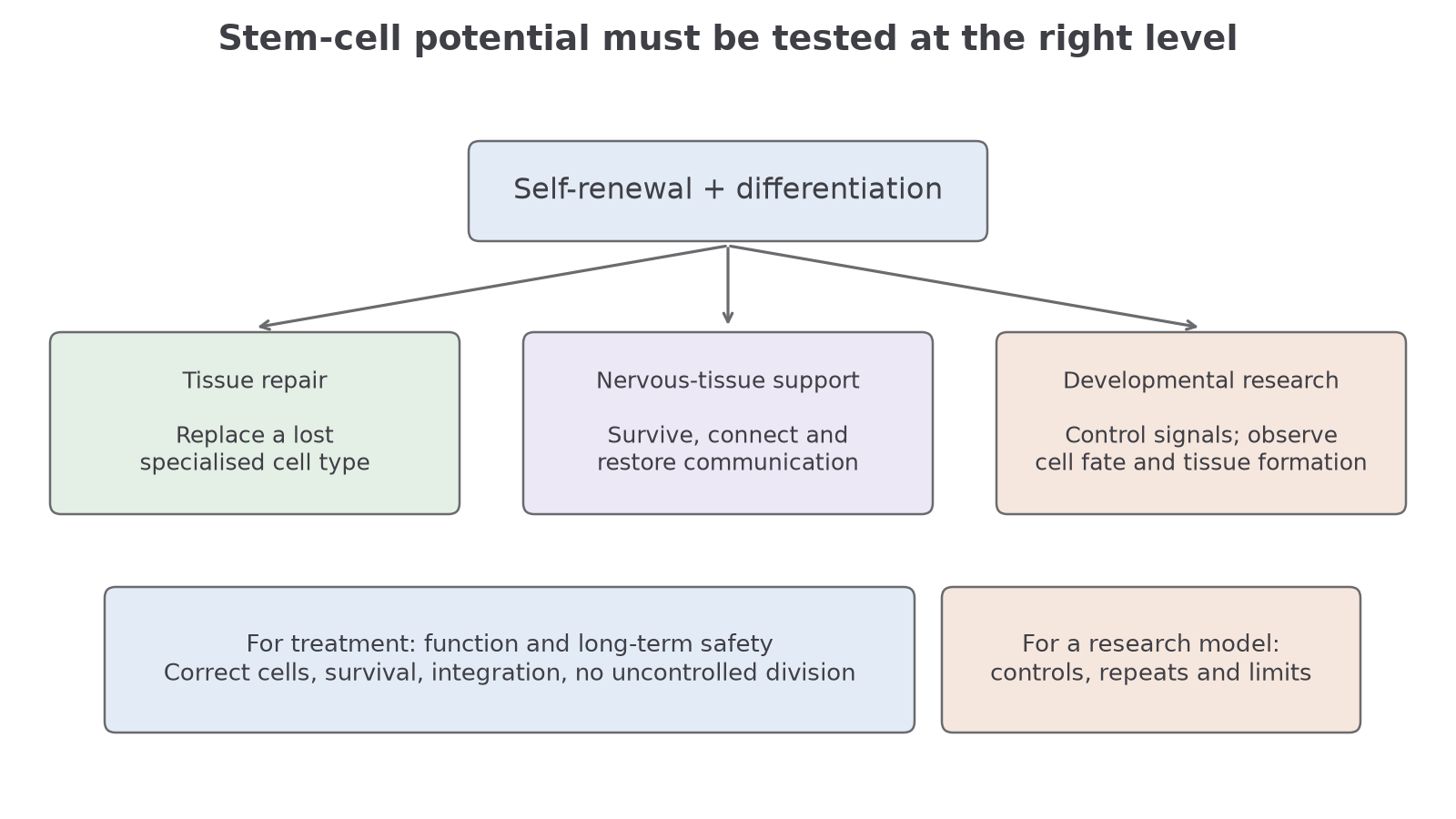
The diagram is deliberately a flow, not a list. It shows why a student answer should move from stem-cell properties to a specific use, and then to evidence or safety checks.
Stem cells have potential because they can provide new specialised cells, but every medical claim must still be tested for correct differentiation, survival, integration, function and safety.
Repairing damaged tissues
Tissue damage matters when specialised cells are lost faster than the body can replace them. Some tissues naturally repair well because their own stem cells remain active. Other tissues repair poorly, or repair by forming scar tissue rather than replacing the exact specialised cells that were lost.
The stem-cell repair idea has four steps.
- A tissue has lost or damaged specialised cells.
- Stem cells are cultured so there are enough cells to work with.
- The cells are given conditions that encourage differentiation into the required specialised cell type.
- The differentiated cells are placed into or onto the damaged tissue, where they must survive and restore some function.
That final step is the hard one. A group of cells in a dish is not yet a working tissue. In the body, cells must be in the right place, communicate with neighbouring cells, receive oxygen and nutrients, avoid being attacked by the immune system, and perform the correct specialised role for long enough to matter.
A conditional mechanism for tissue repair
Suppose a tissue has lost many specialised cells after damage. A careful explanation would be:
Stem cells can divide by mitosis, producing many cells. If the conditions are controlled, some of these cells may differentiate into the specialised cell type that was lost. These replacement cells could be transplanted into the damaged tissue. If they survive, integrate with surrounding cells and function normally, they may restore some tissue function.
The important word is may. The explanation gives the potential mechanism, then states the condition needed for success.
Common weak answers stop at "stem cells turn into new cells". Better answers name differentiation and then link it to replacing a lost specialised cell type. The best answers also include one limitation, such as immune rejection, tumour formation, the cells differentiating incorrectly, or the cells failing to integrate into the tissue.
Neurological treatment potential
Neurological conditions involve the nervous system. Stem cells may have potential for replacing damaged nerve cells or supporting cells. The general mechanism can be understood without a particular named condition.
The appeal is easy to see: nervous tissue contains highly specialised cells, and damage to those cells can have serious effects because nervous communication depends on precise connections. If stem cells could be directed to form suitable nerve cells or supporting cells, they might replace or support cells that have been lost or damaged.
The challenge is also easy to underestimate. A useful cell in nervous tissue must do more than stay alive. It may need to connect with other cells in the correct place, respond to signals, release or receive chemical messengers appropriately, and avoid disrupting existing circuits. If the cells divide uncontrollably, differentiate into the wrong cell type, or trigger an immune response, the treatment could be harmful.
If a question asks about neurological treatment, you can keep the answer generic: damaged nervous-system cells could be replaced or supported by specialised cells derived from stem cells. Do not spend time trying to remember a named condition.
Continue this lesson.
You’re previewing NovaLearn without an account. Create a free account to read the rest.
Create free account