6.1.1(c) - Homeobox and Hox genes in body plans
An embryo is not built because every cell has different DNA. Most cells have the same genome, but different genes are switched on and off in different places and at different times. In this lesson you will learn how conserved Homeobox genes regulate gene expression, and how Hox genes, as a subset of Homeobox genes, help control animal body-plan development.
Body Plans Need Gene Control
A body plan is the overall arrangement of the main parts of an organism: for example, where the head end, tail end, repeated segments, limbs or organs develop. Body-plan development depends on cells receiving and using positional information, so that cells in different regions follow different developmental pathways.
The key idea is control of gene expression. Early cells in an organism may contain the same DNA, but they do not all use the same genes in the same way. Some genes are switched on in one region and switched off in another region. This affects which proteins are made, which affects how cells develop and how tissues form.
Regulation of gene expression
Regulation of gene expression means controlling whether, when and how strongly a gene is transcribed and used to make its gene product.
Homeobox and Hox genes belong in this control layer. They are not ordinary "structure genes" that simply code for one visible body part. They are regulatory genes whose products can influence the expression of other genes.
Homeobox Genes
Homeobox genes are regulatory genes that contain a similar DNA sequence called a homeobox. The homeobox sequences are similar and highly conserved in plants, animals and fungi.
Highly conserved
A highly conserved DNA sequence has remained similar over long evolutionary time because changes to it are often harmful or strongly selected against.
The homeobox sequence is commonly described as about 180 base pairs long. It codes for a homeodomain, a region of the protein that can bind to DNA. Because of this DNA-binding role, many homeobox gene products act as transcription factors: they help regulate whether target genes are switched on or off.
The sequence is conserved because it does an important job. If a DNA-binding regulatory protein is changed in a way that prevents it binding to the correct target DNA, many downstream genes may be expressed in the wrong place, at the wrong time, or not at all.
| Term | Meaning |
|---|---|
| Homeobox | A conserved DNA sequence found within Homeobox genes |
| Homeodomain | The protein region encoded by the homeobox sequence; it binds DNA |
| Homeobox gene | A regulatory gene containing a homeobox sequence, found across plants, animals and fungi |
| Target gene | A gene whose expression is influenced by a regulatory protein |
[DIAGRAM: homeobox_hox_body_plan_control: Lesson 138: Homeobox and Hox genes in body plans - diagram 01; asset_slug: 138_m06_1_1_homeobox_and_hox_genes_in_body_plans__diagram_01; recommended_method: drawn_biology; description: A deterministic 16:9 flow diagram linking conserved Homeobox genes in plants, animals and fungi to a shared homeobox sequence, a homeodomain transcription factor regulating target genes, and Hox genes as an animal subset controlling anterior-posterior body-plan regions.]
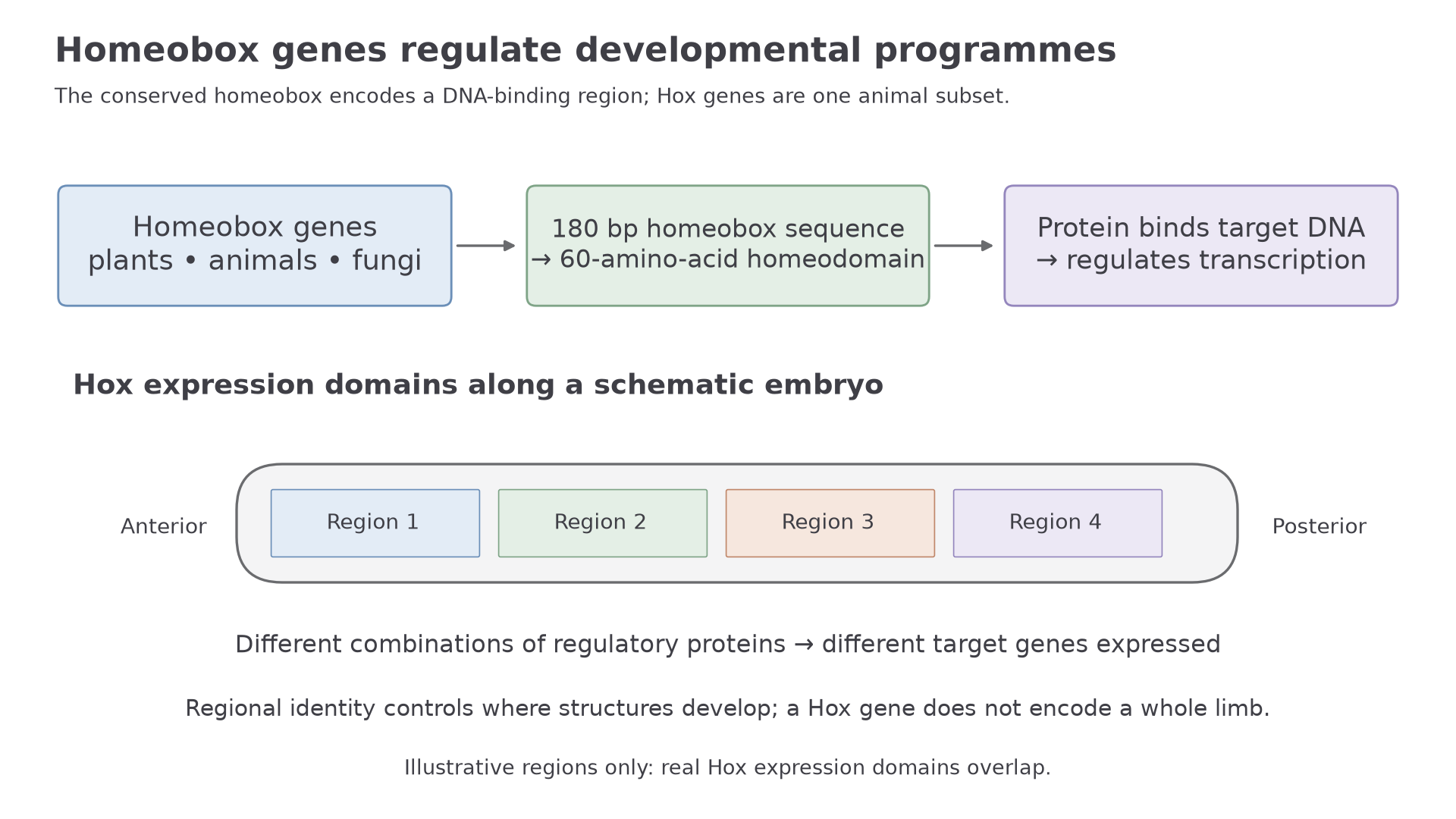
Use the diagram as a hierarchy. Homeobox is the conserved DNA sequence; Homeobox genes are the wider regulatory gene group; Hox genes are one important subset involved in body-plan control.
Hox Genes And Body Plan
Hox genes are a subset of Homeobox genes. They control regional identity during animal development.
Continue this lesson.
You’re previewing NovaLearn without an account. Create a free account to read the rest.
Create free account