6.1.2(e) - Selection, drift, bottlenecks and founder effects
Evolution is not only about dramatic new species appearing. At this scale, it means inherited characteristics in a population changing over generations because allele frequencies change. In this lesson you will compare two broad routes: selection, where survival and reproduction are linked to phenotype, and genetic drift, where chance changes allele frequencies, especially in small populations.
Evolutionary Factors
A population evolves when the genetic composition of that population changes over generations. The individuals alive today do not decide to evolve; instead, alleles become more or less common as individuals survive, reproduce, die or leave offspring by chance.
Allele frequency
The proportion of all copies of a gene in a population that are a particular allele.
Two factors in this lesson can change allele frequencies in very different ways.
| Factor | Core idea | Usual effect on allele frequencies |
|---|---|---|
| Natural selection | Some heritable phenotypes give higher survival and reproductive success under a selection pressure. | Alleles linked to the favoured phenotype tend to increase. |
| Genetic drift | Chance events mean a random sample of alleles is passed on or survives. | Alleles can increase, decrease, be lost or become fixed by chance. |
A selection pressure is an environmental factor that affects survival or reproductive success. Predation, disease, competition and climate can all act as selection pressures. Genetic drift does not need a phenotype to be helpful or harmful; it can happen simply because a small population is a small sample.
Keep the level of explanation at the population level. A strong answer says that allele frequencies change over generations, not that an individual organism changes its alleles during life.
Selection Patterns
Natural selection needs three ingredients: variation between individuals, a genetic basis to at least some of that variation, and a selection pressure that makes some phenotypes more successful than others. If the phenotype affects survival or reproduction, the alleles contributing to that phenotype can change in frequency.
Two important selection patterns are stabilising selection and directional selection.
Stabilising selection
Selection that favours intermediate phenotypes and selects against extreme phenotypes.
Stabilising selection tends to keep the population mean similar but reduces the range of phenotypes. For example, if very small and very large individuals both survive less well than intermediate individuals, alleles contributing to the intermediate phenotype become relatively common.
Directional selection
Selection that favours one extreme phenotype, causing the population mean to shift in that direction over generations.
Directional selection happens when the environment favours one end of the existing range. If darker individuals are better camouflaged after a habitat change, alleles contributing to darker colour may increase. The key point is that selection acts on phenotypes, but evolution is recorded as a change in allele frequencies across generations.
[DIAGRAM: selection_curve_comparison: Lesson 145: Selection, drift, bottlenecks and founder effects - diagram 01; asset_slug: 145_m06_1_2_selection_drift_bottlenecks_and_founder_effects__diagram_01; recommended_method: drawn_biology; description: 16:9 NovaLearn-style graph comparing stabilising selection and directional selection. Each panel shows a dashed before-selection phenotype distribution and a solid after-selection distribution, with stabilising selection narrowing around the mean and directional selection shifting the mean toward one favoured extreme.]
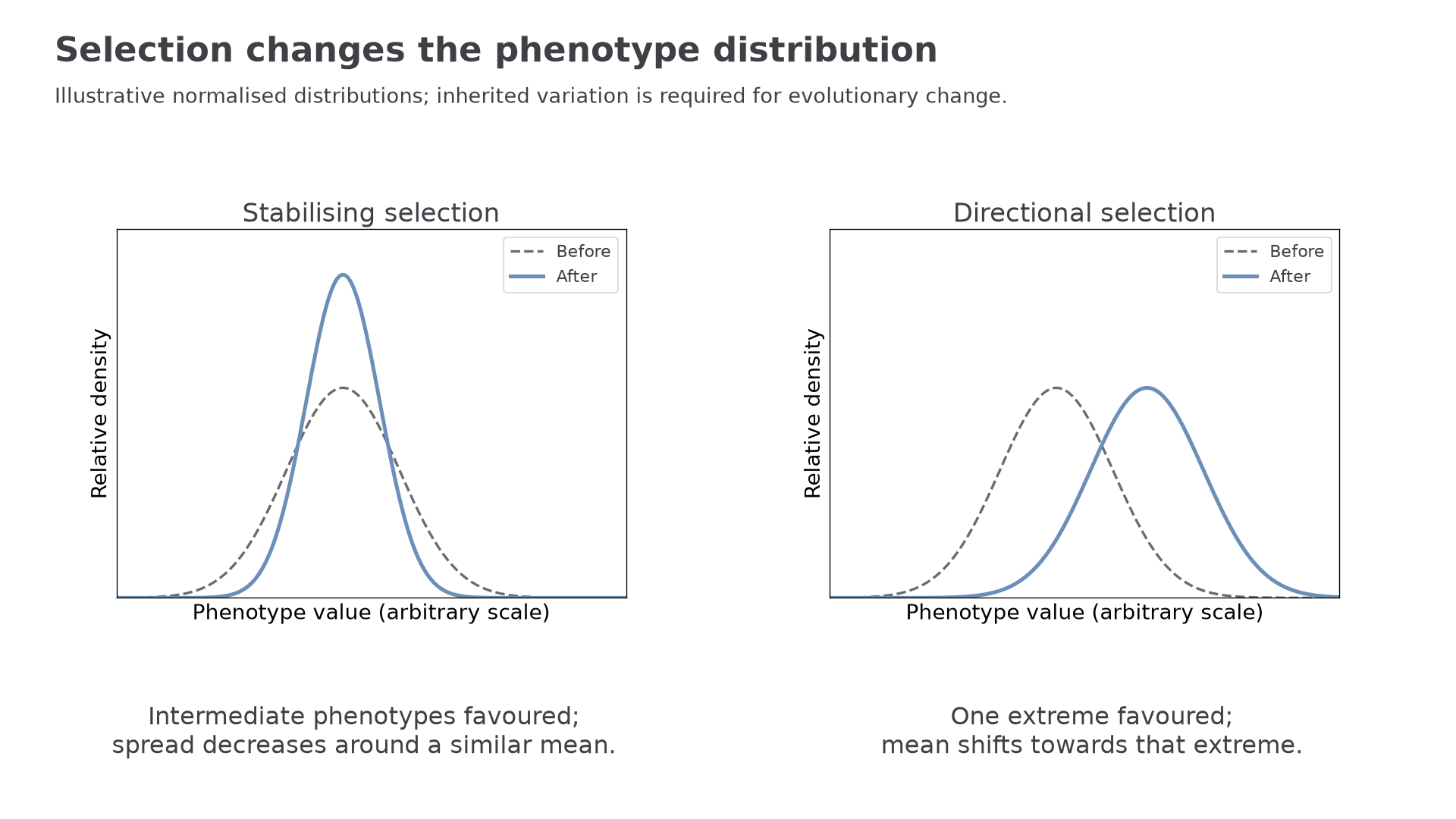
Use the diagram to separate two ideas that students often merge. Stabilising selection reduces extremes but does not move the mean much. Directional selection moves the mean because one extreme is favoured over the other.
Genetic Drift
Genetic drift is chance change in allele frequency. It is not caused by an allele being useful. It is caused by random sampling: which gametes happen to form offspring, which individuals happen to survive, or which individuals happen to reproduce.
Genetic drift
Random change in allele frequencies in a population, especially noticeable in small populations.
Imagine a population with equal numbers of two allele copies, A and a. In a very large population, chance differences from one generation to the next are often small. In a small population, a few births or deaths can represent a large fraction of the gene pool, so the allele frequency can move sharply just by chance.
Drift can make an allele more common, less common, completely lost, or fixed. An allele is fixed when every copy of that gene in the population is the same allele. This can happen even if the allele gives no advantage.
Continue this lesson.
You’re previewing NovaLearn without an account. Create a free account to read the rest.
Create free account