5.2.2(j)-(k) - Respiratory substrates and respiratory quotient
Cells do not have to use only glucose as a fuel. Carbohydrates, lipids and proteins can all act as respiratory substrates, but they differ in how much energy they release per gram and in the gas-exchange pattern they produce. In this lesson you will learn how to compare those substrates and how to calculate and interpret respiratory quotient, or RQ.
Substrates As Fuels
A respiratory substrate is an organic molecule that can be broken down in respiration to release energy for ATP synthesis. In this specification point the key substrate groups are carbohydrates, lipids and proteins.
Respiratory Substrate
A respiratory substrate is an organic molecule that can be oxidised in respiration to release energy for ATP synthesis.
Glucose is often used as the model carbohydrate because it is familiar and enters glycolysis directly. That does not mean cells only respire glucose. Lipids can be respired after being broken down into glycerol and fatty acids, and proteins can be used when amino acids are available as respiratory substrates. Glycerol can enter glycolysis; fatty acids are broken into acetyl groups that enter the Krebs cycle via acetyl CoA. Amino acids lose their amino group before their carbon skeletons enter respiratory pathways.
The first comparison is relative energy value: the energy released per gram of substrate when it is respired.
| Respiratory substrate | Relative energy value per gram | precise comparison |
|---|---|---|
| Carbohydrate | Lower | Similar to protein, lower than lipid |
| Lipid | Highest | Much more energy per gram than carbohydrate or protein |
| Protein | Similar to carbohydrate | Lower than lipid; not usually the preferred energy source |
Lipids have the highest energy value because they contain proportionally more carbon-hydrogen bonds and less oxygen than carbohydrates. Those hydrogen atoms can be removed and used to reduce coenzymes, which then feed electrons into oxidative phosphorylation. More reduced substrate means more potential energy can be transferred to ATP per gram.
[DIAGRAM: substrate_energy_rq_comparison: Lesson 134: Respiratory substrates and respiratory quotient - diagram 01; asset_slug: 134_m05_2_2_respiratory_substrates_and_respiratory_quotient__diagram_01; recommended_method: drawn_biology; description: A deterministic 16:9 comparison chart showing carbohydrate, lipid and protein relative energy values per gram alongside typical RQ values, using exact labels and precise cautions.]
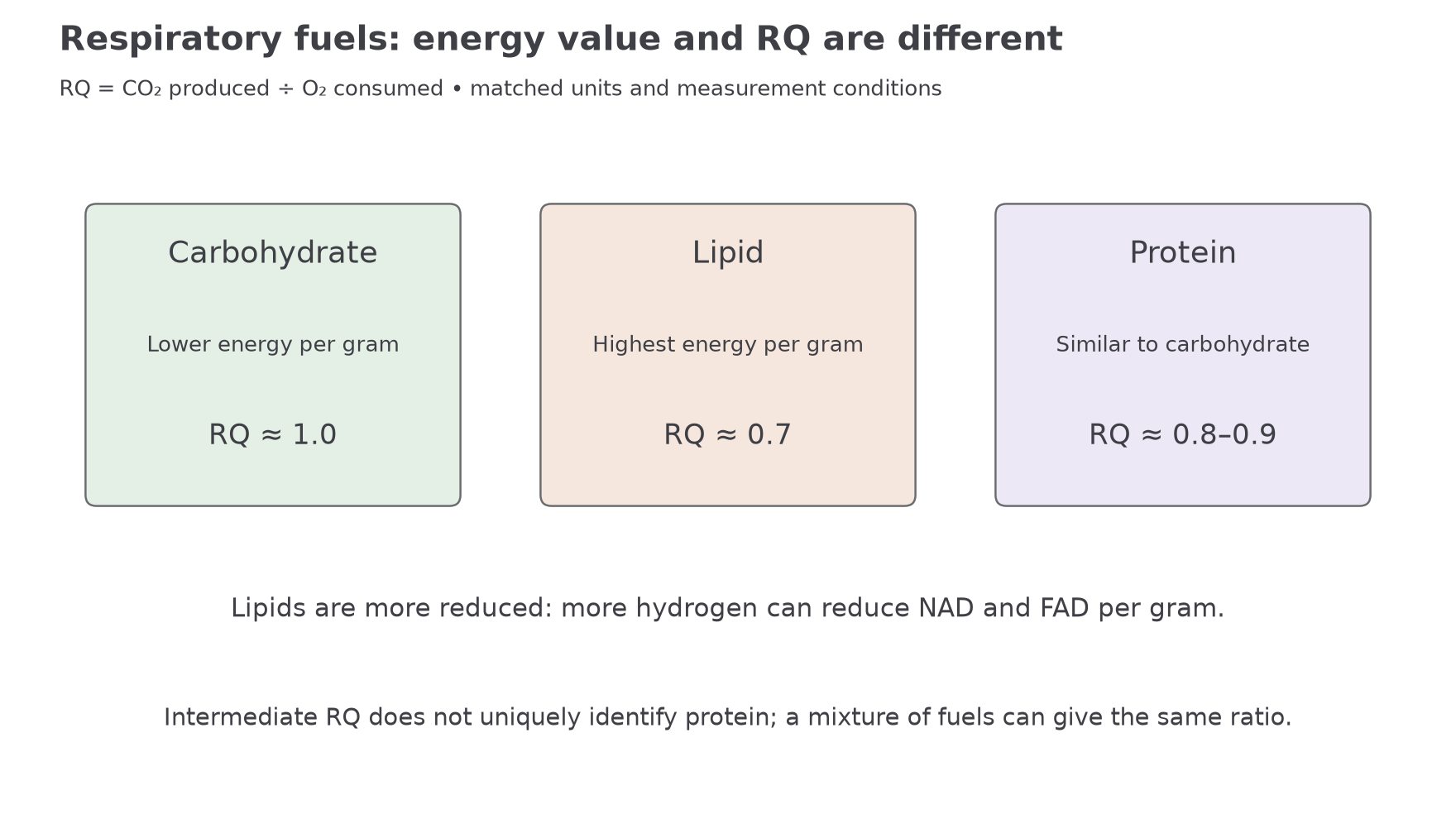
Do not mix up "high energy value" with "high RQ". Lipids have the highest energy value per gram, but they have a lower RQ than carbohydrates.
Proteins also have essential roles as enzymes, transporters and structural components. Breaking down functional protein to supply energy therefore has a cost. Excess dietary amino acids can be respired even when other fuels are available; increased tissue-protein breakdown may occur during prolonged starvation. Deamination produces nitrogenous waste that must be processed and excreted, rather than nitrogen being oxidised to CO₂.
RQ As A Gas Ratio
The respiratory quotient, or RQ, compares the volume of carbon dioxide produced with the volume of oxygen consumed during respiration.
Respiratory Quotient
RQ has no unit because the same volume units cancel. For example, if both gas volumes are measured in cm³, the calculation is:
The cm³ units cancel, leaving a ratio.
The value depends on the substrate because different molecules need different amounts of oxygen for complete oxidation and produce different amounts of carbon dioxide.
| Main substrate being respired | Typical RQ | Meaning |
|---|---|---|
| Carbohydrate | about 1.0 | Carbon dioxide produced and oxygen consumed are equal |
| Lipid | about 0.7 | Less carbon dioxide is produced for each oxygen molecule consumed |
| Protein | intermediate, often around 0.8 to 0.9 | Varies with amino acid composition, but usually lies between lipid and carbohydrate |
For glucose, the balanced equation explains the RQ:
Six carbon dioxide molecules are produced for every six oxygen molecules consumed, so:
For a fatty acid, more oxygen is needed relative to the amount of carbon dioxide produced, so the RQ is lower. That is why a value close to 0.7 suggests lipid is the main substrate.
If a question asks for RQ, write the formula as CO₂ produced divided by O₂ consumed. Reversing the ratio gives a biologically wrong interpretation.
Calculating RQ
RQ calculations are usually short, but the method needs to be tidy. Use the same order every time:
- Identify the volume of CO₂ produced.
- Identify the volume of O₂ consumed.
- Substitute into .
- Cancel the volume units.
- Interpret the value using the substrate reference values.
Continue this lesson.
You’re previewing NovaLearn without an account. Create a free account to read the rest.
Create free account