6.2.1(c)-(d)(ii) - Natural and artificial animal cloning
Animal cloning is about copying genetic information into whole animals, either when it happens naturally or when humans intervene. In this lesson, you will learn how embryo splitting can produce natural animal clones, how artificial embryo twinning and somatic cell nuclear transfer produce artificial clones, and how to evaluate animal cloning in agriculture and medicine without ignoring welfare, cost and longevity evidence.
Natural Animal Clones
A clone is a cell or organism with the same genetic information as another cell or organism. In animals, the clearest natural example is a pair of monozygotic twins, often called identical twins.
Natural clone
A natural clone is a genetically identical organism produced without deliberate human cloning.
Monozygotic twins form when one fertilised egg, or zygote, begins dividing by mitosis and the early embryo splits into two. Each separated group of cells continues developing as an embryo. Because both embryos came from the same original zygote, they have the same combination of alleles in their nuclear DNA.
This is different from dizygotic, or non-identical, twins. Dizygotic twins form when two different eggs are fertilised by two different sperm cells. They are siblings developing at the same time, not clones, because they do not start with the same zygote.
For animal natural clones, use the phrase "twins formed by embryo splitting". Do not describe ordinary siblings or non-identical twins as clones.
Natural clones do not have to be identical in every visible feature. Developmental conditions, the environment, gene expression and later mutations can affect phenotype. The important point for this lesson is that embryo splitting produces individuals with the same original nuclear genotype.
Artificial Embryo Twinning
Artificial embryo twinning copies the natural embryo-splitting process under laboratory control. It starts with an early embryo produced after fertilisation, not with a body cell from an adult animal.
A simple sequence is:
- A sperm cell fertilises an egg cell to form a zygote.
- The zygote divides by mitosis to form an early embryo.
- The embryo is separated into two or more smaller embryos or groups of cells while the cells can still develop into a whole animal.
- Each embryo is grown briefly in suitable conditions.
- The embryos are implanted into surrogate mothers.
- Offspring that develop from the separated embryo parts are clones of each other.
The phrase "clones of each other" matters. In artificial embryo twinning, the farmer or researcher is not copying a chosen adult animal. They are producing genetically identical offspring from one early embryo. The method can multiply a valuable combination of alleles that already exists in that embryo, but it cannot guarantee that the embryo has the exact adult traits wanted later.
Artificial embryo twinning starts with an early embryo and produces offspring that are genetically identical to each other.
The method is most useful when the aim is to increase the number of animals with the same embryo genotype. It is less useful if the aim is to copy an adult animal whose phenotype is already known, because the original embryo has not yet grown and shown its adult traits.
Somatic Cell Nuclear Transfer
Somatic cell nuclear transfer, usually shortened to SCNT, is the animal-cloning method used to make Dolly the sheep. It can copy the nuclear DNA of a chosen adult animal because the nucleus comes from one of that animal's body cells.
Somatic cell
A somatic cell is a body cell that is not a gamete.
Enucleation
Enucleation is the removal of the nucleus from a cell.
SCNT has a different logic from embryo twinning:
- Take an egg cell from one animal and remove its nucleus. This produces an enucleated egg cell.
- Take a somatic cell, such as a skin or mammary-gland cell, from the animal to be cloned.
- Transfer the somatic-cell nucleus into the enucleated egg cell, or fuse the whole somatic cell with the egg cell.
- Stimulate the reconstructed egg cell to divide by mitosis.
- Allow it to develop into an early embryo.
- Implant the embryo into a surrogate mother.
- If development continues successfully, the offspring is a clone of the animal that donated the somatic-cell nucleus.
[DIAGRAM: animal_cloning_routes: Lesson 158: Natural and artificial animal cloning - diagram 01; asset_slug: 158_m06_2_1_natural_and_artificial_animal_cloning__diagram_01; recommended_method: drawn_biology; description: A clean 16:9 line diagram comparing artificial embryo twinning with SCNT, showing embryo splitting, enucleated egg, donor somatic-cell nucleus, reconstructed egg, stimulated embryo and surrogate mother.]
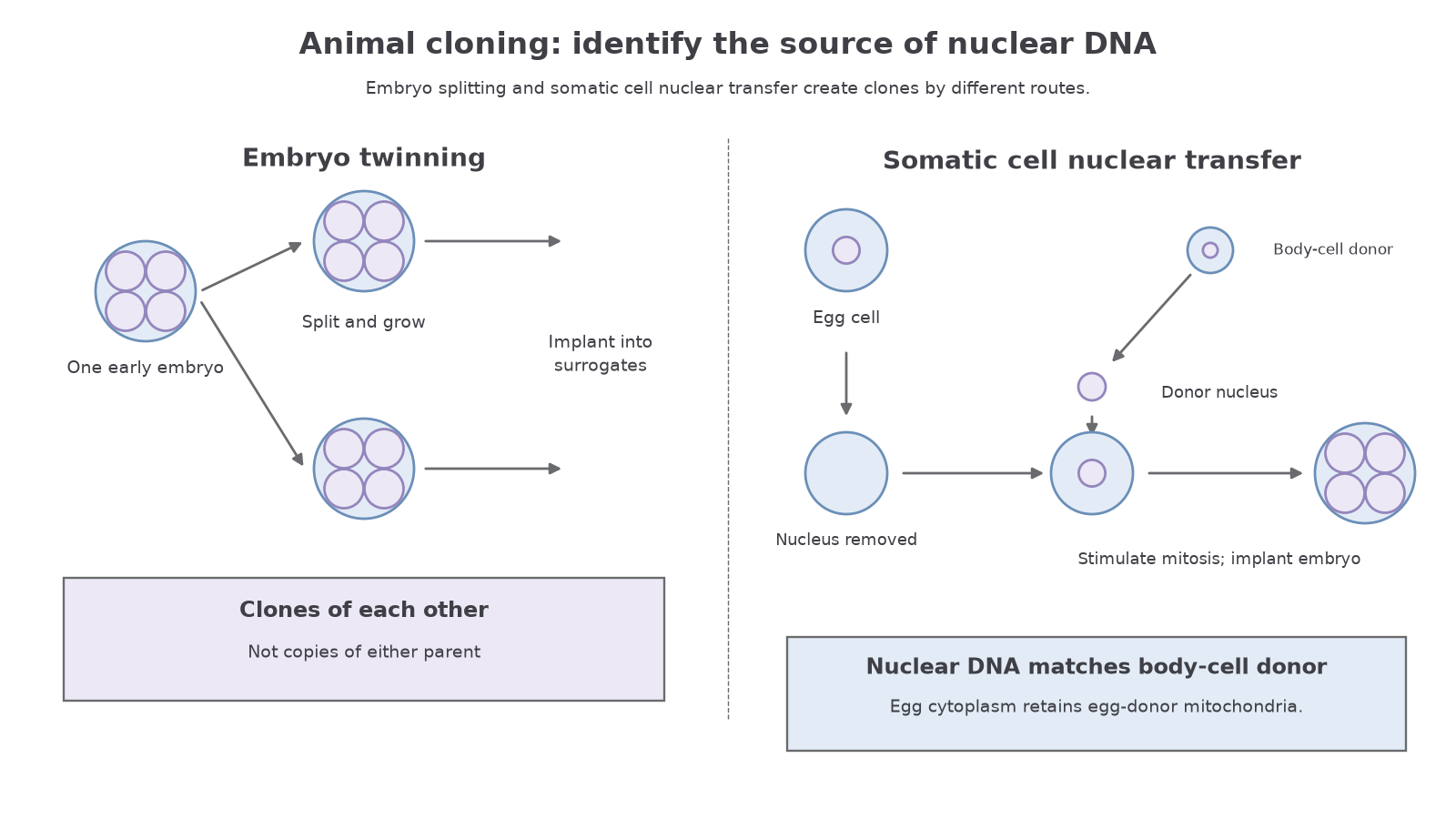
The diagram highlights the key comparison. Embryo twinning uses nuclear DNA from the same original embryo. SCNT uses nuclear DNA from the donor somatic cell, so it can copy a chosen adult animal. The egg cell still provides cytoplasm, mitochondria and cellular factors needed for early development, so a precise answer says that an SCNT clone has the same nuclear DNA as the somatic-cell donor.
When describing SCNT, include both enucleation and the source of the donor nucleus. Answers that say only "put DNA into an egg" are usually too vague.
Dolly's case is a useful model of the method: a nucleus from an adult sheep cell was placed into an enucleated egg, the embryo was implanted into a surrogate, and the lamb that developed had nuclear DNA from the adult donor rather than from the surrogate mother.
A differentiated donor cell still normally contains a complete diploid genome. The egg cytoplasm must reprogramme gene expression so that this nucleus can direct embryonic development. Incomplete reprogramming helps explain why many reconstructed embryos fail. Nuclear transfer is not fertilisation: a sperm nucleus is not added, and the egg nucleus is removed to avoid retaining an extra set of chromosomes.
Continue this lesson.
You’re previewing NovaLearn without an account. Create a free account to read the rest.
Create free account