6.3.1(b) - Biomass transfers and efficiency
Every food chain depends on biomass being built, eaten and rebuilt in another organism. This lesson shows how biomass transfer is measured, why the transfer between trophic levels is inefficient, and how to calculate percentage efficiency. You will also learn how human activities can manipulate biomass transfer in farming, while still needing careful evaluation.
Biomass As Growth
Biomass is the mass of living biological material. In ecosystem calculations, biomass is usually compared as dry mass because water content varies between organisms and does not represent stored organic matter in the same way as carbohydrate, lipid, protein and other biological molecules.
Trophic level
The feeding position of an organism in a food chain, such as producer, primary consumer or secondary consumer.
Biomass is transferred through ecosystems when one trophic level provides material that is used to make new biomass in the next trophic level. The most important word is growth. A consumer only makes biomass available to the next trophic level if some of its intake becomes new body tissue or reproductive material.
That is why respiration is not biomass transfer to the next trophic level. Respiration releases energy from organic molecules so that cells can do work. Some matter is released as carbon dioxide and water, and the energy is eventually dissipated as heat. Excretion and egestion also do not build new consumer biomass; they remove waste material from the organism.
[DIAGRAM: biomass_intake_budget: Lesson 164: Biomass transfers and efficiency - diagram 01; asset_slug: 164_m06_3_1_biomass_transfers_and_efficiency__diagram_01; recommended_method: drawn_biology; description: 16:9 NovaLearn-style flow diagram showing producer biomass available to a consumer, uneaten biomass entering detritus, consumer biomass intake splitting into egested/excreted material, respiration losses and growth/reproduction as biomass transferred to the next trophic level.]
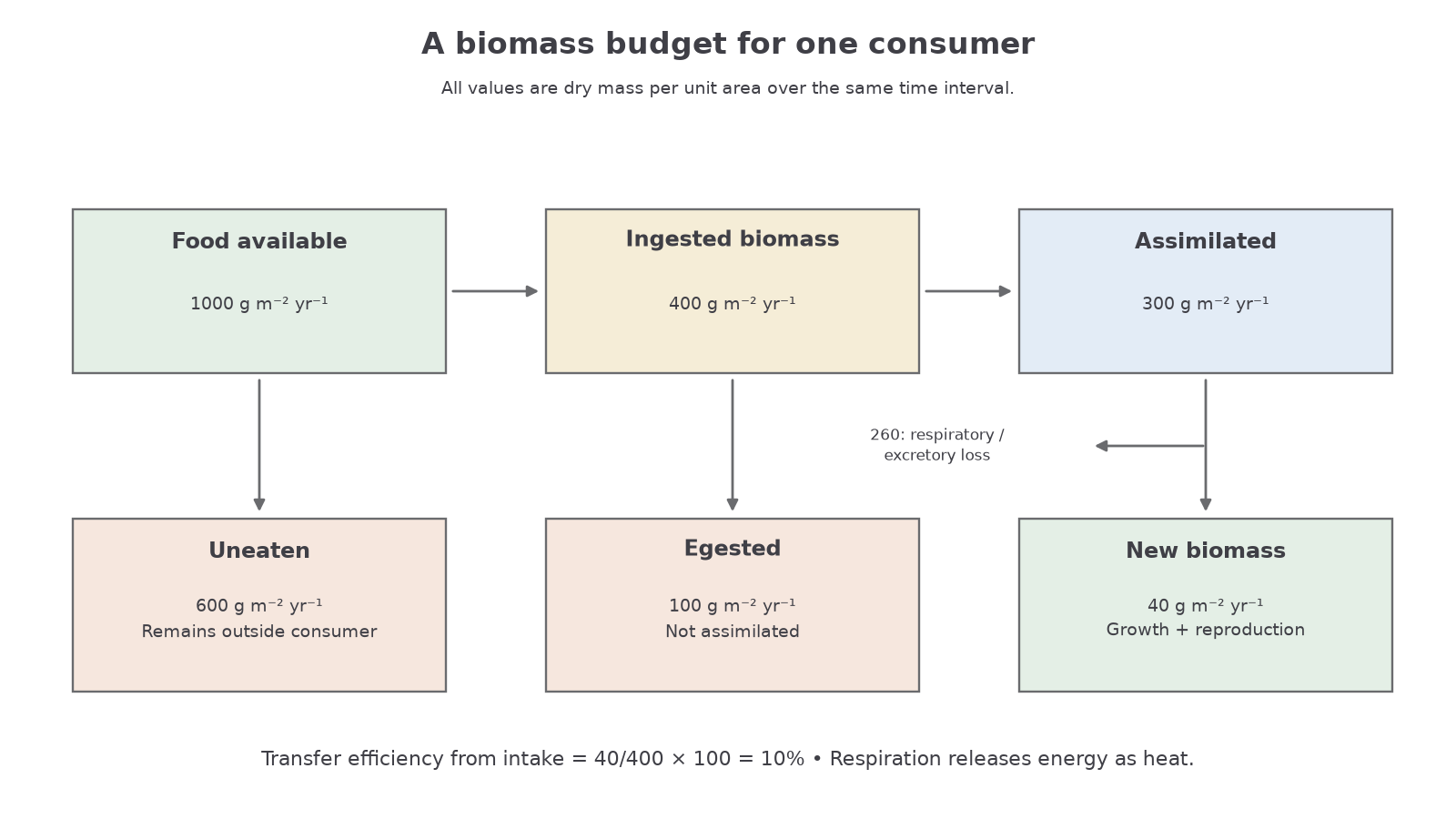
The diagram separates available biomass from biomass intake. Biomass that is never eaten is still important in the ecosystem, but it is not intake for that consumer. Biomass intake is the material consumed. Only the fraction converted into growth and reproduction is transferred onwards as new biomass.
If a question asks what makes biomass available to the next trophic level, the safest answer is growth or reproduction. Do not answer respiration, excretion or egestion.
Measuring Biomass
To measure biomass transfer, the measurements on the two sides of the calculation must match. They should refer to the same population or area, the same time period, and the same type of mass. Mixing wet mass with dry mass, or one week of intake with one month of growth, makes the result meaningless.
Biomass can be estimated in several ways:
| Measurement decision | Why it matters |
|---|---|
| use dry mass | removes variation caused by water content |
| measure per unit area, such as g m⁻² | allows trophic levels in different areas to be compared |
| sample organisms and calculate a mean | avoids needing to kill or measure every organism |
| count or estimate population size | lets the mean mass be scaled up to total biomass |
| record the time period | distinguishes standing biomass from rate of biomass production |
Estimating producer biomass
A student samples grass plants in a field. In repeated quadrats, the mean number of grass plants is 42 plants m⁻². A representative sample is dried to constant mass, giving a mean dry mass of 0.18 g per plant.
Estimated grass biomass:
To an appropriate number of significant figures, this could be reported as 7.6 g m⁻².
The same principle can be used for consumers. For example, a farmer could measure feed dry mass eaten by a group of animals and the dry biomass gained by those animals over the same period. In ecological fieldwork, direct measurement may be destructive, so estimates, samples, historical data or non-lethal measurements may be more appropriate.
The important calculation idea is that biomass transfer is quantitative. It is not enough to say "some biomass is passed on". You need a value for intake, a value for transferred biomass, and units that make sense.
A fair biomass-transfer measurement uses matching units, matching time or area, and a clear distinction between biomass eaten and biomass converted into growth.
Obtaining a comparable dry mass
Take small representative samples using random positions, with permission and minimal damage. Dry in an oven at a suitable temperature that removes water without burning organic matter; cool in a dry container, weigh, then repeat heating and weighing until constant mass. A fixed drying time alone is insufficient. For clonal grasses, counting separate plants can be ambiguous; harvesting a small known quadrat area and scaling its dry mass per square metre may be more defensible. Repeat quadrats to estimate spatial variation.
Standing biomass is a snapshot, whereas productivity is biomass formed per unit area per unit time. Rapidly reproducing aquatic producers may have low standing biomass because consumers eat them quickly, despite high production. Do not calculate transfer efficiency by dividing two unmatched standing stocks as though they were intake and growth over the same interval.
Efficiency Calculations
Efficiency tells you what percentage of biomass intake becomes biomass transferred to the next trophic level.
Biomass Transfer Efficiency
The units in the numerator and denominator must be the same, so they cancel. The final answer is a percentage.
Calculating biomass transfer efficiency
A group of caterpillars eats 500 g of leaf dry mass. Over the same period, the caterpillars gain 42 g of dry biomass.
Formula:
Substitution:
Calculation:
Interpretation:
Only 8.4% of the leaf biomass intake became new caterpillar biomass. The remaining intake was not retained as new caterpillar biomass: material was egested, excreted or broken down in respiration. Respiration releases matter such as carbon dioxide and water; energy is eventually dissipated as heat, which is not a loss of mass as heat.
Always sense-check the answer. A transfer efficiency greater than 100% would mean more biomass was transferred than was taken in, so either the data are not measuring the same thing or the calculation has been set up incorrectly.
For a multi-step chain, multiply fractional efficiencies. If 10% of producer intake becomes herbivore biomass and 15% of that becomes carnivore biomass, the combined fraction is 0.10 × 0.15 = 0.015, or 1.5%. Adding 10% and 15% would be wrong: the second percentage applies to a much smaller amount.
Continue this lesson.
You’re previewing NovaLearn without an account. Create a free account to read the rest.
Create free account