2.1.3(a)-(b) - Nucleotides and polynucleotides
Nucleic acids such as DNA and RNA are built from smaller monomers called nucleotides. In this lesson you will learn what a nucleotide contains, how DNA and RNA nucleotides differ, and how nucleotides join into polynucleotides through phosphodiester bonds. This is the molecular foundation for later lessons on DNA structure, replication and protein synthesis, but those later processes are not the target here.
The parts of a nucleotide
A nucleotide is the monomer used to make nucleic acids. Each nucleotide has three parts: a phosphate group, a pentose sugar and a nitrogenous base. A pentose sugar has five carbon atoms. The nitrogenous base is the part that varies between nucleotide types, while the sugar and phosphate help form the repeating backbone of a polynucleotide.
Nucleotide
A monomer of a nucleic acid made from a phosphate group, a pentose sugar and a nitrogenous base.
Do not reduce a nucleotide to "a base". The base is only one component. The full nucleotide includes the sugar and phosphate group as well.
[DIAGRAM: nucleotide_and_phosphodiester_backbone: Lesson 030: Nucleotides and phosphodiester-linked polynucleotides - diagram 01; asset_slug: 030_m02_1_3_nucleotides_and_phosphodiester_linked_polynucleotides__diagram_01; recommended_method: drawn_biology; description: Pale-colour schematic showing phosphate, pentose sugar and base components, with a directional sugar-phosphate chain. Symbols represent components, not every atom; the accompanying text identifies 3′–5′ phosphodiester links.]
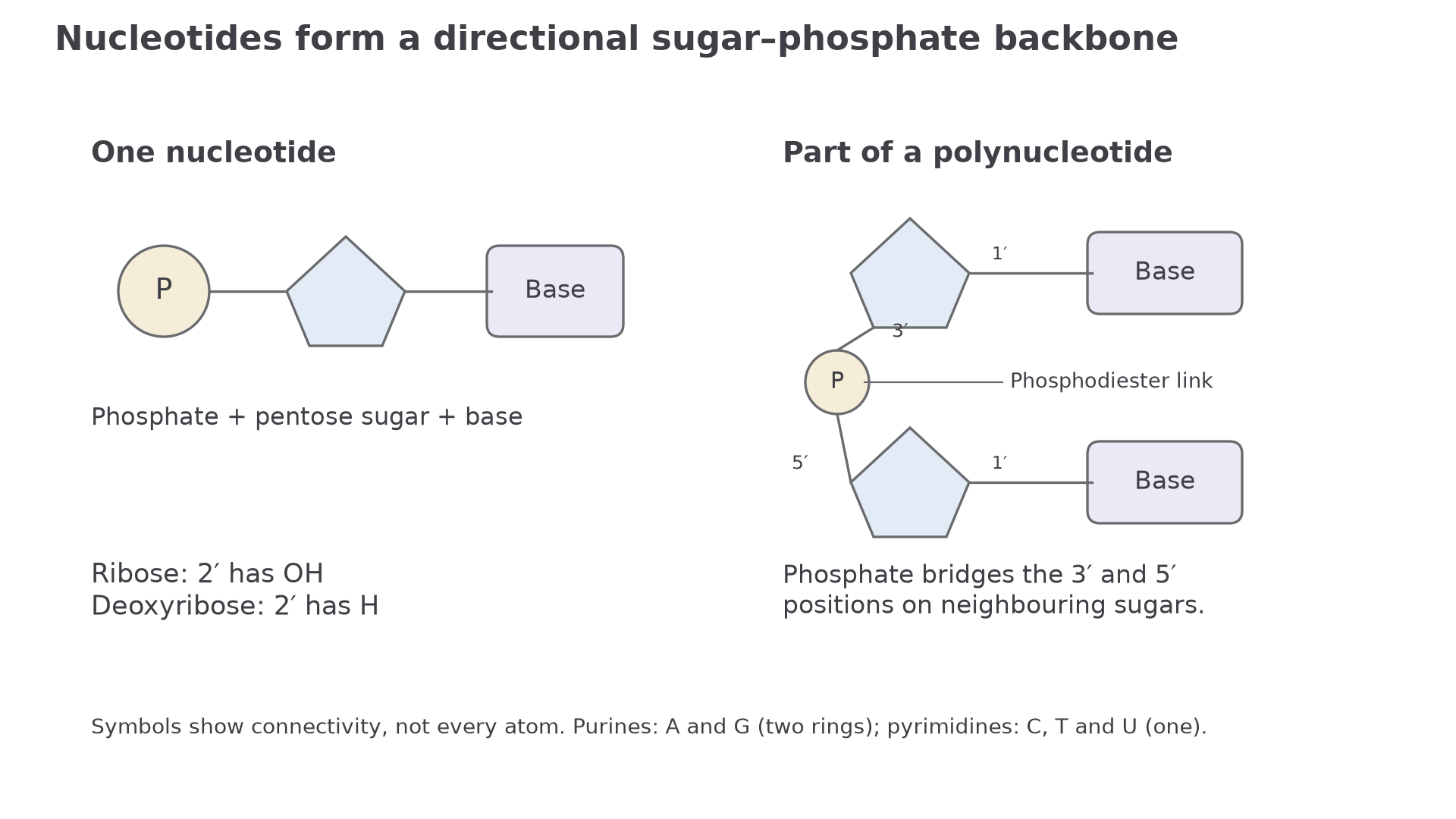
The diagram separates two ideas that are often blurred. One nucleotide has three components. A polynucleotide is many nucleotides joined together, with the sugars and phosphates forming a repeating backbone.
DNA and RNA nucleotides
Ribose has an OH group at carbon 2′; deoxyribose has H at that position, so it contains one less oxygen atom. The prime mark distinguishes sugar-carbon numbering from numbering in the base. A five-membered sugar ring contains four carbons and one oxygen; the fifth carbon lies outside the ring.
OCR expects you to identify the differences between DNA nucleotides and RNA nucleotides. The most important difference is the type of pentose sugar. DNA nucleotides contain deoxyribose. RNA nucleotides contain ribose.
The bases also differ. DNA nucleotides can contain adenine, guanine, cytosine or thymine. RNA nucleotides can contain adenine, guanine, cytosine or uracil.
| Feature | DNA nucleotide | RNA nucleotide |
|---|---|---|
| Pentose sugar | Deoxyribose | Ribose |
| Bases that may be present | Adenine, guanine, cytosine, thymine | Adenine, guanine, cytosine, uracil |
| Base found here but not in the other nucleic acid | Thymine | Uracil |
The bases can also be grouped by ring type. Adenine and guanine are purines. Cytosine, thymine and uracil are pyrimidines. Purines have two fused rings, whereas pyrimidines have one ring. This difference in size helps explain why pairing one purine with one pyrimidine gives DNA a regular width.
In an OCR-style answer, "DNA has thymine and RNA has uracil" is incomplete if the question asks for nucleotide differences. Include the pentose sugar: deoxyribose in DNA nucleotides and ribose in RNA nucleotides.
Later lessons use base pairing, hydrogen bonds, antiparallel strands and the double helix. Keep those ideas out of your answer unless the question has clearly moved on to DNA structure.
Purines and pyrimidines
Purines and pyrimidines are categories of nitrogenous base. The safest way to learn them is as two short groups:
| Group | Bases |
|---|---|
| Purines | Adenine and guanine |
| Pyrimidines | Cytosine, thymine and uracil |
A useful check is that the two purines are present in both DNA and RNA nucleotides. Cytosine is also present in both, but thymine is associated with DNA nucleotides and uracil with RNA nucleotides.
Identifying a nucleotide component
A student is told that molecule X is a nitrogenous base found in RNA but not DNA. The phrase "found in RNA but not DNA" points to uracil. Uracil is a pyrimidine, so the full identification is "uracil, a pyrimidine base".
Notice the order of reasoning: first identify the base from the DNA/RNA clue, then classify it as a purine or pyrimidine. Do not call the whole nucleotide a purine or a pyrimidine; only the nitrogenous base is being classified.
Phosphodiester bonds in polynucleotides
In a nucleotide the base attaches to carbon 1′ of the sugar. Along a nucleic-acid strand, phosphate links the 3′ position of one sugar to the 5′ position of the next. Each phosphate therefore links two sugars through ester linkages: this is the meaning of phosphodiester. The 5′ and 3′ ends are chemically different, giving the chain direction. A linear chain of 50 nucleotides contains 49 links; complete hydrolysis of those links uses 49 water molecules. A circular chain would have 50 links, so the shape must be specified before applying the n−1 rule.
A polynucleotide is a polymer made from many nucleotide monomers. Adjacent nucleotides are joined by phosphodiester bonds. A phosphodiester bond is a covalent bond involving a phosphate group and the pentose sugars of neighbouring nucleotides.
During synthesis, phosphodiester bonds form between nucleotides. Joining nucleotide units is represented by the condensation model at this level, with water released as the covalent linkage forms. During breakdown, phosphodiester bonds are broken. This is hydrolysis, so water is used to break the bond.
Phosphodiester bond
A covalent bond that links nucleotides in a polynucleotide by joining the phosphate group of one nucleotide to the pentose sugar of another.
The repeated sugar-phosphate-sugar-phosphate pattern is called the sugar-phosphate backbone. The nitrogenous bases project from this backbone. At this point, do not add hydrogen bonds or complementary base pairs to your answer unless the question asks about DNA structure rather than a single polynucleotide.
Classifying bond changes
A short polynucleotide is synthesised from separate nucleotides. Because nucleotide monomers are being joined into a polymer, phosphodiester bonds are formed. If the same polynucleotide is digested into separate nucleotides, phosphodiester bonds are broken by hydrolysis.
That distinction is a common mark-scheme hinge: formation for synthesis, breakage for breakdown.
Using models to inspect nucleotide structure
Rotate and zoom the model, select a nucleotide, and display its atoms and bonds. Locate the five sugar carbons, distinguish the 2′ group, trace the base attachment at 1′, then follow the phosphate bridge to the next sugar. Change between a simplified backbone display and an atom-and-bond display to check what the simplified line represents. Record the model/file identity and annotated observations so another learner can check the identifications; a label alone is weaker evidence than the actual atoms when the structure is available.
This specification point is linked to PAG10, which can involve computer modelling. A molecular model such as RasMol or Mol* can help you inspect where the phosphate groups, pentose sugars and nitrogenous bases sit in a nucleic-acid structure. For this lesson, the useful modelling skill is not "memorise a pretty shape"; it is using the model to make accurate identifications.
A good modelling note might record:
| Model observation | Biological interpretation |
|---|---|
| Repeating phosphate and sugar units | Evidence of a sugar-phosphate backbone |
| Bases attached to sugars | Bases are components of nucleotides, not separate monomers in the polymer |
| Ribose or deoxyribose label in the model file | Helps decide whether a nucleotide belongs to RNA or DNA |
| Bond between neighbouring sugar-phosphate units | Identifies where phosphodiester bonds link nucleotides |
A static structural model does not show the rate or conditions of nucleotide synthesis/breakdown in a living cell. Missing atom or molecule labels can also limit whether the sugar is ribose or deoxyribose. Use the model as structural evidence and interpret it with the appropriate biological terms.
Quick Recap
A nucleotide includes phosphate, pentose sugar and nitrogenous base. DNA and RNA differ in sugar and T/U use. Phosphodiester bonds form the polynucleotide backbone; bases are not the whole monomer.