5.2.1(c)(i)-(ii) - Photosynthetic pigments and TLC
In this lesson you are learning why plants need several photosynthetic pigments, how those pigments are arranged in photosystems, and how thin layer chromatography can separate pigments from leaf extract. This matters because pigments are the first link between light energy and the chemical reactions of photosynthesis. The practical focus is evidence: a chromatogram lets you measure how far different pigments move and use those measurements carefully.
Why Pigments Matter
A photosynthetic pigment is a molecule that absorbs light energy. In plants, important photosynthetic pigments include chlorophyll a, chlorophyll b and carotenoid pigments. They are found in the thylakoid membranes of chloroplasts, where the light-dependent reactions of photosynthesis begin.
Photosynthetic Pigment
A photosynthetic pigment is a light-absorbing molecule that helps capture light energy for photosynthesis.
Visible light contains a range of wavelengths, and pigments do not all absorb the same wavelengths equally well. A pigment absorbs some wavelengths and reflects or transmits others. This is why leaves appear green: much green light is not absorbed as strongly as red and blue light by chlorophyll pigments.
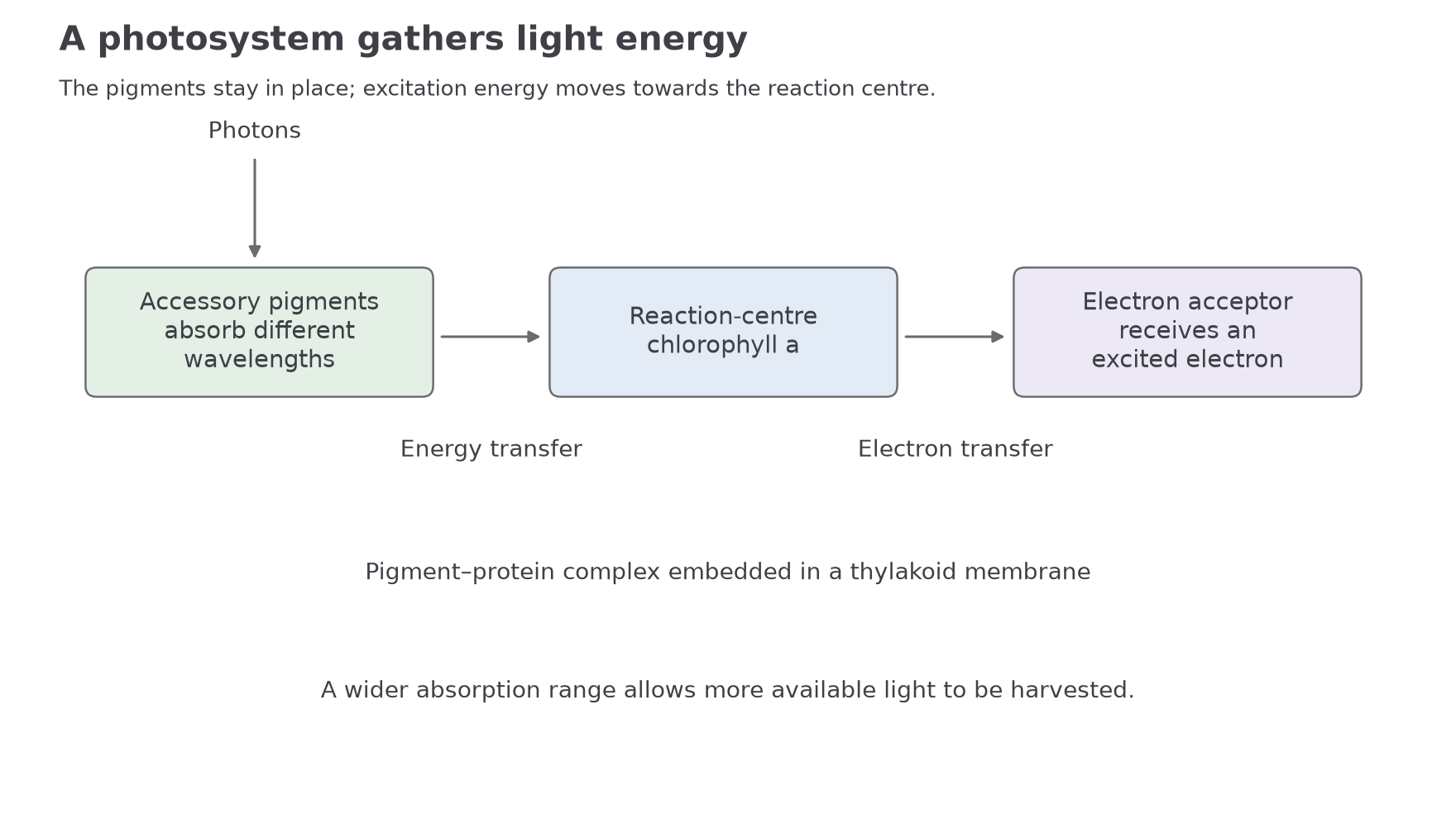
Chlorophyll a is the main pigment at the reaction centre of a photosystem. Other pigments are often called accessory pigments because they absorb additional wavelengths of light and pass the energy towards chlorophyll a. The importance of having several pigments is that the plant can harvest a wider range of wavelengths than chlorophyll a alone could absorb.
Accessory pigments do not replace chlorophyll a. They widen the range of light energy that can be harvested and funnel that energy towards the reaction centre.
When explaining pigment importance, link "different pigments" to "different wavelengths" and then to "energy transfer to the reaction centre". Naming pigment colours alone is rarely enough.
Photosystems
A photosystem is a protein-pigment complex in a thylakoid membrane. It contains many pigment molecules arranged so that light energy can be collected and passed towards a reaction centre.
Photosystem
A photosystem is a protein-pigment complex in a thylakoid membrane that contains light-harvesting pigments and a reaction centre.
The light-harvesting system acts like an antenna. Pigments in the antenna absorb photons of light. The energy is then transferred between neighbouring pigments until it reaches chlorophyll a in the reaction centre. At the reaction centre, the energy can be used to excite an electron and start the chemical events of the light-dependent reaction.
[DIAGRAM: photosystem-light-harvesting: Lesson 123: Photosynthetic Pigments And TLC - diagram 01; asset_slug: 123_m05_2_1_photosynthetic_pigments_and_tlc__diagram_01; recommended_method: drawn_biology; description: A thylakoid membrane photosystem showing accessory pigments in a light-harvesting system transferring energy towards chlorophyll a in the reaction centre.]
This lesson does not require the full electron pathway, photolysis, ATP production or reduced NADP production. Those belong to the light-dependent stage. Here the key idea is earlier in the sequence: pigments make it possible for light energy to be captured and delivered to the reaction centre efficiently.
A common mistake is to say that accessory pigments "make photosynthesis happen" without saying how. The creditworthy link is that they absorb light energy at different wavelengths and pass that energy to the reaction centre of a photosystem.
TLC Method
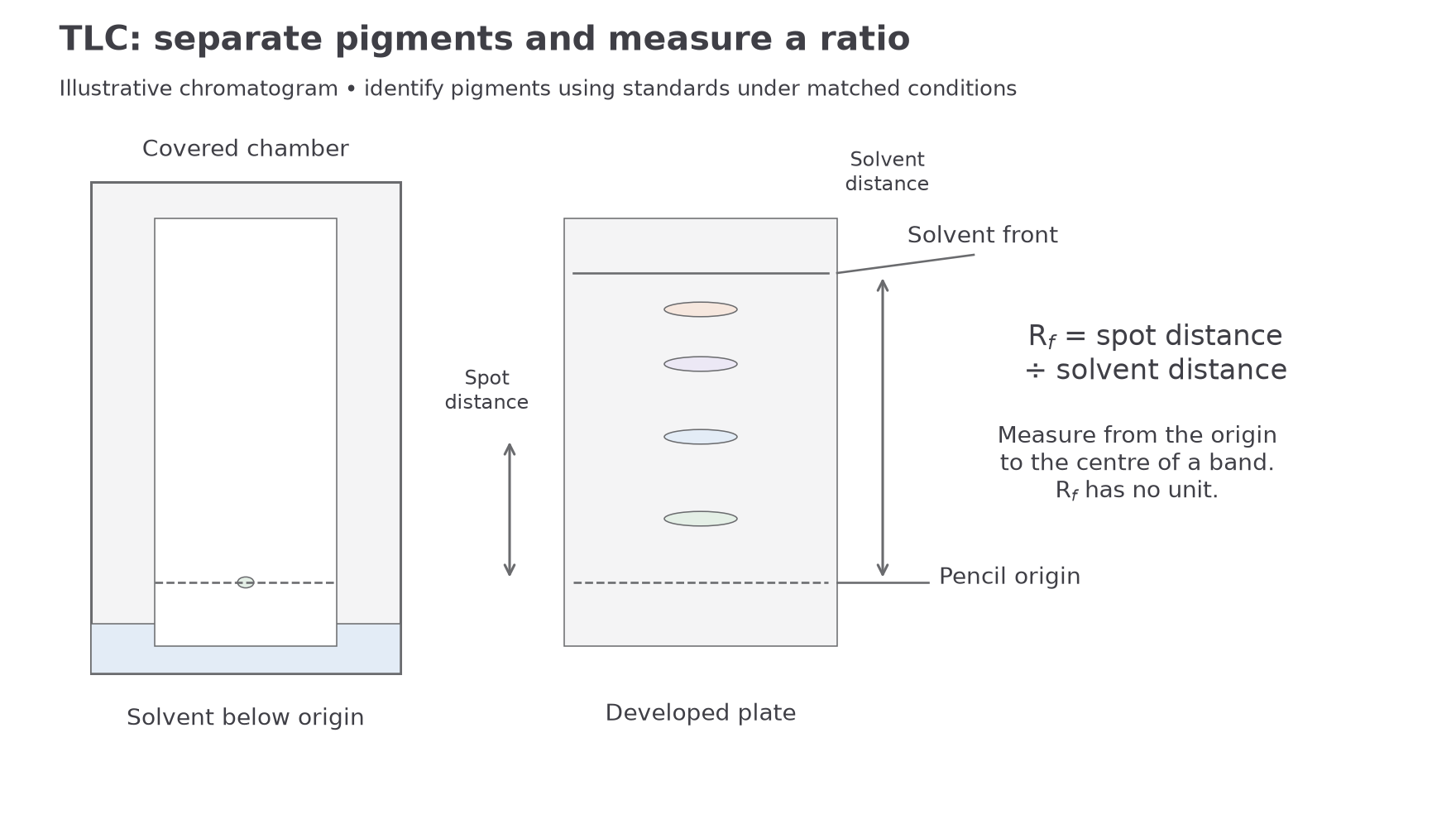
Thin layer chromatography, or TLC, separates pigments because different pigment molecules move different distances with the solvent. The TLC plate has a stationary phase, usually a thin solid layer such as silica gel on a support. The mobile phase is the solvent that moves up the plate and carries dissolved pigments.
Stationary Phase
The stationary phase is the material that stays fixed during chromatography, such as the thin solid layer on a TLC plate.
Mobile Phase
The mobile phase is the solvent that moves through the stationary phase and carries dissolved pigments with it.
A typical leaf pigment TLC practical follows this route:
| Method step | Why it matters |
|---|---|
| Grind leaf tissue with a suitable solvent | Extracts pigments from the cells and chloroplasts |
| Draw a pencil baseline near the bottom of the TLC plate | Gives a fixed origin that will not dissolve and move |
| Apply extract with a capillary tube; dry and re-spot on the same small origin | Reduces smearing and makes separated pigments easier to measure |
| Stand the plate in a covered chamber with solvent below the baseline | Prevents the sample washing directly into the solvent reservoir |
| Let the solvent rise up the plate | Pigments separate because they differ in solubility in the mobile phase and attraction to the stationary phase |
| Remove the plate before the solvent reaches the top and mark the solvent front immediately | Preserves the distance needed for Rf calculation |
[DIAGRAM: plant-pigment-tlc: Lesson 123: Photosynthetic Pigments And TLC - diagram 02; asset_slug: 123_m05_2_1_photosynthetic_pigments_and_tlc__diagram_02; recommended_method: drawn_biology; description: TLC of leaf photosynthetic pigments showing sample spot on pencil baseline, solvent below baseline, developed pigment bands, solvent front and distance measurements for Rf.]
Continue this lesson.
You’re previewing NovaLearn without an account. Create a free account to read the rest.
Create free account