4.2.1(a) - Levels of biodiversity
Biodiversity is not just a long species list. In this lesson you will learn how the same biological area can be described at three different levels: habitat biodiversity, species biodiversity and genetic biodiversity. That distinction matters because a question about habitats needs a different answer from a question about species richness, species evenness or variation within one species.
Choosing a level
Biodiversity means the variety of living organisms in an area, considered at a particular scale. The important word is scale. A valley, a woodland edge, a meadow, a stream and a group of individuals from one species can all be discussed in terms of biodiversity, but they are not asking the same biological question.
Biodiversity can be described at three levels:
- habitat biodiversity: the variety of habitats in an area
- species biodiversity: the variety of species in a habitat or area, including richness and evenness
- genetic biodiversity: the variety of genes or alleles within one species
The levels are connected, but they are not interchangeable. A landscape with woodland, meadow and a stream has habitat biodiversity because it contains different habitat types. A single meadow may have species biodiversity if it contains many different plant and animal species. A population of one plant species may have genetic biodiversity if its individuals carry different alleles.
[DIAGRAM: biodiversity_levels_map: Lesson 079: Levels of biodiversity - diagram 01; asset_slug: 079_m04_2_1_levels_of_biodiversity__diagram_01; recommended_method: drawn_biology; description: 16:9 NovaLearn-style three-level map distinguishing habitat biodiversity, species biodiversity, and genetic biodiversity with OCR examples and key decision cues.]
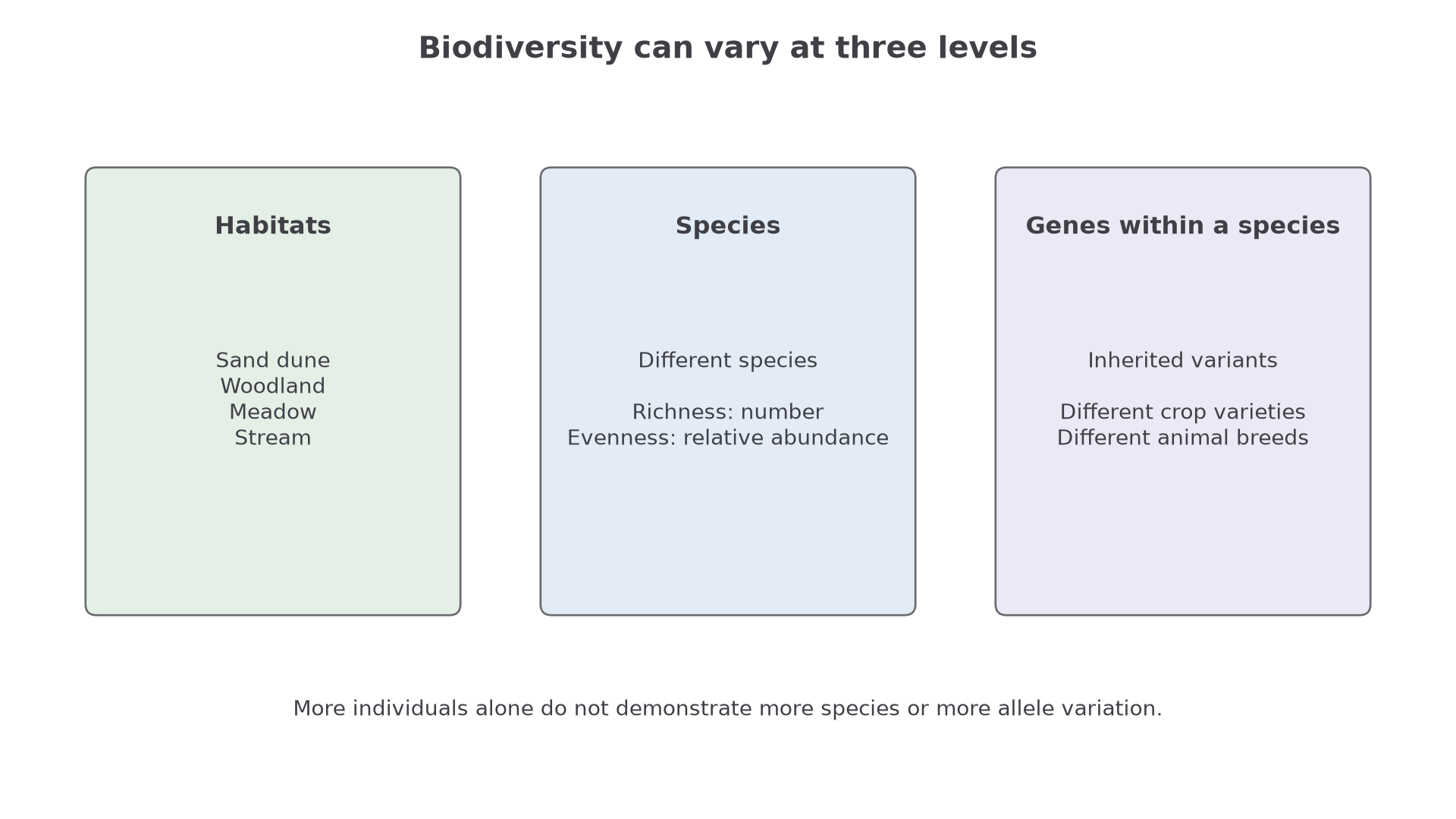
The three descriptions refer to different units of variation: habitats, species, and inherited variation within a species.
Biodiversity can be considered at different levels. Do not answer every biodiversity question as if it only means "number of species".
Habitat biodiversity
Habitat biodiversity is the variety of different habitats in an area. A habitat is the place where an organism lives, including the physical conditions and the other organisms around it. At this level, the focus is on habitat types, not on counting every species inside them.
For example, a coastal reserve might contain sand dunes, woodland, meadows and streams. Even before you count any individual species, that reserve has habitat biodiversity because it includes several distinct habitats. A smaller site made only of intensively managed grassland would have lower habitat biodiversity, even if there were many individual grass plants.
This level is useful because different habitats provide different sets of conditions. Sand dunes are dry, exposed and shifting. Woodland is shaded and structured into layers. Meadows are open and often rich in flowering plants. Streams are aquatic habitats with flowing water. Each habitat can support different communities, but the word habitat biodiversity itself is about the variety of habitats present.
If a question compares sand dunes, woodland, meadows or streams, it is usually pointing at habitat biodiversity. Do not switch to species richness unless the question asks about the number of species.
Keep the comparison scale consistent. A larger mapped area may contain more habitats simply because it includes more land, so record survey area and habitat definitions. Habitat variety can support species variety by providing different resources and abiotic conditions, but four habitat types do not guarantee more species than every single-habitat site.
Species biodiversity
Species biodiversity is the variety of species in a habitat or area. It has two components: species richness and species evenness.
Species richness
The number of different species in a habitat or area.
Continue this lesson.
You’re previewing NovaLearn without an account. Create a free account to read the rest.
Create free account