5.2.2(c) - Glycolysis
Glycolysis is the first stage in transferring energy from glucose into ATP. In this lesson you will learn where glycolysis happens, how one six-carbon glucose molecule is split and oxidised, and why the products are described as a small ATP yield plus reduced NAD. Track carbon, phosphate and hydrogen separately to explain the small net ATP gain.
Site And Overview
Glycolysis takes place in the cytoplasm of cells. It does not require the mitochondrion as its site, even in eukaryotic cells that have mitochondria.
Glycolysis
The stage of cellular respiration in which glucose is phosphorylated, split into two triose phosphate molecules, and oxidised to pyruvate with a small yield of ATP and reduced NAD.
The word glycolysis means "splitting sugar", but the process is more than cutting glucose in half. The glucose molecule is first made more reactive by phosphorylation, then the six-carbon intermediate is split into two three-carbon molecules, and then each three-carbon molecule is oxidised to pyruvate.
[DIAGRAM: glycolysis_pathway_overview: Lesson 129: Glycolysis - diagram 01; asset_slug: 129_m05_2_2_glycolysis__diagram_01; recommended_method: drawn_biology; description: A clean 16:9 grey-on-white pathway diagram showing cytoplasmic glycolysis from glucose to hexose bisphosphate, two triose phosphate molecules and two pyruvate molecules, with ATP investment, oxidation, reduced NAD and net ATP yield annotated.]
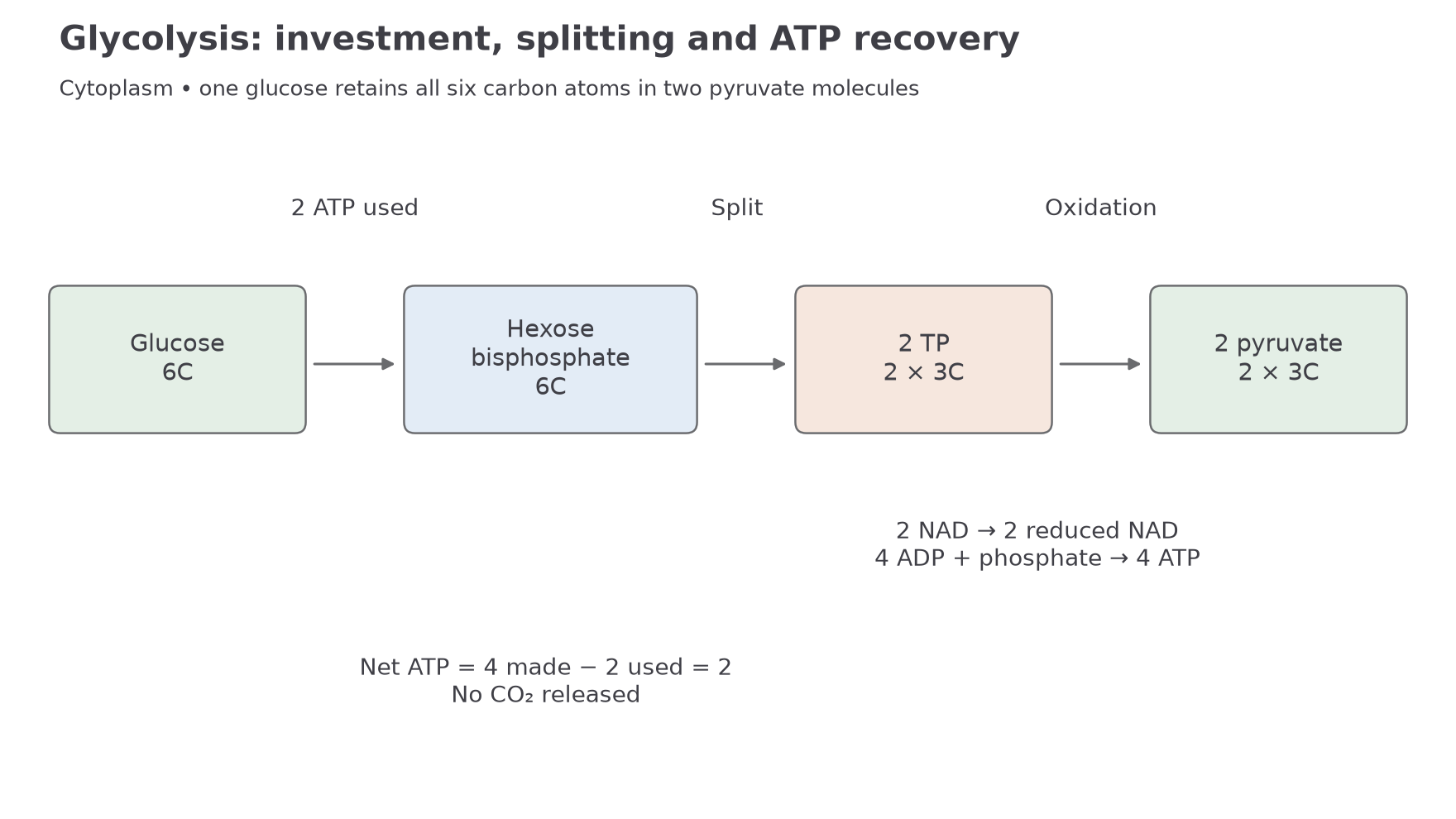
The pathway is best read per glucose molecule:
| Stage idea | Carbon accounting | Main energy or carrier change |
|---|---|---|
| glucose is phosphorylated | 6C remains 6C | ATP is used |
| hexose bisphosphate is split | 6C becomes two 3C molecules | two triose phosphate molecules form |
| triose phosphate is oxidised | each 3C becomes a 3C pyruvate | reduced NAD and ATP are produced |
For site questions, write "cytoplasm" or "cytosol". Do not give "mitochondrion" for glycolysis; mitochondrial sites are tested in later respiration stages.
Phosphorylation And Splitting
The first required idea is phosphorylation. Phosphorylation means adding phosphate groups to a molecule. In glycolysis, ATP provides phosphate groups to glucose, producing hexose bisphosphate.
Hexose Bisphosphate
A phosphorylated six-carbon sugar formed when glucose has phosphate groups added during the early stage of glycolysis.
This step uses ATP, so glycolysis begins with an energy investment. That can feel surprising because respiration is about making ATP, but the investment makes the six-carbon sugar reactive enough to be split in a controlled enzyme-catalysed pathway.
After phosphorylation, hexose bisphosphate is split into two triose phosphate molecules. "Triose" means three-carbon sugar, so the carbon accounting is:
Carbon Split
No carbon dioxide is released at this stage. The six carbon atoms from glucose are still present, now divided between two triose phosphate molecules.
The first half of glycolysis uses ATP to phosphorylate glucose, then splits one six-carbon molecule into two three-carbon triose phosphate molecules.
Two ATP molecules are invested per glucose. This is phosphorylation of a sugar, not substrate-level phosphorylation of ADP. The similar word describes phosphate addition in both cases, but the recipient and the direction of ATP use are different. Enzyme control also matches glycolytic flux to demand: in a supplied regulatory model, high ATP can inhibit a glycolytic enzyme at an allosteric site, while low-energy signals can increase its activity. Inhibition by a regulator is not necessarily denaturation.
Continue this lesson.
You’re previewing NovaLearn without an account. Create a free account to read the rest.
Create free account