6.3.2(a) - Population size and carrying capacity
Population size is never just "how many organisms there happen to be". It is the outcome of survival, reproduction, movement and the environment's ability to keep supporting that species. In this lesson you will learn how limiting factors set carrying capacity, how that affects final population size, and how to interpret evidence about population change.
Population Size As A Balance
A population is a group of organisms of the same species living in the same area at the same time. Population size is the number of individuals in that population.
The size of a population changes when individuals are added or removed. Four processes do this directly:
| Process | Effect on population size |
|---|---|
| births | increase population size |
| deaths | decrease population size |
| immigration | increase population size when individuals enter the population |
| emigration | decrease population size when individuals leave the population |
So the first idea is simple: a population increases when additions are greater than removals, and decreases when removals are greater than additions.
Population size
The number of individuals of one species in a population at a particular time.
Final population size
The long-term population size reached under the conditions in that environment, often after growth has slowed because limiting factors restrict further increase.
This does not mean every individual is identical, or that every year is the same. It means that, at population level, the balance of births, deaths, immigration and emigration determines whether the population is growing, shrinking or staying about the same.
Calculating net change
A population starts with 500 animals. During one year there are 80 births, 55 deaths, 20 immigrants and 35 emigrants. Net change = 80 + 20 − 55 − 35 = +10 animals, so the final count is 510 and the percentage increase is 10/500 × 100 = 2.0%. Counts and per-capita rates are different: 80 births in 500 animals is 0.16 births per original individual per year.
Limiting Factors
A population does not keep increasing forever because every environment has constraints. A limiting factor is any factor that restricts population growth, survival or reproduction in that environment.
Limiting factor
A factor that restricts the growth, survival, reproduction, abundance or distribution of a population.
Limiting factors can be abiotic or biotic.
| Type of limiting factor | Examples | How it can affect population size |
|---|---|---|
| abiotic | temperature, light intensity, water availability, oxygen concentration, mineral ions, space | reduces survival or reproduction if conditions are outside the species' tolerance or resources are too scarce |
| biotic | food supply, disease, parasites, predation, competition for resources | changes birth rate, death rate, immigration or emigration |
For example, a plant population may be limited by light beneath a dense canopy, water during drought, or mineral ions in poor soil. A herbivore population may be limited by food, disease, predators, nesting sites or competition within the same species.
The key is to identify the factor that is actually restricting the population at that time. A pond may contain plenty of oxygen but little space for nesting. In that case, oxygen is not the limiting factor for that population, even though oxygen matters biologically.
When asked to explain a limiting factor, link it to survival or reproduction. "Less food" is a start; "less food reduces energy available for growth and reproduction, so birth rate falls and death rate may rise" is a biological explanation.
Some limiting factors become stronger as population density increases. Competition for food or space is usually like this: the more individuals there are, the less resource is available per individual. Other limiting factors, such as an extreme frost, flood or pollutant event, can affect a population whatever its size. Density-dependent feedback helps explain why net growth slows as a population becomes crowded.
Carrying Capacity
Carrying capacity is the maximum population size that a particular environment can support for a particular species over time.
Carrying capacity
The maximum population size of a species that an environment can support over time under its current conditions.
It is not a magic fixed number for all species. The carrying capacity of a woodland for oak trees is not the same as its carrying capacity for aphids, and both can change if light, nutrients, water, disease or management change.
Population growth often follows a curve like this:
[DIAGRAM: population_growth_to_carrying_capacity: Lesson 169: Population size, limiting factors and carrying capacity - diagram 01; asset_slug: 169_m06_3_2_population_size_limiting_factors_and_carrying_capacity__diagram_01; recommended_method: matplotlib; description: Deterministic 16:9 line graph showing population size against time, early slow growth, rapid growth, slowing as limiting factors intensify, and fluctuation around carrying capacity.]
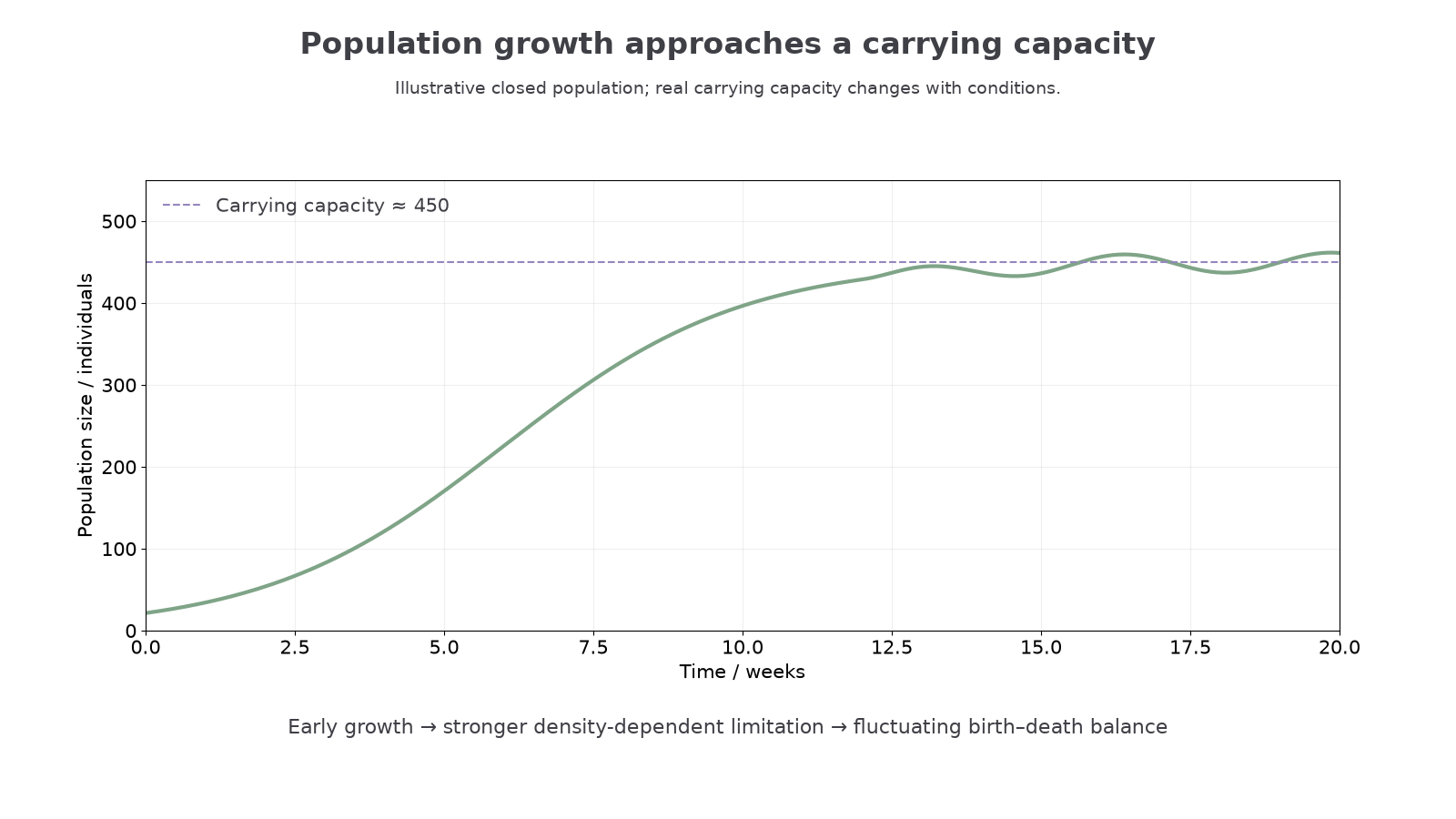
Read the curve as a biological story:
| Region of curve | What is happening biologically |
|---|---|
| slow initial growth | there may be few breeding individuals, or individuals may still be establishing in the habitat |
| rapid growth | resources are plentiful, so birth rate is greater than death rate |
| slowing growth | limiting factors intensify; competition, disease, waste, predation or resource shortage reduce net growth |
| around carrying capacity | births and immigration are roughly balanced by deaths and emigration, so population size changes little overall |
Real populations often fluctuate around carrying capacity rather than forming a perfectly flat line. Weather, disease, resource availability and random variation can shift the balance from year to year.
Estimating carrying capacity from data
A population of insects on one plant species is recorded over seven weeks.
Continue this lesson.
You’re previewing NovaLearn without an account. Create a free account to read the rest.
Create free account