4.2.2(d) - Classification and phylogeny
Classification is the organised grouping and naming of organisms. Phylogeny is about evolutionary history: which organisms share ancestors, and how recently those ancestors were shared. In this lesson, you will connect the two ideas so that a classification table or a simple evolutionary tree becomes evidence you can interpret, not just a list to memorise.
Classification and phylogeny
A classification system places organisms into groups called taxa. The familiar hierarchy, from broad to narrow, is domain, kingdom, phylum, class, order, family, genus and species. That hierarchy is useful because it gives biologists a shared language for organising living things.
Phylogeny asks a different but connected question: what is the evolutionary relationship between organisms?
Phylogeny
The evolutionary history and relationships of an organism or group of organisms.
The relationship between classification and phylogeny is that modern classification aims to reflect phylogeny. In other words, organisms grouped together should, as far as the evidence shows, share a common ancestor. A narrow shared taxon, such as the same genus or family, usually suggests a more recent common ancestor than a broad shared taxon, such as the same class or phylum.
That does not mean classification is fixed. It is a human system built from evidence. When better evidence changes scientists' understanding of relationships, the classification may change too.
| Idea | Main question | Good answer wording |
|---|---|---|
| Classification | How are organisms grouped and named? | "These species are in the same family." |
| Phylogeny | How are organisms evolutionarily related? | "These species share a more recent common ancestor." |
| Relationship | Why are they connected? | "Classification should reflect evolutionary relationships." |
For this specification point, the strongest wording is usually about common ancestry. "They look similar" is weaker than "they share a more recent common ancestor".
A common ancestor is an ancestral population from which lineages diverged. Two living species normally share that ancestor; neither living species has to be the ancestor of the other.
Reading relatedness
A phylogenetic tree is a diagram that represents a hypothesis about evolutionary relationships. The tips of the branches represent the organisms or groups being compared. A branch point, often called a node, represents a common ancestor that is inferred from evidence.
The key rule is simple:
Two organisms are more closely related if they share a more recent common ancestor.
[DIAGRAM: phylogeny-classification-map: Lesson 087: Classification and phylogeny - diagram 01; asset_slug: 087_m04_2_2_classification_and_phylogeny__diagram_01; recommended_method: drawn_biology; description: A simple rooted phylogenetic tree with five labelled species, labelled most recent common ancestor nodes, and classification brackets showing how nested taxa can reflect shared ancestry.]
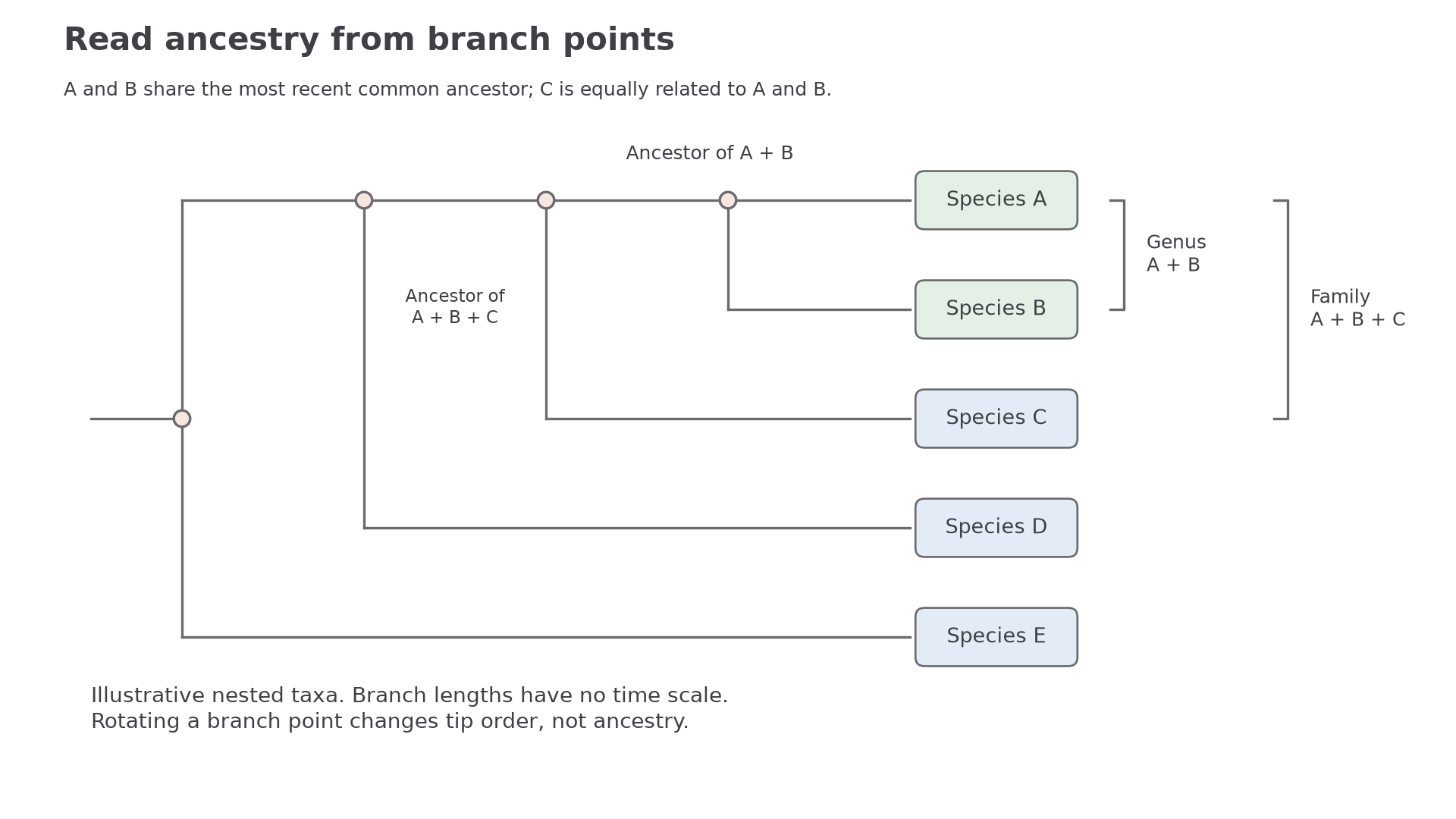
In the diagram, species A and species B share the most recent common ancestor shown, so they are the most closely related pair. Species C shares an older common ancestor with A and B, so it is related to them, but less closely. Species E is on a branch that separated earlier, so it is the least closely related to A among the species shown.
Be careful with two common tree-reading errors. First, the left-to-right order of tips does not by itself show relatedness; branches could be rotated around a node without changing the relationships. Second, branch length does not show time or amount of evolutionary change unless the diagram includes a scale saying that it does.
Using a common ancestor
Suppose A and B descend from a common ancestor that is itself descended from the older common ancestor of A, B and C.
- Identify the most recent common ancestor of A and B.
- Identify the most recent common ancestor of A and C.
- Trace the branching relationships: the A-B ancestor is a descendant of the older ancestor shared with C.
The A-B common ancestor is more recent, so A and B are more closely related than A and C.
C is equally closely related to A and B: tracing from C to either tip reaches the same common ancestor. A longer line on the page does not make A older or more evolved. All the living tips have continued evolving since their lineages diverged. The diagram shows branching order only, not dated intervals.
Continue this lesson.
You’re previewing NovaLearn without an account. Create a free account to read the rest.
Create free account