6.3.2(d) - Sustainable management of timber and fishing
Sustainable resource use is not the same as leaving an ecosystem untouched. In this lesson, you will learn how an ecosystem can be managed so that people obtain timber or fish while the resource can keep being replaced. The central biological idea is simple but powerful: harvesting must be limited by growth, reproduction, regeneration and the wider health of the ecosystem.
Sustainable Resource Use
An ecosystem can provide resources because organisms grow and reproduce. Trees add biomass by photosynthesis and growth. Fish populations are replenished when adults survive long enough to reproduce and young fish grow into adults. A resource is used sustainably when that replacement can continue over time.
Sustainable Management
Sustainable management is the planned use of an ecosystem so that resources can be harvested while the ecosystem remains able to replace them in the future.
The key word is planned. If people simply remove as much timber or as many fish as possible, the harvest may be high for a short time, but the resource can decline. If managers use evidence about growth, regeneration, breeding and ecosystem damage, they can set rules that allow a continuing yield.
Sustainable Yield
A sustainable yield is a harvest that does not exceed the rate at which the resource is replaced by growth, reproduction or restocking.
This lesson is about managed resource use, not complete preservation. A preserved ecosystem would be protected from exploitation as far as possible. A sustainably managed ecosystem may still be harvested, but harvesting is controlled so that future productivity, biodiversity and ecosystem functions are not destroyed.
Two examples are required here:
| Managed ecosystem | Resource obtained | Biological replacement that must be protected |
|---|---|---|
| forest or woodland | timber | tree growth, seedling establishment, regrowth or restocking |
| fishery or marine ecosystem | fish | survival of breeding adults, reproduction, recruitment of young fish |
The same argument works for both examples. Managers need to know how much can be removed, how the population or forest is replacing itself, and what other parts of the ecosystem are affected by the harvest.
For this lesson, sustainable does not mean "no cutting" or "no fishing". It means managed harvesting that can continue because the biological resource and ecosystem are protected enough to replace the harvested material.
A management plan is sustainable only if monitoring shows that biological replacement and ecosystem function continue despite the harvest.
A timber budget
If 200 hectares add a net 5 m³ of timber per hectare per year, annual addition is 200 × 5 = 1000 m³. A harvest of 1200 m³ removes 200 m³ more than annual addition, so standing timber declines unless another input compensates. This simplified budget is an upper bound: managers must also allow for uncertain growth, storm or disease losses and habitat retention. Replacing one mature tree with one seedling does not instantly replace its biomass or ecological functions.
Timber Production
Timber comes from tree biomass. A forest managed for timber is therefore being managed as a biological production system as well as an ecosystem. The aim is to harvest wood without removing the forest's ability to keep producing wood in the future.
The simplest sustainable timber idea is a cycle: assess the woodland, remove timber according to a plan, and make sure new trees replace the harvested trees. In real forests this can be done in different ways, such as selective felling, thinning, coppicing, rotational harvesting, natural regeneration or planting. The suitability of each method depends on tree species, growth rate and habitat conditions.
[DIAGRAM: timber_management_cycle: Lesson 172: Sustainable ecosystem management for timber and fishing - diagram 01; asset_slug: 172_m06_3_2_sustainable_ecosystem_management_for_timber_and_fishing__diagram_01; recommended_method: drawn_biology; description: 16:9 NovaLearn-style cycle diagram showing survey/planning, planting or restocking, growth management, responsible harvest, habitat regeneration and sustainable yield in managed timber production.]
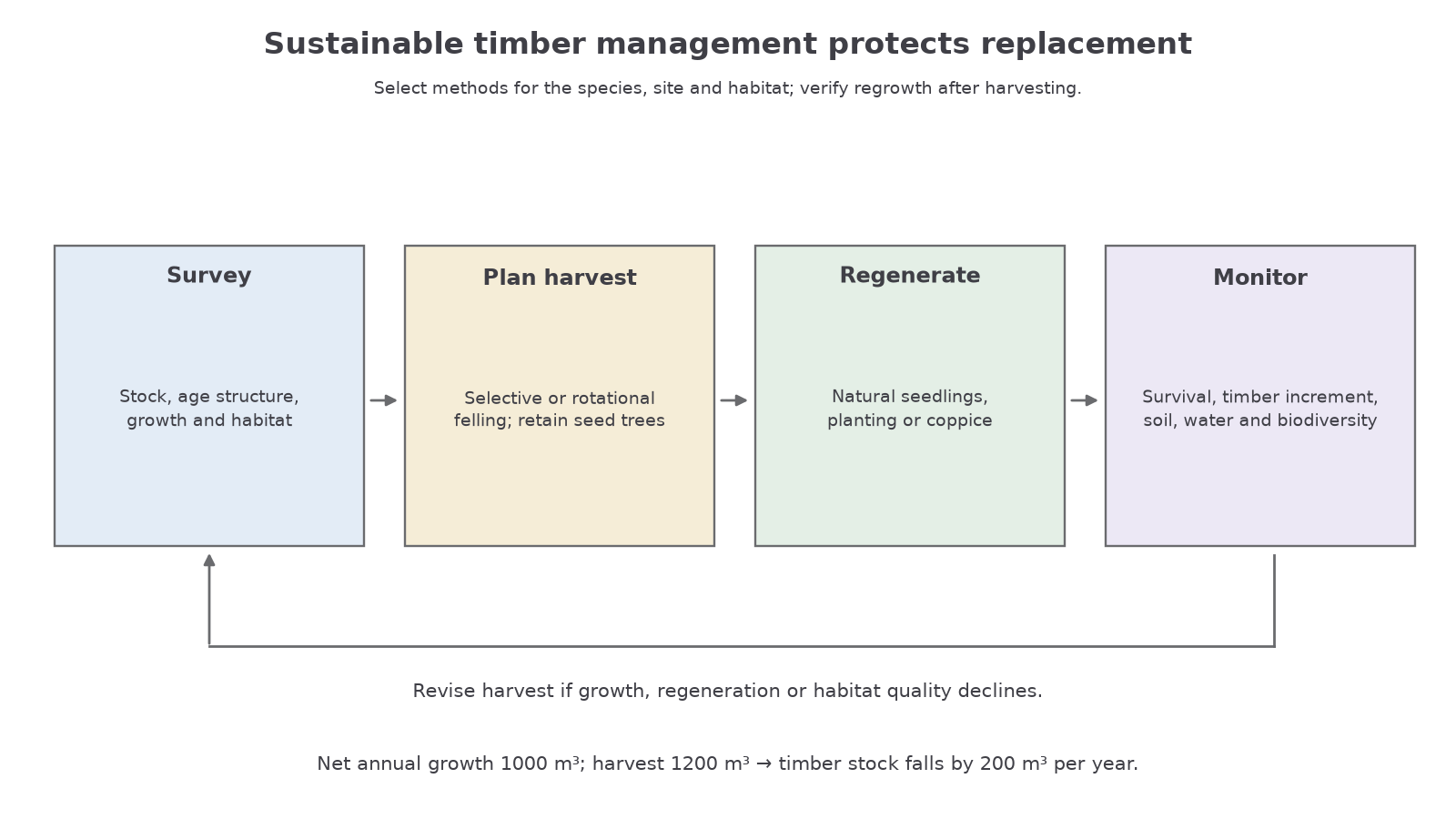
A good timber-management plan usually includes these linked decisions.
| Decision | How it supports sustainable timber production |
|---|---|
| survey tree stock and age structure | estimates how much timber is present and how much growth is occurring |
| harvest only selected trees or rotate harvested areas | prevents all productive trees being removed at once |
| plant, restock or encourage natural regeneration | replaces harvested trees so future timber can grow |
| use a mixture of species or age classes | reduces the risk that one disease, pest or environmental change damages the whole forest |
| retain some habitats, deadwood, soil cover and water protection | helps maintain biodiversity, nutrient recycling, soil structure and ecosystem resilience |
| monitor regrowth after harvest | checks whether the ecosystem is actually replacing the harvested timber |
Selective felling means removing particular trees rather than clearing every tree in an area. This can leave mature trees, younger trees and habitat structure in place. Rotational harvesting divides woodland into areas harvested at different times, so some areas are growing while others are ready for harvest. Coppicing cuts certain trees close to the base so new shoots grow from the stump; this can produce repeated harvests from the same plant if the species is suitable.
Restocking is important, but it is not the whole answer. Replanting one species in neat rows may produce future wood, but it may also leave the forest more vulnerable to pests, diseases or climate stress. Sustainable management considers future productivity and the wider ecosystem, including soil, water, biodiversity and resilience.
Linking a timber method to sustainability
A woodland manager removes only a proportion of mature trees each year and plants young trees in the gaps. The biological reasoning is:
- mature trees provide the timber harvest;
- younger trees and planted seedlings replace the harvested trees;
- the remaining woodland protects soil, habitats and some biodiversity;
- monitoring checks whether new trees survive and grow.
That is stronger than simply saying "trees are replanted". It explains how the ecosystem keeps producing timber.
The replacement step must be checked over time, because planting alone does not show that seedlings survive or the woodland remains productive.
Coppicing retains an established root system and dormant buds, allowing new shoots to grow after stems are cut near ground level. Pollarding cuts above browsing height; both require suitable species and recovery time. Cutting different compartments in different years creates a range of regrowth ages. Keeping seed trees, deadwood, riparian buffer strips and undisturbed soil supports regeneration and nutrient cycling alongside the wood harvest.
Continue this lesson.
You’re previewing NovaLearn without an account. Create a free account to read the rest.
Create free account