4.2.2(a)-(b) - Taxonomic hierarchy and binomial naming
Classification gives biologists a shared way to organise the huge variety of living organisms. In this lesson, you will learn the taxonomic hierarchy from domain to species, how a binomial scientific name is built, and why this naming system is useful when common names are unclear or different in different places.
Classification As A Hierarchy
Biological classification groups organisms into a hierarchy of named groups. A group at any level in the hierarchy is called a taxon; the plural is taxa. The hierarchy is nested, so a species belongs to a genus, that genus belongs to a family, that family belongs to an order, and so on.
Taxonomic hierarchy
The taxonomic hierarchy is the ordered system of classification ranks used to group organisms, from broad groups to more specific groups.
The order required here is:
| Broadest to narrowest rank | What happens as you move down the hierarchy |
|---|---|
| domain | the broadest grouping in this hierarchy |
| kingdom | a large group within a domain |
| phylum | a group within a kingdom |
| class | a group within a phylum |
| order | a group within a class |
| family | a group within an order |
| genus | a group of very closely related species |
| species | the narrowest standard rank in this hierarchy |
As you move from domain towards species, the group usually contains fewer organisms and those organisms usually share more features. This is why the hierarchy is useful: it does not just list organisms; it places them into nested groups that can be compared.
Be precise about the difference between a rank and a named taxon. “Family” is a rank. Suidae is a named family. “Genus” is a rank. Sus is a named genus.
If you are asked for the order of ranks, give the ranks, not example names. If you are asked for the name of a taxon at a rank, give the actual taxon name, such as Mammalia for class.
The hierarchy is a model of classification. Like all scientific models, it is useful because it helps organise evidence, but it can be revised when better evidence becomes available.
Nested taxa in mammals
A named taxon contains all the lower taxa assigned to it; the nesting lets us infer memberships that a table leaves unstated. The wild boar can be classified through the ranks like this:
| Rank | Example taxon for wild boar |
|---|---|
| domain | Eukaryota |
| kingdom | Animalia |
| phylum | Chordata |
| class | Mammalia |
| order | Artiodactyla |
| family | Suidae |
| genus | Sus |
| species | Sus scrofa |
[DIAGRAM: taxonomy_hierarchy_wild_boar: Lesson 085: Taxonomic hierarchy and binomial naming - diagram 01; asset_slug: 085_m04_2_2_taxonomic_hierarchy_and_binomial_naming__diagram_01; recommended_method: drawn_biology; description: A clean 16:9 hierarchy diagram showing nested taxonomic ranks from domain to species using the wild boar example, with rank labels on the left, example taxa in boxes, arrows showing increasing specificity, and a small note that the full species name is the binomial Sus scrofa.]
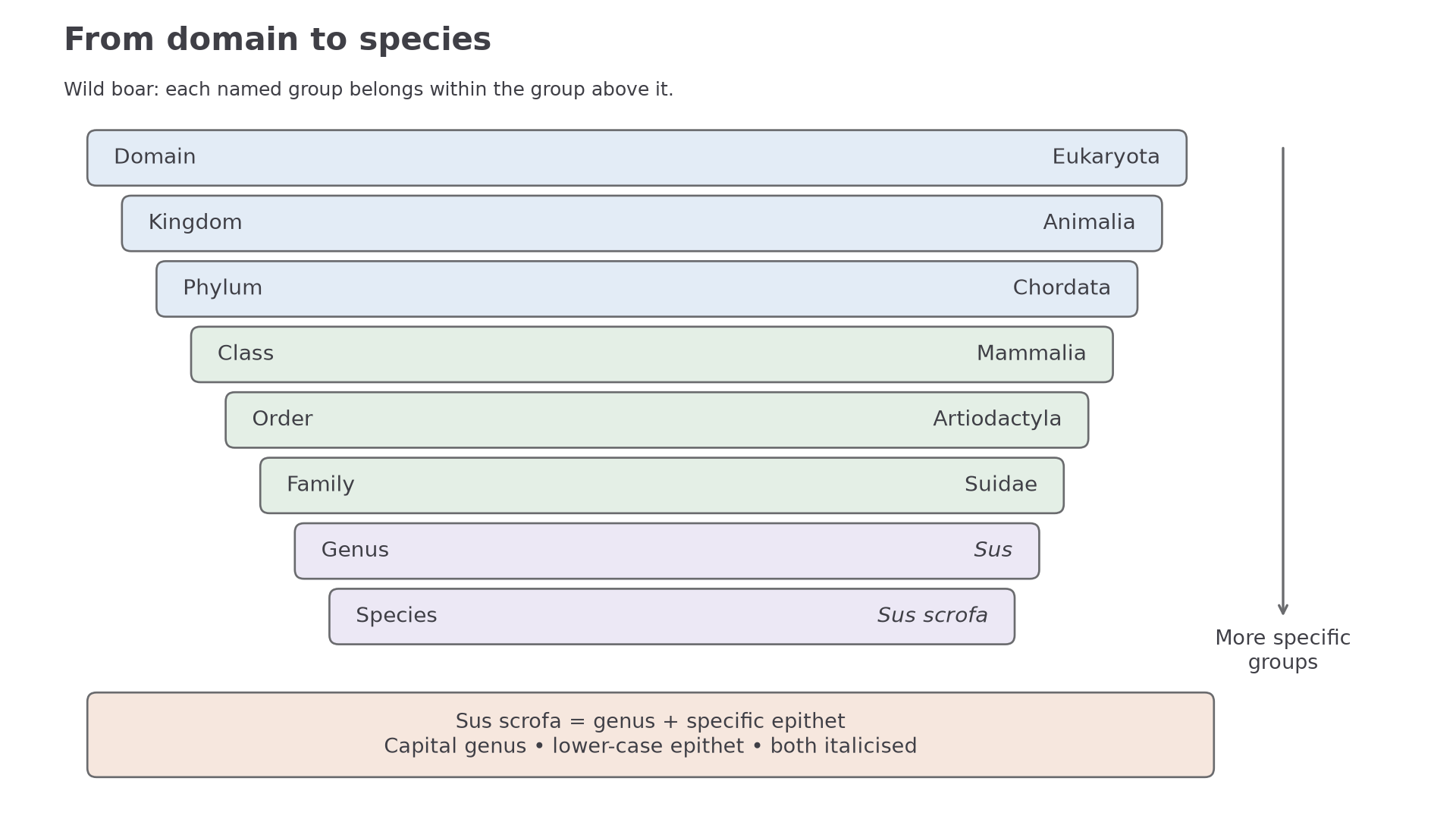
Notice two things in the example.
First, each lower rank sits inside the rank above it. The genus Sus is inside the family Suidae, which is inside the order Artiodactyla.
Second, the species entry is best written as the full binomial name, Sus scrofa. In some classification tables, the genus may already be written in a separate column, so the species column may contain only the species epithet, scrofa. That does not mean scrofa alone is normally a full species name.
Reading a classification table
A table gives this classification for an organism:
| Rank | Entry |
|---|---|
| domain | Eukaryota |
| kingdom | Animalia |
| phylum | Chordata |
| class | Mammalia |
| order | Primates |
| family | Hominidae |
| genus | Homo |
| species epithet | sapiens |
The rank immediately above species is genus, and the genus name is Homo. The full species name is Homo sapiens, because a binomial name uses the genus plus the species epithet.
When you answer hierarchy questions, work in order rather than trying to remember isolated names. If you know that family sits below order and above genus, you can often place a missing rank even when the organism is unfamiliar.
Continue this lesson.
You’re previewing NovaLearn without an account. Create a free account to read the rest.
Create free account