5.1.1(c) - Principles of homeostasis and feedback
Homeostasis is the reason cells can keep functioning even when the outside world changes. In this lesson you will learn the general control-system language behind later examples such as temperature control, blood glucose control and water-potential control. The key skill is to describe the loop accurately: what detects the change, what carries out the response, and whether the response opposes or amplifies the original change.
Meaning of homeostasis
The cells of a multicellular organism depend on suitable conditions in the tissue fluid around them. Cells need conditions such as temperature, pH, water potential and concentrations of useful substances to remain within workable limits so that enzymes, membranes and metabolic pathways can function.
Homeostasis
Homeostasis is the regulation of the internal conditions of a cell or organism to maintain optimum conditions for function in response to internal and external changes.
That definition has three important parts.
| Part of the idea | What it means |
|---|---|
| Regulation | The organism detects change and responds to it; conditions are not left to drift. |
| Internal conditions | The controlled environment is inside cells, tissues, organs or the whole organism. |
| Optimum conditions | Conditions are kept within narrow limits around a useful value, not perfectly fixed at one number. |
A controlled variable is any condition being regulated, such as body temperature or blood glucose concentration. The useful target value is often called a set point, although real biological systems usually work around a normal range rather than an exact single value. A stimulus, in this context, is a change in the monitored condition. Detection, signalling and effector action take time, so small deviations and occasional overshoots can occur before correction. Continuous disturbances such as meals and exercise also prevent the value remaining exactly fixed.
Homeostasis is best described as maintaining a stable internal environment within narrow limits, not as keeping everything absolutely constant.
Control loop components
A homeostatic system works as a loop. It must detect a deviation, communicate information about that deviation, produce a response, and then use the effect of the response to influence what happens next.
[DIAGRAM: homeostatic_control_loop: Lesson 094: Principles of homeostasis and feedback - diagram 01; asset_slug: 094_m05_1_1_principles_of_homeostasis_and_feedback__diagram_01; recommended_method: drawn_biology; description: Deterministic labelled control-loop diagram showing deviation from set point, receptor, communication/coordinator, effector response, and correction back towards normal range.]
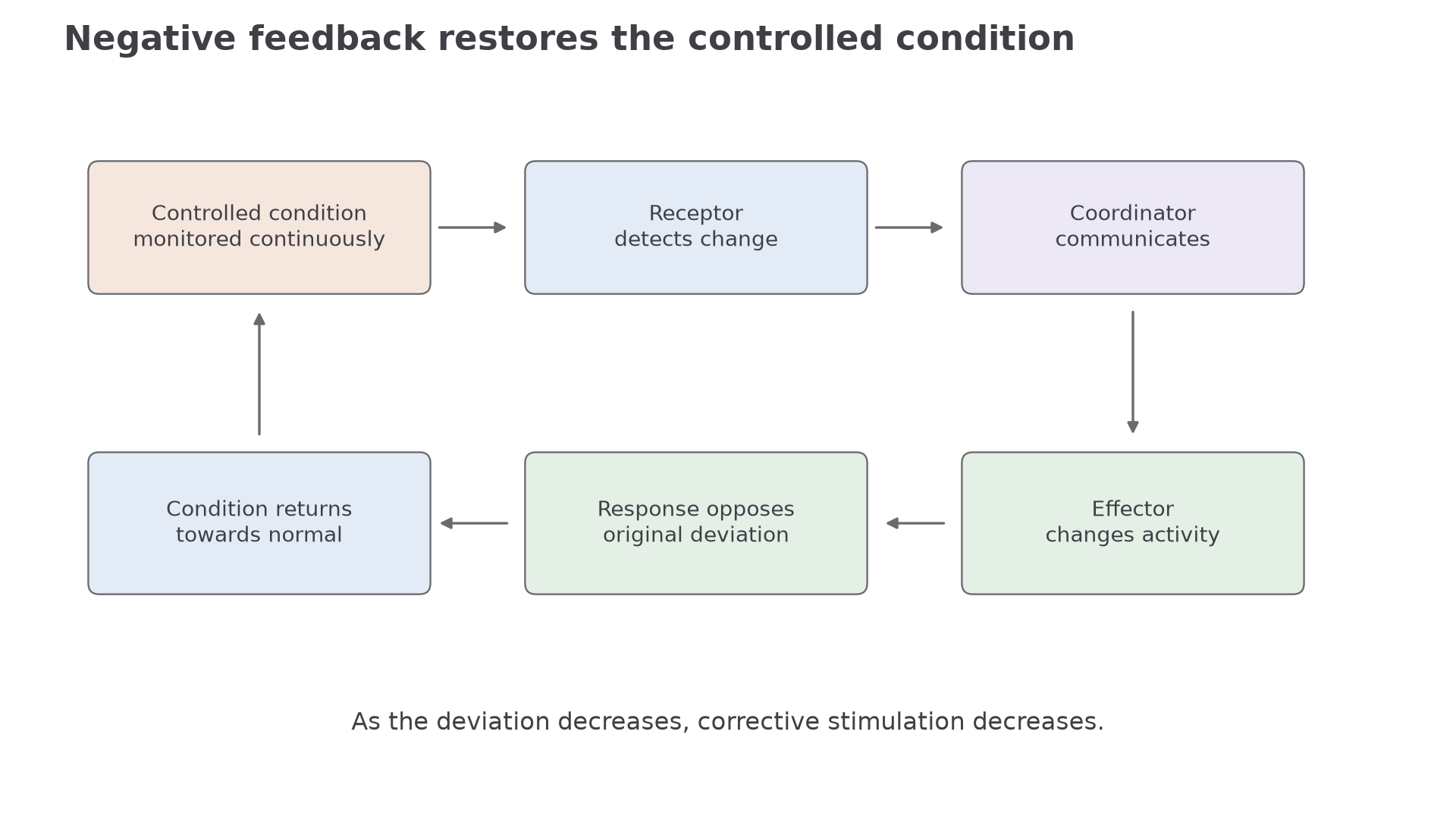
Receptors and effectors perform different jobs in the loop.
Receptor
A receptor detects a stimulus or change in a controlled condition.
Effector
An effector carries out a response that changes the controlled condition.
A receptor is the input side of the system. It is linked to detection: it monitors a condition and provides information when that condition changes. An effector is the output side of the system. It is linked to action: it changes its activity to produce a response. Muscles and glands are common effectors, but the exact effector depends on the homeostatic system.
The communication between receptor and effector may involve the nervous system, the endocrine system, or both. This lesson is not yet about the detailed routes of nerve impulses, synapses or hormones. The principle is that information about the deviation must be communicated before the response can be coordinated.
In a homeostasis answer, do not write that the receptor "fixes" the change. The receptor detects; the effector responds.
Continue this lesson.
You’re previewing NovaLearn without an account. Create a free account to read the rest.
Create free account