4.2.1(f)-(g) - Threats to biodiversity and reasons to maintain it
Biodiversity can be lowered by changes in human activity and the physical environment. Human population growth, monoculture and climate change alter habitats and populations through different mechanisms. Ecological, economic and aesthetic reasons explain why conserving this variety matters.
Threat Routes
A factor affecting biodiversity is something that changes the variety of life at habitat, species or genetic level. In this lesson, the required factors are:
- human population growth
- agriculture using monoculture
- climate change
These factors do not all work in the same way. Human population growth mainly increases demand for land, food, water, energy, transport and housing. Agriculture using monoculture simplifies the habitat and the genes present in the crop. Climate change alters abiotic conditions such as temperature and rainfall, so species may no longer be suited to the place where they live.
[DIAGRAM: biodiversity_threat_routes: Lesson 083: Threats to biodiversity and reasons to maintain it - diagram 01; asset_slug: 083_m04_2_1_threats_to_biodiversity_and_reasons_to_maintain_it__diagram_01; recommended_method: drawn_biology; description: A 16:9 NovaLearn-style causal map linking human population growth, monoculture agriculture and climate change to mechanisms that can reduce species biodiversity or genetic resources.]
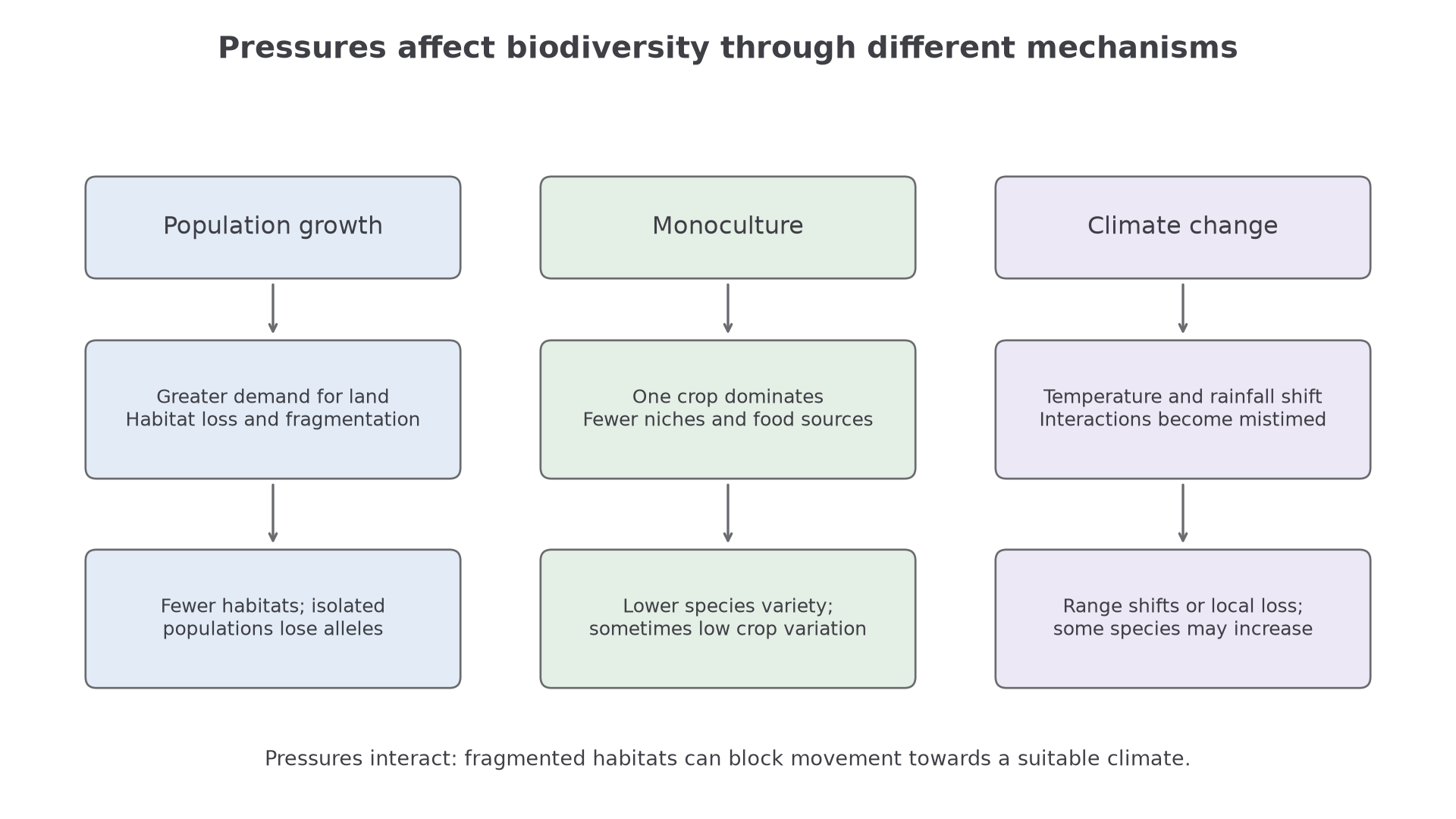
The same pressure can affect several levels of biodiversity. Clearing a woodland removes a habitat, may eliminate local species, and can remove alleles from populations that survive elsewhere.
Population Growth And Monoculture
Human population growth can affect biodiversity because more people usually means greater demand for resources. More food may be needed, more land may be used for housing and farming, and more transport and energy infrastructure may be built. If natural habitats are cleared or divided into smaller fragments, some species lose food sources, breeding sites or shelter.
Habitat fragmentation is especially important because a species may remain present in a small patch but become more vulnerable. Small isolated populations may have fewer mates, less genetic variety and a greater risk of local extinction. Isolation reduces movement between populations and therefore gene flow. Rare alleles are more easily lost by chance in a small population.
Monoculture
Monoculture is the agricultural practice of growing one crop species or one crop variety over a large area.
Monoculture can reduce biodiversity in several linked ways. A field of one crop provides fewer niches than a mixed habitat, so fewer wild plant species and fewer animal species are supported. The crop itself may also have low genetic biodiversity if the plants are genetically similar. That makes the system efficient for farming, but biologically simplified.
Continuous monoculture is also linked to soil depletion. The same crop is grown repeatedly, so similar mineral ions are removed from the soil each season. Soil organisms and nutrient cycling may be reduced if the system is simplified and heavily managed. This is why soil depletion appears again as an economic reason for maintaining biodiversity.
| Factor | Immediate change | Likely biodiversity effect |
|---|---|---|
| human population growth | greater demand for land and resources | habitats may be lost or fragmented |
| monoculture agriculture | one crop dominates a large area | fewer niches, lower species variety and lower crop genetic variety |
Herbicides remove competing wild plants and insecticides can kill non-target insects, reducing food for other animals. These management effects should be distinguished from monoculture itself. Growing one species does not necessarily mean every plant has an identical genotype; the genetic effect depends on the varieties planted.
Climate Change And Data
Climate change affects biodiversity by changing abiotic conditions. If temperature, rainfall patterns or the frequency of extreme events changes, the conditions in a habitat may no longer match the tolerances of some species. Species may shift their distribution, fail to reproduce successfully, or lose synchrony with other organisms they depend on.
Interdependence makes climate effects harder to predict. A plant might flower earlier after warmer springs. If its pollinator does not become active at the same time, both populations may be affected. A prey species might move northwards or uphill as temperatures change, but its predator or food plant may not shift at the same rate.
A survey comparing sites is observational: temperature cannot be assumed to be the only difference. Use matched sites, comparable sampling effort and repeated surveys over several years to test whether changes track temperature after allowing for land use, grazing and soil conditions. Replicate habitats provide stronger evidence than many quadrats in just one habitat.
Habitat fragmentation can also prevent a species moving into newly suitable areas as climate changes. Some warm-adapted species may increase while cold-adapted species decline; a change in species composition does not always produce an immediate fall in species richness.
Continue this lesson.
You’re previewing NovaLearn without an account. Create a free account to read the rest.
Create free account