2.1.6(j)-(l) - Stem cells and differentiated cell outcomes
Multicellular organisms need some cells to become highly specialised, but they also need a way to keep making new specialised cells. This lesson follows one central idea: a stem cell can renew an undifferentiated source and can also produce differentiated outcomes. The OCR examples are deliberately concrete: erythrocytes and neutrophils from bone marrow, and xylem vessels and phloem sieve tubes from meristems.
Stem Cell Features
A stem cell is useful because it can do two linked jobs.
Stem Cell
A stem cell is an undifferentiated cell that can divide to produce more stem cells and can give rise to specialised cells by differentiation.
The first job is self-renewal. Across the dividing stem-cell population, some daughter cells remain stem cells; other daughters can differentiate. This keeps a renewing source of undifferentiated cells available for future growth, repair or replacement.
The second job is differentiation. A daughter cell may begin a pathway that changes its structure and activity so it becomes adapted for a particular function. Differentiation does not mean the cell has gained a completely new set of genes; it means the cell has become specialised, with the structures and molecules needed for a particular role.
A helpful way to keep the idea precise is:
| Feature | What it means in this lesson | Why it matters |
|---|---|---|
| Undifferentiated | The cell has not yet become a final specialised type | It can still follow a differentiation route |
| Self-renewing | Cell division can maintain the stem-cell pool | The source is not used up immediately |
| Differentiating | Some descendants become specialised cells | The organism gains cells with particular functions |
Stem cells matter because they preserve a source of undifferentiated cells while supplying differentiated cells for particular roles.
Different genes are expressed in different descendants: the proteins produced help build each specialised structure and carry out its function. Mitosis usually preserves the inherited genetic information, while differentiation changes which parts of that information are used. An adult bone-marrow stem cell normally has a restricted range of blood-cell outcomes; being a stem cell does not mean it can make every type of cell in the body.
Bone Marrow Outcomes
Bone marrow contains stem cells that provide a renewing source for blood-cell production. From a common bone marrow stem cell, different daughter cells can follow different differentiation routes. OCR names two outcomes here: erythrocytes and neutrophils.
An erythrocyte is a red blood cell. During differentiation it becomes adapted for oxygen transport: it is packed with haemoglobin, loses its nucleus as it matures, and has a biconcave shape that gives a large surface area relative to volume. These are not random details; they are the differentiated outcome that makes the cell effective at carrying oxygen.
A neutrophil is a type of white blood cell. It has a lobed nucleus, cytoplasm with granules, and the ability to move towards and engulf pathogens. Its differentiated outcome is therefore very different from an erythrocyte, even though both can be traced back to a common stem-cell source in bone marrow.
[DIAGRAM: common_stem_cell_outcomes: Lesson 051: Stem cells and differentiated cell outcomes - diagram 01; asset_slug: 051_m02_1_6_stem_cells_and_differentiated_cell_outcomes__diagram_01; recommended_method: drawn_biology; description: Two-panel lineage diagram showing a common bone marrow stem cell producing erythrocyte and neutrophil outcomes, and a common meristem stem cell producing xylem vessel and phloem sieve tube outcomes.]
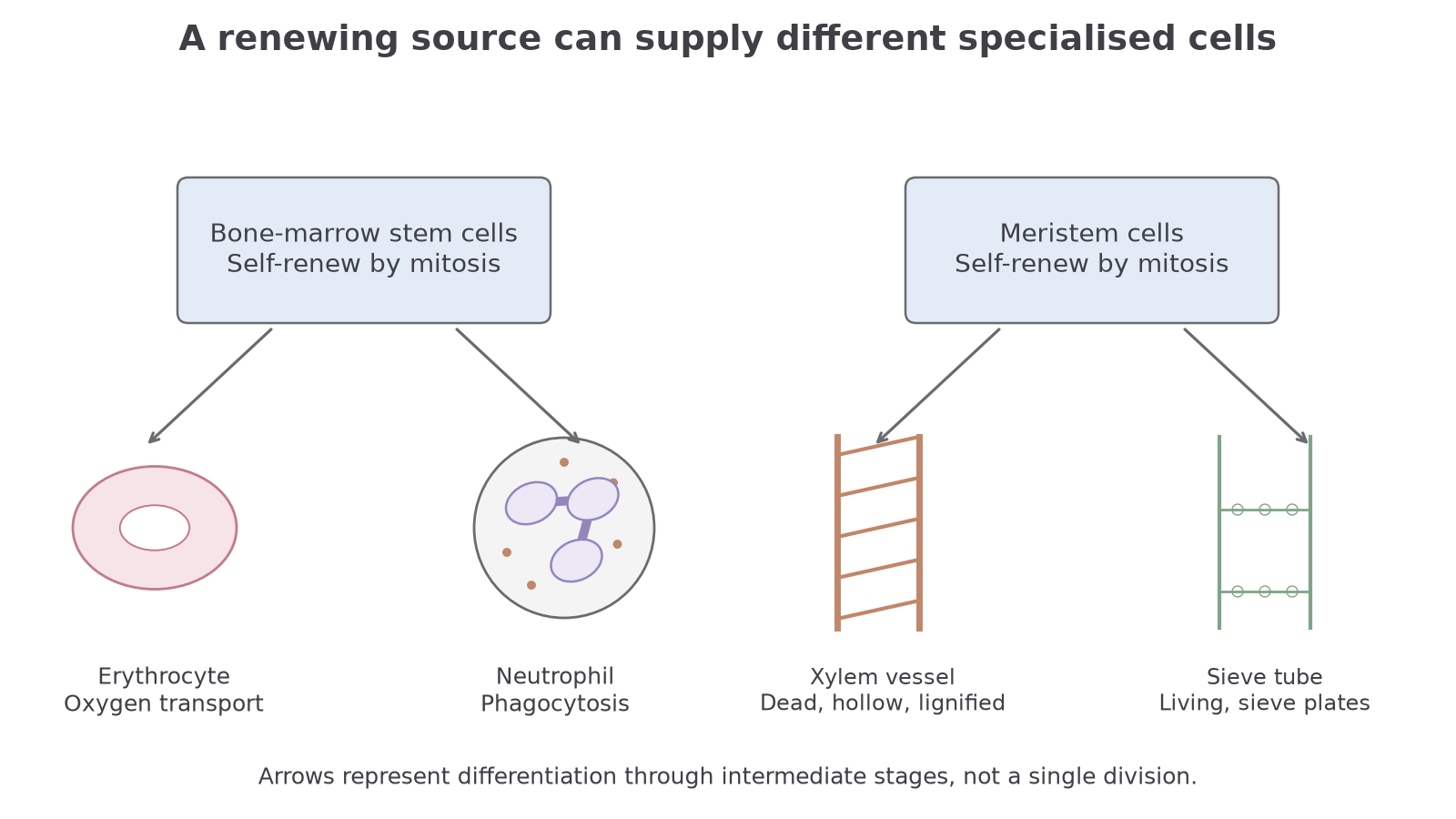
The diagram is there to stop a common error: do not think of a stem cell as already being half an erythrocyte or half a neutrophil. The stem cell is an undifferentiated renewing source. The specialised outcome appears as the descendant cell differentiates.
Continue this lesson.
You’re previewing NovaLearn without an account. Create a free account to read the rest.
Create free account