3.1.1(f) - Bony fish gills and countercurrent exchange
Bony fish live in water, where oxygen is dissolved at a much lower concentration than in air. This lesson explains how a bony fish keeps water moving over its gills, how the gill surface is organised for diffusion, and why countercurrent flow lets more oxygen enter the blood than a simpler same-direction system would.
Why gills need ventilation
Gas exchange is the movement of respiratory gases between an organism and its environment. In a bony fish, oxygen diffuses from water into the blood, and carbon dioxide diffuses from the blood into water.
The difficulty is that water is not like air. Water contains less available oxygen than air and is denser, so it takes more work to move it across an exchange surface. A larger, active fish cannot rely on slow diffusion across its outer body surface. It needs a specialised exchange surface with a constant supply of water passing over it.
Ventilation
Ventilation is the movement of the external medium, such as water or air, over a gas exchange surface to maintain diffusion gradients.
For a bony fish, ventilation means keeping water moving in one direction: into the mouth, across the gills, and out past the operculum. The gills then provide the large, thin, blood-supplied surface where diffusion can happen quickly.
The direction matters. If the same water stayed around the gills, its oxygen concentration would fall and its carbon dioxide concentration would rise. Diffusion would slow. Ventilation replaces that water, maintaining a steep concentration gradient for oxygen into the blood and carbon dioxide out of the blood.
Gill structure and function
The mouth cavity of a fish is called the buccal cavity. Behind it are the gills, protected by a bony flap called the operculum. When water leaves the fish, it exits through the opercular opening rather than flowing back out through the mouth.
[DIAGRAM: gill_structure_and_ventilation: Lesson 056: Bony fish ventilation, gills and countercurrent exchange - diagram 01; asset_slug: 056_m03_1_1_bony_fish_ventilation_gills_and_countercurrent_exchange__diagram_01; recommended_method: drawn_biology; description: A clean labelled line diagram showing a bony fish head in side view, the buccal cavity, operculum, gill arch, gill filaments, lamellae/gill plates, and one-way water movement during buccal-opercular ventilation.]
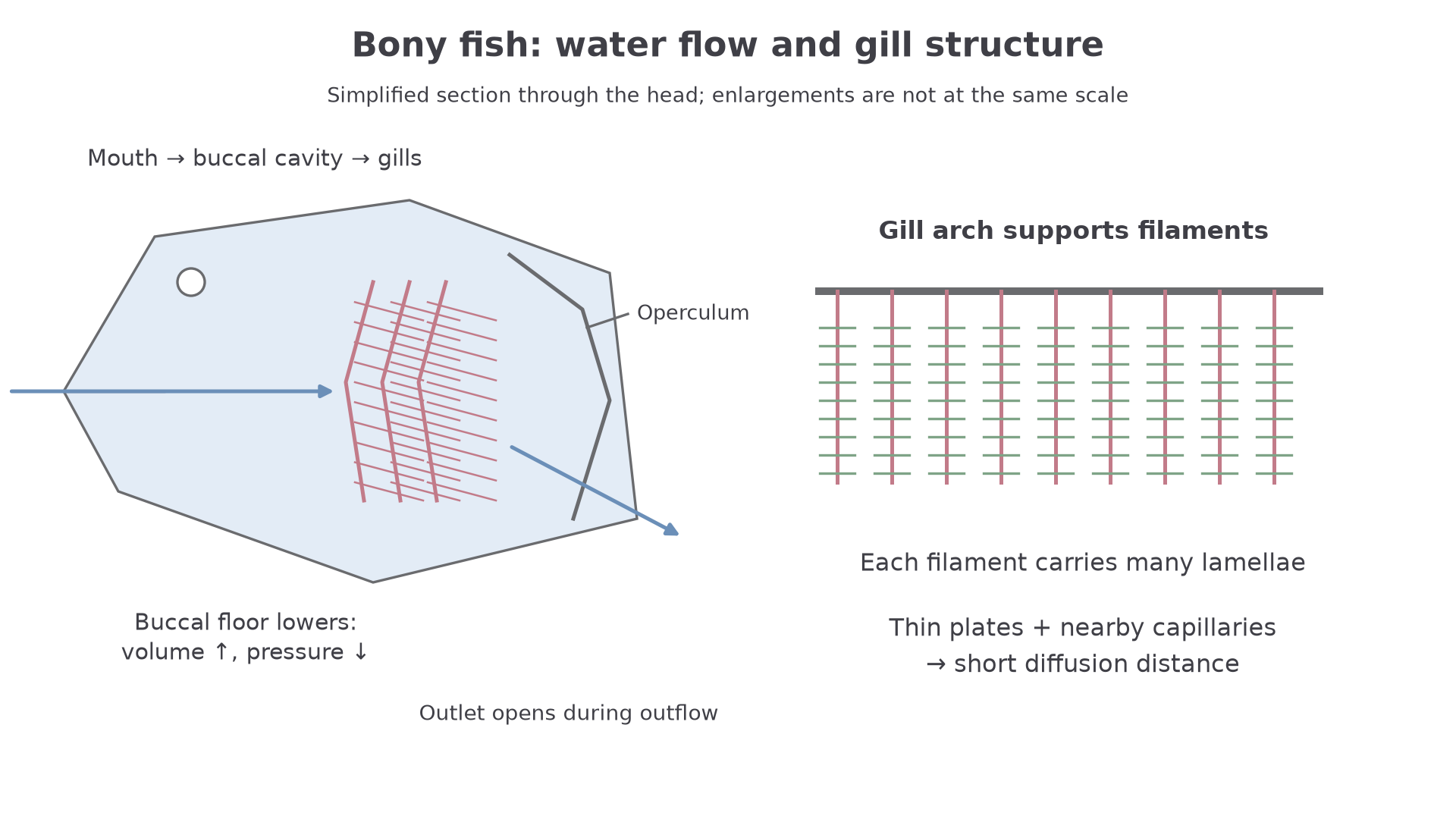
The ventilation diagram is a simplified movement schematic: “operculum closed” refers to its outlet valve being closed, while the opercular cover can move outwards to expand the cavity. The visible gill surface is not one flat sheet. It is folded into a hierarchy:
| Structure | Function in gas exchange |
|---|---|
| Operculum | Protects the gills and helps produce one-way water movement by opening and closing with pressure changes. |
| Gill arch | Supports rows of gill filaments. |
| Gill filaments | Long projections that increase surface area and carry many lamellae. Their arrangement exposes a large surface to moving water. |
| Gill lamellae, or gill plates | Thin plates on the filaments where most gas exchange occurs. They contain blood capillaries and give a short diffusion distance. |
The lamellae are especially important. They give a very large surface area, are thin, and have a good blood supply. This is the same exchange-surface logic you have seen before: large area, short diffusion distance, and movement of both the external medium and the transport fluid to maintain gradients.
The named structures are not just labels: the operculum helps ventilation, filaments increase area and hold lamellae, and lamellae are the thin blood-supplied plates where diffusion occurs.
Use the structure-function link in that sentence to answer the check, rather than listing labels without their roles.
Buccal-opercular pump
The ventilation mechanism in a bony fish is a pump based on volume and pressure changes. A larger cavity volume gives a lower pressure; a smaller cavity volume gives a higher pressure. Water moves down a pressure gradient from higher pressure to lower pressure.
In the first phase, the mouth opens and the valve at the opercular opening is closed. The floor of the buccal cavity lowers, increasing the volume of the buccal cavity. This lowers the pressure inside the buccal cavity below the pressure outside the fish, so water moves into the mouth.
The closed outlet valve prevents water flowing backwards from outside into the opercular cavity. At about the same time, the opercular cover moves outwards and the opercular cavity expands. That helps keep pressure lower behind the gills, so water is encouraged to move from the buccal cavity towards the opercular cavity rather than reversing direction.
In the second phase, the mouth closes and the floor of the buccal cavity rises. The buccal cavity volume decreases, so the pressure in the buccal cavity increases. Water is forced across the gill filaments and lamellae into the opercular cavity.
Finally, the opercular outlet valve opens and the opercular cavity decreases in volume. The increased pressure drives water through the outlet; the buccal pressure remains high enough to support forward flow across the gills during this phase.
For a ventilation-sequence answer, use pressure language. "The fish sucks water in" is too vague; the creditworthy idea is that changes in cavity volume produce pressure gradients.
The next check asks for that sequence, so keep the direction of water movement tied to pressure changes at each stage.
Continue this lesson.
You’re previewing NovaLearn without an account. Create a free account to read the rest.
Create free account