5.1.5(a)(i)-(ii) - Plant responses, tropisms and practicals
Plants do not have nerves or muscles like animals, but they still detect changes in their surroundings and respond in ways that improve survival. In this lesson, you will learn the range of plant responses, how tropisms are named, and how phototropism and geotropism can be investigated using controlled practical methods.
Response Types
A plant response is a change in growth, chemistry, position or physiology after a stimulus. A stimulus is a change in the internal or external environment that can be detected.
For this specification point, keep three big categories separate:
| Category | What the stimulus is | Examples |
|---|---|---|
| abiotic stress response | a non-living environmental factor | drought, freezing, high wind, low light |
| herbivory response | feeding by animals | alkaloids, pheromone signals, folding in response to touch |
| tropism | a directional stimulus causing directional growth | light, gravity, water, touch, chemicals |
[DIAGRAM: plant_response_types: Lesson 110: Plant responses, tropisms and practical investigations - diagram 01; asset_slug: 110_m05_1_5_plant_responses_tropisms_and_practical_investigations__diagram_01; recommended_method: drawn_biology; description: A clean OCR 5.1.5(a) map separating abiotic stress, herbivory, tropisms and PAG11 evidence, with examples and the warning that herbivory is biotic.]
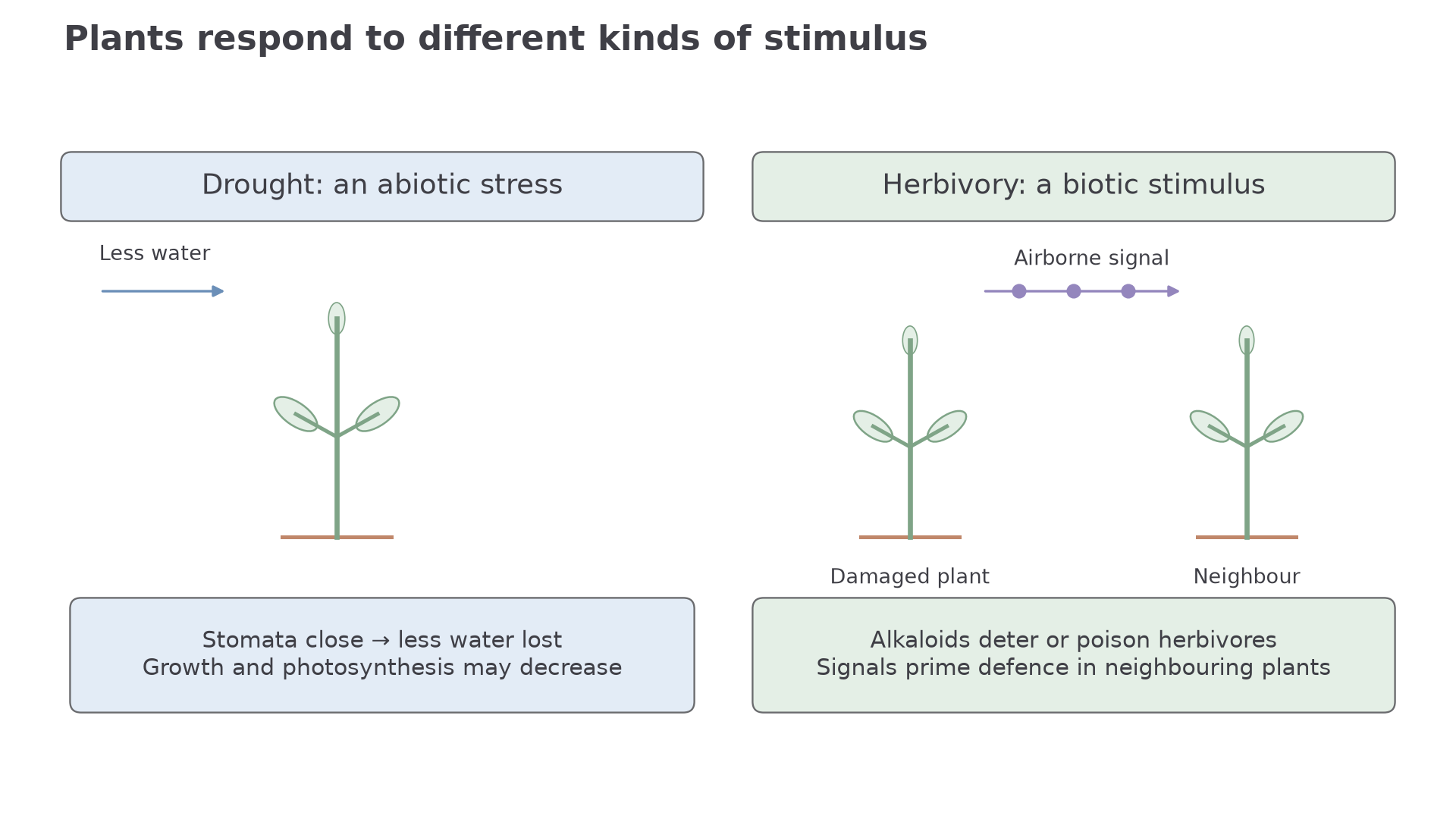
The distinction matters in exam answers. Drought is abiotic because it is a physical environmental condition. Herbivory is biotic because it involves another living organism feeding on the plant. A tropism is narrower again: it is not just any plant response, but a directional growth response.
Tropism
A tropism is a directional growth response by part of a plant to a directional stimulus.
The term is tropism, meaning a directional growth response.
Tropism Direction
Tropisms are named from the stimulus:
| Tropism | Directional stimulus | Example of the response |
|---|---|---|
| phototropism | light | shoots often grow towards light |
| geotropism or gravitropism | gravity | roots often grow downwards; shoots often grow upwards |
| hydrotropism | water | roots may grow towards a water source |
| thigmotropism | touch | tendrils may grow around a support |
| chemotropism | chemicals | growth occurs in response to a chemical gradient |
A positive tropism means growth towards the stimulus. A negative tropism means growth away from the stimulus. So a shoot growing towards light is positively phototropic, while a shoot growing upwards against gravity is negatively geotropic.
The word "growth" is important. Folding in response to touch is a plant response, but it is not a tropism if it is a rapid reversible movement rather than directional growth. In a sensitive plant, folding depends on changes in water movement and turgor at specialised cells near the leaflet bases, so it belongs with touch responses rather than the growth-tropism examples.
At the cellular level, tropisms usually happen because one side of a growing organ elongates more than the other. In a shoot exposed to light from one side, the shaded side may elongate more, so the shoot bends towards the light. In a root responding to gravity, the pattern is different because root cells are more sensitive to growth-inhibiting effects of auxin. Later lessons handle plant hormones and their experimental evidence in more detail; here, the core requirement is to name and interpret the response.
For a one-mark definition, include both "directional" and "growth". "A plant moves towards light" is too vague for a secure tropism definition.
Phototropism Practical
Phototropism can be investigated by giving seedlings a directional light stimulus and measuring their growth response. The exact method can vary, but the logic should stay the same: change one feature of the light, keep other conditions constant, and measure the response after a fixed time.
[DIAGRAM: tropism_practical_setups: Lesson 110: Plant responses, tropisms and practical investigations - diagram 02; asset_slug: 110_m05_1_5_plant_responses_tropisms_and_practical_investigations__diagram_02; recommended_method: drawn_biology; description: A deterministic practical diagram showing a phototropism box with side light, a geotropism dish kept in the dark, a clinostat control, repeated seedlings, and measurable response variables.]
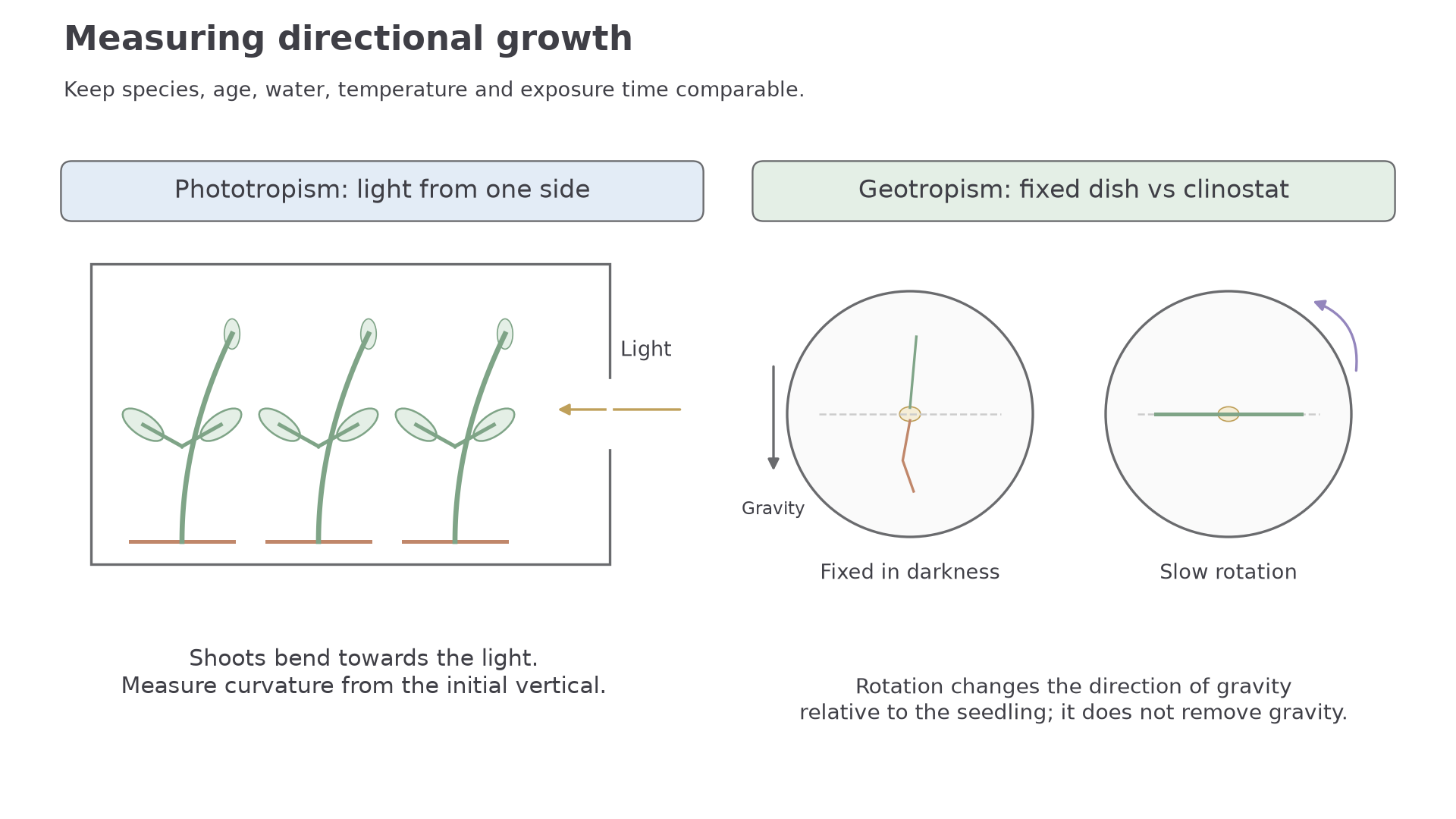
A basic investigation could use germinating seedlings in a box with a small hole on one side. Light enters from one direction. After a set number of hours or days, the angle of shoot curvature can be measured. A larger positive angle towards the hole suggests a stronger positive phototropic response.
The independent variable could be:
- direction of light;
- colour or wavelength of light;
- distance from the light source;
- presence or absence of unilateral light.
The dependent variable could be:
- angle of shoot curvature;
- number of seedlings bending towards the light;
- change in shoot length in a particular direction.
Control variables are essential because seedlings grow quickly and are affected by many conditions. Use the same species, similar seedling age and starting size, the same number of seedlings, the same time period, the same temperature, the same water availability and the same light intensity where light intensity is not the independent variable.
PAG11 also expects safe and ethical use of living organisms. Seedlings are low risk, but they should be handled gently, kept moist, not exposed to unnecessary heat from lamps, and disposed of according to local laboratory instructions. If lamps and water are used near each other, keep electrical equipment away from spills.
Continue this lesson.
You’re previewing NovaLearn without an account. Create a free account to read the rest.
Create free account