4.2.2(i) - Evolutionary implications for human populations
Evolution is not only a long-term idea about fossils or distant ancestors. It can happen quickly in species with short generation times, and that can affect human health, food production and disease control. In this lesson you will learn how resistance evolves in insects exposed to pesticides and in microorganisms exposed to drugs, then how those changes create decisions for human populations.
Resistance as selection
Resistance means that an organism can survive exposure to a control method that would kill or inhibit most individuals of the same species. In this lesson the control method might be a pesticide used against insects, or a drug used against microorganisms.
The key evolutionary point is that resistance is about populations changing over generations. A pesticide or drug does not deliberately create the useful mutation because the organism "needs" it. Instead, there is variation in the population. Some individuals may already carry a heritable resistance characteristic, or in bacteria a resistance gene may be gained from another bacterium. When the pesticide or drug is applied, susceptible individuals are more likely to die or fail to reproduce. Resistant individuals are more likely to survive, reproduce and pass on the resistance characteristic.
Selection pressure
An environmental factor that affects which individuals are more likely to survive and reproduce.
[DIAGRAM: resistance_selection_flow: Lesson 092: Evolutionary implications for human populations - diagram 01; asset_slug: 092_m04_2_2_evolutionary_implications_for_human_populations__diagram_01; recommended_method: drawn_biology; description: 16:9 NovaLearn-style flow diagram showing initial variation, pesticide or drug selection pressure, resistant survivors reproducing, increasing resistant frequency, and human implications for control strategies.]
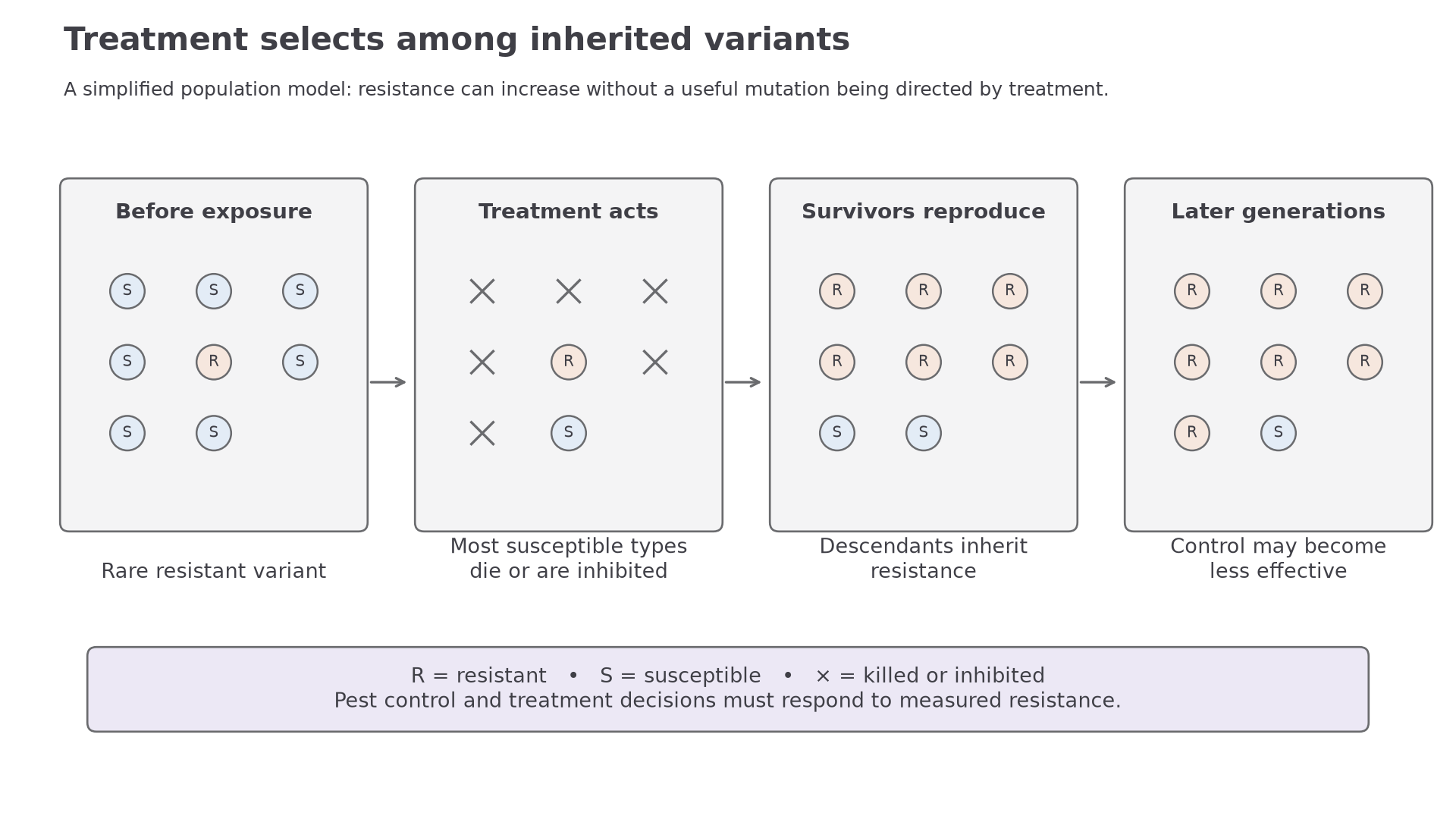
The diagram is the shared mechanism for both examples in the specification. The selection pressure is different, but the logic is the same: variation exists, treatment selects, resistant survivors reproduce, and the resistant type becomes more common.
Explaining resistance as natural selection
A crop field contains many insects. A few have an inherited characteristic that lets them survive a pesticide. The pesticide is sprayed every week.
The causal explanation is:
- There is genetic variation in the insect population.
- Some insects have a heritable resistance characteristic.
- The pesticide is a selection pressure because susceptible insects are more likely to die.
- Resistant insects are more likely to survive and reproduce.
- They pass on the resistance characteristic, so the proportion of resistant insects increases over generations.
Notice the wording. The pesticide selects resistant insects; it does not make individual insects immune.
New mutations can also arise while treatment is being used. Their occurrence is not directed towards what the organism needs; selection changes which variants leave descendants.
Pesticide resistance in insects
Pesticides are used to reduce pest populations. In this specification point, the named example is pesticide resistance in insects. This can matter for crop pests that reduce food production and for insect vectors that transmit disease.
The evolutionary sequence is the same as the worked example, but the human implication is especially clear. If the same pesticide is used repeatedly, insects with resistance are more likely to survive each application. Over time, the resistant insects can make up a larger proportion of the population. The pesticide then becomes less effective at the labelled dose or normal frequency of use.
Insects can evolve resistance quickly because many insect populations are large and have short generation times. Large populations are more likely to contain rare resistant variants. Short generation times mean that selection can change the population over many generations in a relatively short time.
| Observation | Careful interpretation |
|---|---|
| Fewer insects die after repeated pesticide use | The resistant proportion may have increased. |
| More pesticide is then applied | This can maintain strong selection for resistant insects. |
| A different control method is introduced | Selection pressure may change, so resistance management depends on evidence. |
Human populations are affected because food crops may suffer more damage, farmers may spend more on control, and insect vectors may be harder to manage. A response might include rotating pesticides with different modes of action, reducing unnecessary pesticide use, using biological control, protecting non-resistant insects in refuges, and monitoring resistance. Rotation helps only if the alternative is effective against the resistant insects; cross-resistance can make a change of product ineffective. Biological control reduces reliance on the chemical, but its effects on non-target species need assessment. A refuge can retain susceptible insects that mate with resistant survivors and reduce the relative frequency of resistance alleles; its effectiveness depends on mating, inheritance and how resistance affects fitness.
Do not write that insects "become immune" or that the pesticide "causes the mutation". Better wording is: resistant insects survive and pass on the resistance characteristic, so resistance becomes more common.
Before increasing application, compare susceptibility tests, correct application conditions and resistance trends. Poor coverage or weather can also reduce pest mortality, so treatment failure alone does not establish inherited resistance.
Continue this lesson.
You’re previewing NovaLearn without an account. Create a free account to read the rest.
Create free account