5.1.5(g) - Organisation of the mammalian nervous system
This lesson is about the map of the mammalian nervous system before the next lessons zoom in on the brain, reflexes and coordinated responses. The key skill is to use two different classification lenses accurately: a structural lens and a functional lens. That prevents a common exam error: mixing up where nervous tissue is with what kind of response it controls.
Two Organisation Lenses
The mammalian nervous system is a fast communication system. It receives information from receptors, processes information, and helps coordinate responses in effectors such as muscles and glands.
For this lesson, the required organisation has two separate lenses:
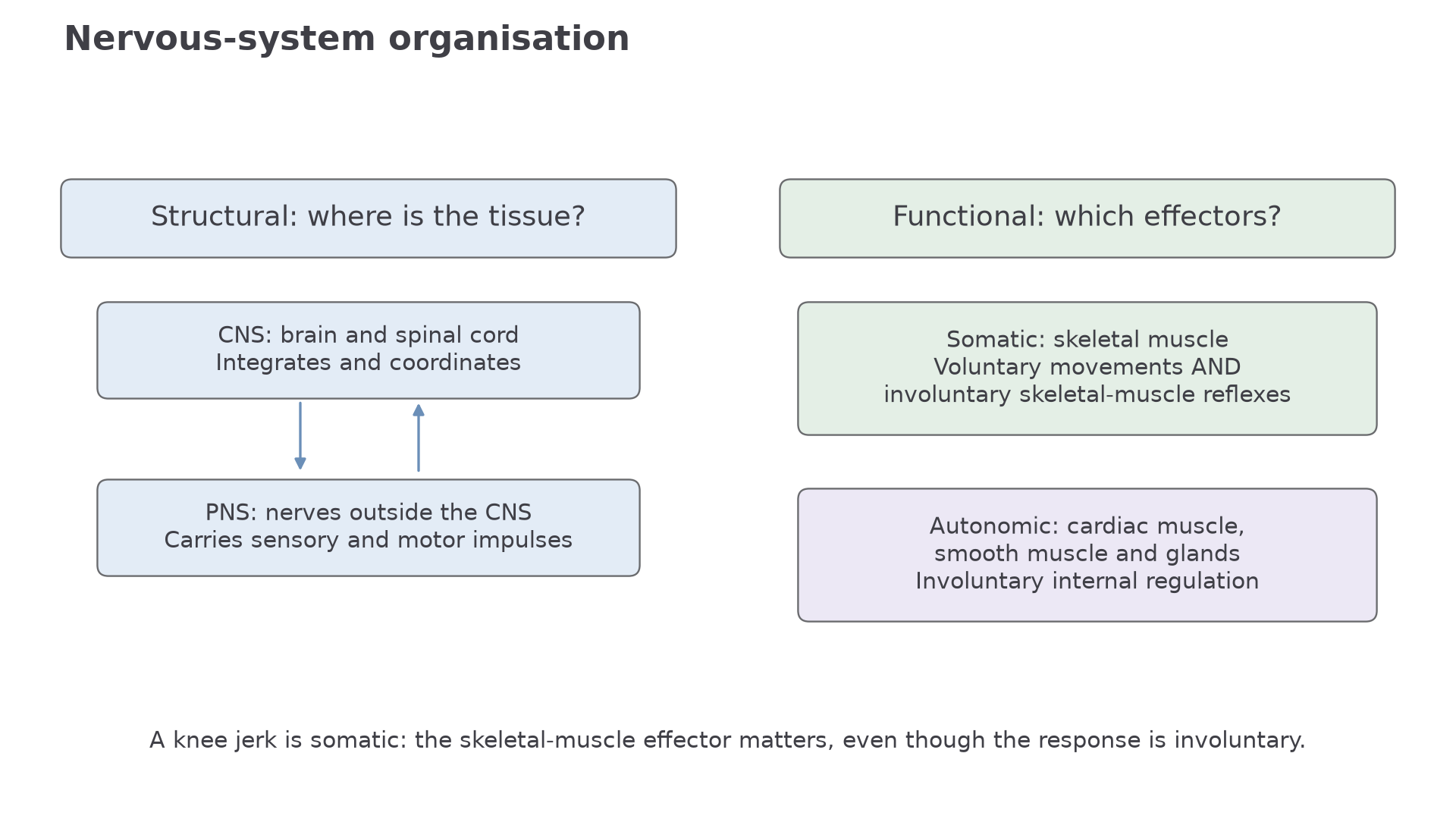
- Structural organisation asks where the nervous tissue is. This divides the nervous system into the central nervous system and peripheral nervous system.
- Functional organisation asks what type of control is being carried out. This divides nervous control into the somatic nervous system and autonomic nervous system.
These are not just four words to memorise. They are two ways to describe the same communication network. For example, a response may involve the peripheral nervous system structurally, while being somatic or autonomic functionally.
[DIAGRAM: nervous_system_organisation_map: Lesson 115: Organisation of the mammalian nervous system - diagram 01; asset_slug: 115_m05_1_5_organisation_of_the_mammalian_nervous_system__diagram_01; recommended_method: drawn_biology; description: A two-lens organisation map showing structural division into CNS and PNS, and functional division into somatic and autonomic nervous systems, with example effectors.]
Central And Peripheral Systems
The central nervous system, or CNS, is the brain and spinal cord. It is central because it is where information is integrated and coordinated before suitable responses are produced.
Central Nervous System
The brain and spinal cord.
The peripheral nervous system, or PNS, consists of nerves outside the CNS. These nerves link the CNS with the rest of the body, including receptors that detect stimuli and effectors that carry out responses.
Peripheral Nervous System
The nerves outside the brain and spinal cord that link the CNS with the rest of the body.
The structural distinction is therefore about location. The spinal cord belongs to the CNS even though it runs down the body. A nerve running from the spinal cord to a muscle belongs to the PNS because it is outside the brain and spinal cord.
| Structural system | Main components | Core role in organisation |
|---|---|---|
| CNS | Brain and spinal cord | Integration and coordination |
| PNS | Nerves outside the CNS | Communication between CNS and the rest of the body |
If asked to describe structural organisation, name both systems and give their components. Do not answer only with "brain" or only with "nerves".
Continue this lesson.
You’re previewing NovaLearn without an account. Create a free account to read the rest.
Create free account