5.2.2(f)-(g) - Coenzymes and oxidative phosphorylation
Cellular respiration only keeps going because small carrier molecules move useful chemical cargo from one enzyme-controlled stage to the next. In this lesson, you will separate the roles of NAD, FAD and coenzyme A, then follow how reduced coenzymes feed electrons into oxidative phosphorylation. The key site is the mitochondrial crista: a folded inner membrane where electron carriers, oxygen and ATP formation are brought close together.
Coenzymes as carriers
A coenzyme is a small, non-protein molecule that helps an enzyme-controlled reaction. In respiration, coenzymes are important because they transfer atoms, groups or electrons between reactions instead of being used up permanently.
That carrier role solves a problem. Glycolysis, the link reaction and the Krebs cycle remove hydrogen from respiratory intermediates, but those hydrogens need somewhere useful to go. NAD and FAD accept hydrogen and electrons, becoming reduced coenzymes. Coenzyme A has a different job: it carries an acetyl group into the Krebs cycle as acetyl CoA.
Reduced coenzyme
A coenzyme that has accepted hydrogen and electrons. In respiration, reduced NAD and reduced FAD carry these electrons to oxidative phosphorylation.
[DIAGRAM: coenzyme_role_map: Lesson 131: Coenzymes and oxidative phosphorylation - diagram 01; asset_slug: 131_m05_2_2_coenzymes_and_oxidative_phosphorylation__diagram_01; recommended_method: drawn_biology; description: flow map showing NAD and FAD carrying hydrogen and electrons to the electron transport chain while coenzyme A carries an acetyl group into the Krebs cycle.]
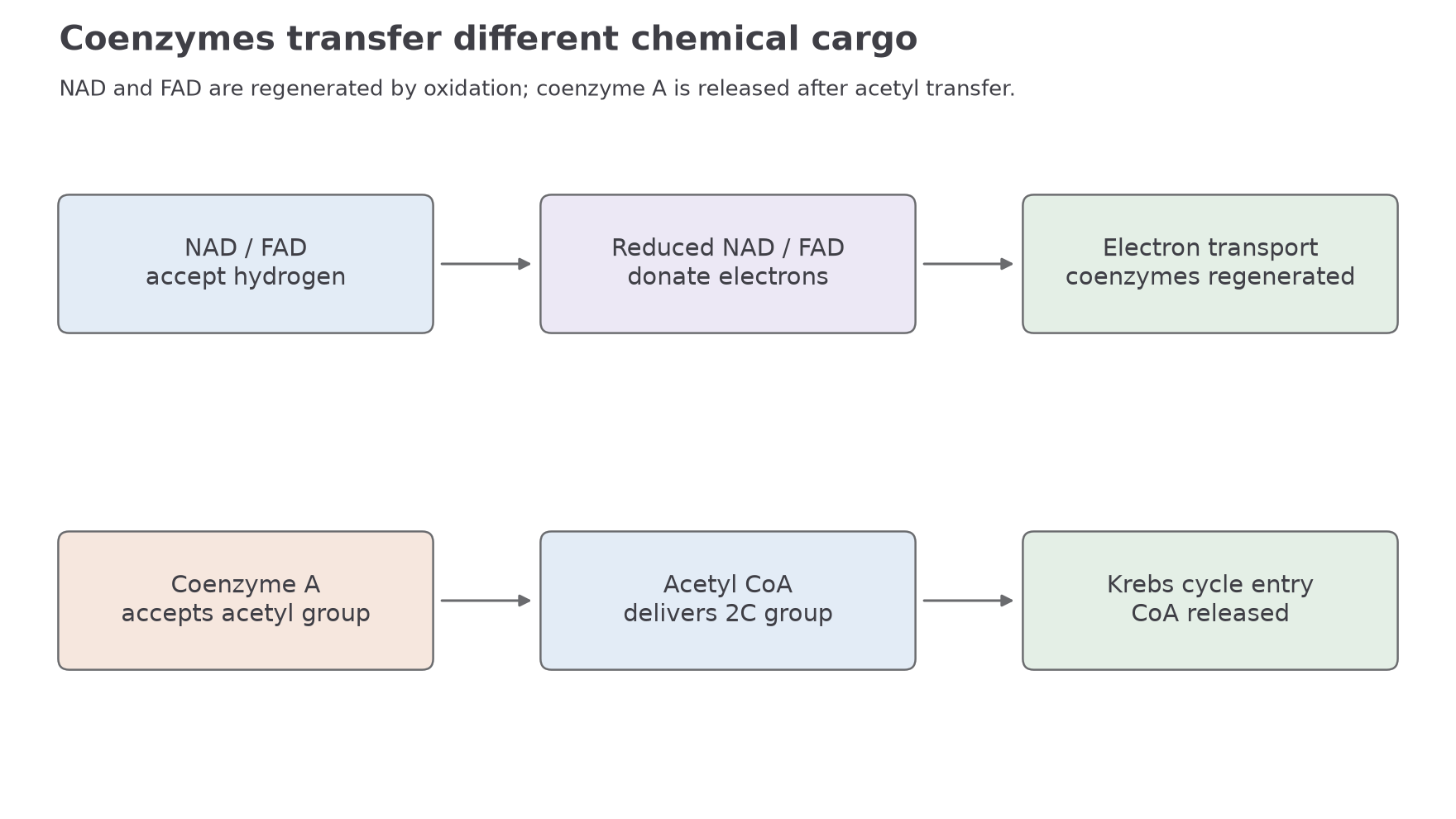
The diagram separates the three coenzymes by cargo. NAD and FAD are hydrogen/electron carriers. Coenzyme A is an acetyl-group carrier. Treating them all as "energy molecules" is too vague for marks, because the useful answer is the specific thing each one transfers.
NAD, FAD and coenzyme A
NAD stands for nicotinamide adenine dinucleotide. In OCR answers, it is usually enough to write NAD and reduced NAD. NAD is reduced when it accepts hydrogen during earlier respiration stages, including glycolysis, the link reaction and the Krebs cycle. Reduced NAD then carries electrons to the electron transport chain.
FAD stands for flavin adenine dinucleotide. It is also reduced by accepting hydrogen and electrons, especially in the Krebs cycle. Reduced FAD also feeds electrons into the electron transport chain, but it does not do the acetyl-group carrying job of coenzyme A.
Coenzyme A is important at a different handoff. In the link reaction, a two-carbon acetyl group joins to coenzyme A to form acetyl CoA. Acetyl CoA then delivers the acetyl group to the Krebs cycle, where it combines with oxaloacetate to form citrate. You do not need to make this lesson a full Krebs-cycle lesson, but you do need to know why coenzyme A matters: it links acetyl-group formation to the cycle.
| Coenzyme | Main cargo in respiration | Carrier cycle |
|---|---|---|
| NAD | Hydrogen/electrons | NAD is reduced to reduced NAD, then later oxidised again. |
| FAD | Hydrogen/electrons | FAD is reduced to reduced FAD, then later oxidised again. |
| Coenzyme A | Acetyl group | Coenzyme A carries the acetyl group as acetyl CoA. |
For this lesson, "oxidised again" means the reduced coenzyme donates electrons and returns to its oxidised form. Avoid saying that coenzymes "make energy"; say what they carry and where the electrons go.
NAD can move between enzymes in solution. FAD is often tightly associated with an enzyme, so saying it “carries hydrogen” does not mean every reduced FAD molecule floats to another organelle. Its reducing equivalents are passed onward through the enzyme system. In both cases, oxidation restores the ability to accept hydrogen again. Coenzyme A is released after its acetyl group enters the cycle and can receive another group.
Oxidative phosphorylation process
Oxidative phosphorylation is the production of ATP using energy released when reduced coenzymes are oxidised. The word "oxidative" refers to reduced NAD and reduced FAD losing electrons. The word "phosphorylation" refers to ADP gaining inorganic phosphate to form ATP.
Continue this lesson.
You’re previewing NovaLearn without an account. Create a free account to read the rest.
Create free account