5.1.5(b) - Roles of plant hormones
Plants coordinate growth, survival and seasonal changes using chemical signals called hormones. In this lesson you will learn how plant hormones help deciduous plants lose leaves, how they control seed germination, and how they close stomata during water stress. The important skill is to link each hormone signal to its target tissue and to the biological outcome.
Hormones As Plant Signals
A plant hormone is a chemical messenger that changes the activity of plant cells or tissues. Plant hormones are sometimes called plant growth substances, but they do more than make plants grow. They can also coordinate dormancy, senescence, abscission and responses to water stress.
Plant Hormone
A plant hormone is a chemical messenger produced in one part of a plant that affects the activity of target cells or tissues, either nearby or in another part of the plant.
Plant hormones are not made in glands like many animal hormones. Many plant cells can produce them, and the same hormone may have different effects in different tissues. The response depends on which receptors and signalling pathways the target cells have, the hormone concentration, the developmental stage of the plant and the presence of other hormones.
For this lesson, three hormone groups matter most.
| Hormone group | Main role in this lesson |
|---|---|
| Auxins and ethene | Help control leaf loss in deciduous plants through the abscission zone |
| Gibberellins | Promote seed germination by stimulating enzyme production in seed tissues |
| Abscisic acid, ABA | Promotes seed dormancy and stomatal closure during water stress |
That table is a starting map, not a rule that each hormone has only one role. In plants, responses often depend on a balance between hormones. For example, germination depends on the balance between gibberellins that promote germination and ABA that maintains dormancy.
Leaf Loss In Deciduous Plants
Deciduous plants lose their leaves during unfavourable seasons, such as autumn in temperate climates. Leaf loss reduces water loss when water uptake from cold or frozen soil is limited, and it avoids the cost of maintaining leaves when light levels are too low for useful photosynthesis.
The biological process of shedding a leaf is called abscission. It happens at an abscission zone near the base of the leaf stalk. Cells in this zone separate from each other, so the leaf can detach.
[DIAGRAM: plant_hormone_role_summary: Lesson 111: Roles of plant hormones - diagram 01; asset_slug: 111_m05_1_5_roles_of_plant_hormones__diagram_01; recommended_method: drawn_biology; description: Three linked drawn-biology flow panels summarising hormone roles in deciduous leaf loss, seed germination and stomatal closure, with labels for auxin, ethene, gibberellin and ABA.]
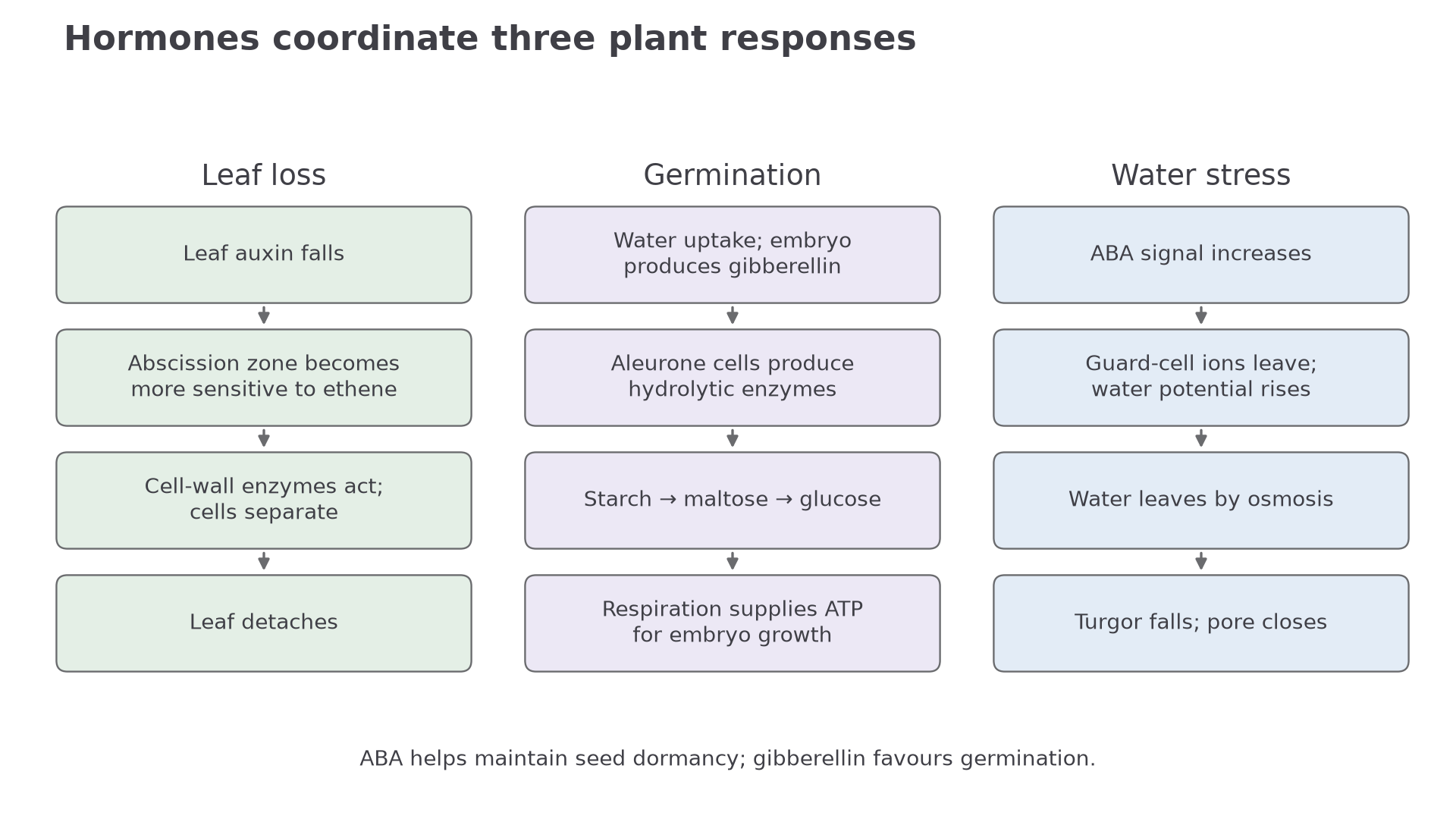
In a healthy, actively growing leaf, auxin moving from the leaf helps maintain the leaf and reduces the sensitivity of cells in the abscission zone to ethene. As a leaf ages, or as day length and temperature change, auxin production by the leaf falls. The abscission zone becomes more sensitive to ethene.
Ethene then promotes the production or activation of enzymes that break down cell walls and the middle lamella between cells in the separation layer. The leaf becomes weakly attached and eventually falls. A protective layer forms on the plant side of the abscission zone, helping to reduce water loss and entry of pathogens after the leaf detaches.
Avoid saying that ABA is the single hormone that causes leaf fall just because its name sounds like abscission. For deciduous leaf loss, the safer explanation is falling auxin influence, increased ethene effect, and cell-wall breakdown in the abscission zone.
Seed Germination
A seed must not germinate just because it exists. If it germinates when conditions are unsuitable, the young plant may die before it can photosynthesise enough to support itself. Hormones help coordinate dormancy and germination.
Continue this lesson.
You’re previewing NovaLearn without an account. Create a free account to read the rest.
Create free account