6.3.1(c) - Nitrogen recycling in ecosystems
Nitrogen is needed to build proteins, nucleic acids and ATP, so every ecosystem needs a way to keep usable nitrogen moving through living organisms and soil. This lesson follows that movement through decomposers and the named microorganisms in the nitrogen cycle: Nitrosomonas, Nitrobacter, Azotobacter and Rhizobium. The carbon cycle is deliberately left for the next lesson.
The Nitrogen Problem
Most of the air around an ecosystem is nitrogen gas, , but that does not mean plants can use it directly. The two nitrogen atoms in are held together strongly, and most organisms do not have the enzymes needed to convert atmospheric nitrogen into useful compounds.
The useful word is bioavailable. A bioavailable nitrogen compound is in a form that can enter living organisms and be built into biological molecules. For plants, the main useful form in soil is nitrate ions, ; ammonium ions, , are also important in the soil nitrogen cycle.
Nitrogen recycling
The conversion of nitrogen between organic compounds, soil ions and atmospheric nitrogen gas by organisms, especially microorganisms.
Nitrogen matters because organisms use it in amino acids and proteins, DNA and RNA, and ATP. Animals obtain organic nitrogen by feeding. Plants build organic nitrogen compounds after absorbing mineral nitrogen ions from the soil.
[DIAGRAM: nitrogen_recycling_process_map: Lesson 165: Nitrogen recycling in ecosystems - diagram 01; asset_slug: 165_m06_3_1_nitrogen_recycling_in_ecosystems__diagram_01; recommended_method: drawn_biology; description: 16:9 NovaLearn-style process map showing atmospheric nitrogen, nitrogen fixation by Rhizobium and Azotobacter, ammonification by decomposers, nitrification by Nitrosomonas and Nitrobacter, nitrate assimilation into plants and animals, and denitrification returning nitrate to nitrogen gas.]
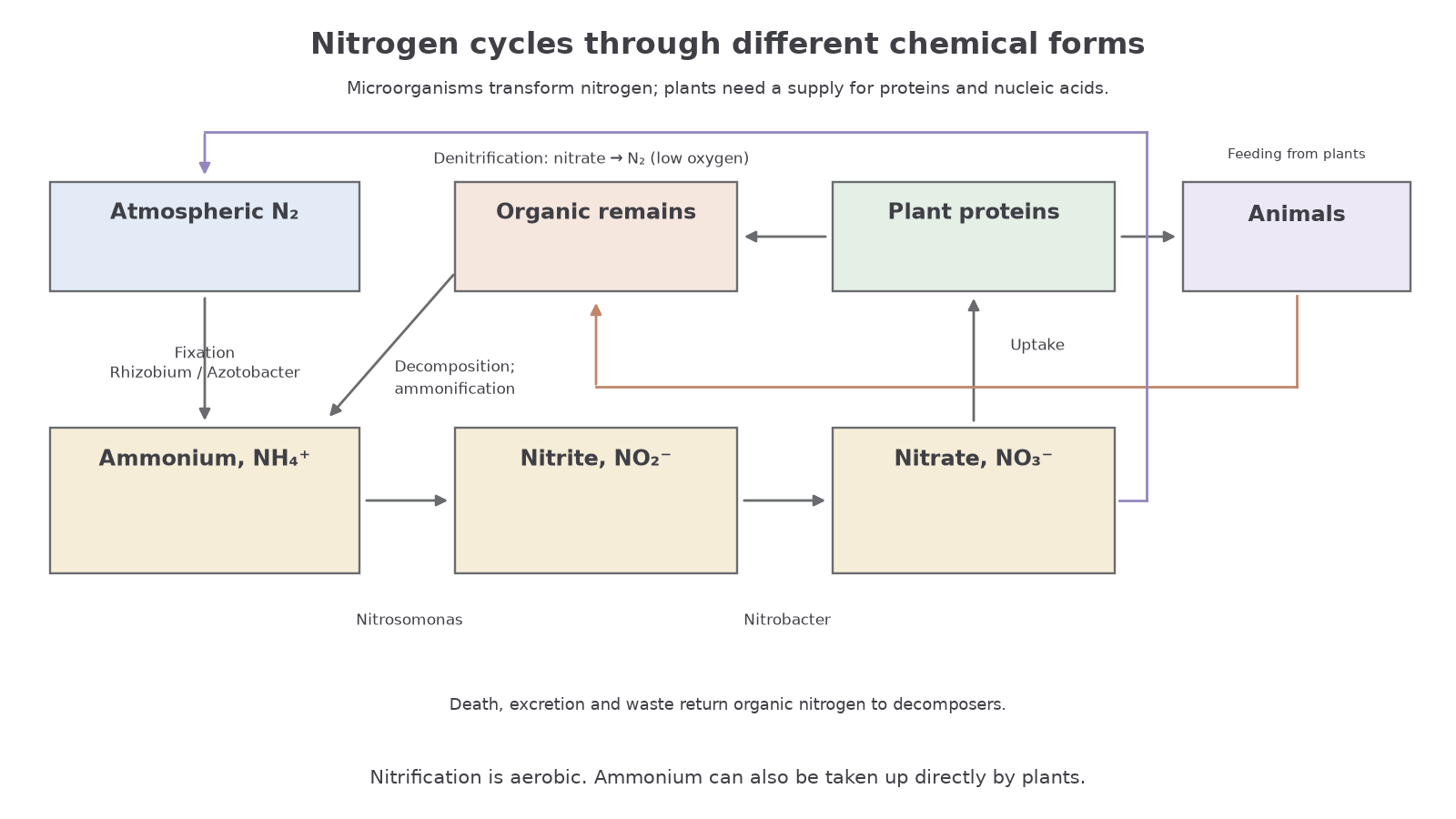
Use the diagram as a process map rather than a memory poster. The key OCR skill is to name the microorganism group, state what nitrogen compound it acts on, and state the product.
Decomposers And Ammonification
Nitrogen does not disappear when an organism dies. Much of it is still locked inside organic molecules such as proteins, nucleic acids and ATP. Waste materials, including egested and excreted material, also contain organic nitrogen compounds.
Decomposers are mainly saprotrophic bacteria and fungi. They feed by secreting enzymes onto dead organic matter or waste. The enzymes digest large biological molecules into smaller soluble molecules, which the decomposers absorb.
When decomposers break down nitrogen-containing organic compounds, nitrogen is released into the soil as ammonia or ammonium ions. This process is called ammonification.
Ammonification
The release of ammonia or ammonium ions from nitrogen-containing organic compounds during decomposition.
A useful way to think about ammonification is as the gateway from organic nitrogen back into the soil ion pool. It does not make nitrate directly. It mainly supplies ammonia/ammonium, which can then be changed by nitrifying bacteria.
If a question asks for the role of decomposers in nitrogen recycling, link decomposition to ammonification. Do not jump straight from dead organisms to nitrate.
Extracellular digestion and ammonification are linked but different steps. Proteases hydrolyse proteins to peptides and amino acids; after absorption, microbial metabolism removes amino groups and releases ammonia, which forms ammonium ions in water. Soil animals that fragment litter increase the surface area for microbial activity, but fragmentation alone does not convert organic nitrogen into ammonium.
Nitrogen Fixation
Nitrogen fixation is the conversion of atmospheric nitrogen gas into a reduced nitrogen compound such as ammonia. In this lesson, the two named nitrogen-fixing bacteria are Azotobacter and Rhizobium.
Azotobacter is free-living in soil. It can fix nitrogen without living inside a plant. Rhizobium is found in root nodules of leguminous plants, such as peas, beans and clover. This is a symbiotic relationship: the plant supplies carbohydrates and a protected nodule environment, while the bacteria supply fixed nitrogen that helps the plant make amino acids and other nitrogen-containing compounds.
Nitrogen fixation
The reduction of atmospheric nitrogen gas, , to ammonia or ammonium compounds by nitrogen-fixing microorganisms.
The word reduction matters. In nitrogen fixation, nitrogen gas gains hydrogen/electrons as it is converted into ammonia. In OCR questions, Rhizobium is commonly linked with root nodules, while Azotobacter is linked with free-living soil bacteria.
Nitrogen fixation is enzyme-controlled and energy-demanding. In Rhizobium, the enzyme nitrogenase catalyses the fixation reaction. Nitrogenase is oxygen-sensitive, so root nodules provide a specialised environment where the bacteria can respire but the enzyme is protected from too much free oxygen. You do not need to learn detailed nitrogenase structure for this lesson unless a question gives that information as a stimulus.
Continue this lesson.
You’re previewing NovaLearn without an account. Create a free account to read the rest.
Create free account