4.1.1(h)-(i) - Antibodies, opsonins, agglutinins and antitoxins
Antibodies are proteins that make the specific immune response precise. In this lesson you will learn the general structure of an antibody molecule, how that structure lets antibodies bind specific antigens, and how three antibody actions - opsonisation, agglutination and anti-toxin action - help remove pathogens or their toxins.
Antibodies and antigens
An antibody is a specific protein produced by the immune system. After a suitable B lymphocyte has been activated, plasma cells secrete antibodies that can bind to a matching antigen.
Antibody
A specific protein, also called an immunoglobulin, that binds to a complementary antigen.
An antigen is a molecule or marker recognised by an antibody or specific immune receptor; it is often a foreign marker. On a pathogen, this may be a surface protein or glycoprotein. The distinction is that the antigen is the target marker; the antibody is the protein made by the immune system that binds to that marker.
When an antibody binds to an antigen, it forms an antigen-antibody complex. The complex does not mean the pathogen has already been digested. It means the antibody has attached to its target, which can then help other immune processes remove the pathogen or neutralise the threat.
Specificity comes from shape. The antibody has a binding site with a shape and chemical properties complementary to one antigen. A different antigen will not fit the binding site in the same way, so it will not form the same stable complex.
Antibody protein structure
An antibody is a globular protein with a Y-shaped overall structure. At this level, the useful structure is:
| Structural feature | Function in antibody action |
|---|---|
| Two identical heavy chains and two identical light chains | Form the general Y-shaped protein molecule |
| Variable regions at the tips of the Y | Form antigen-binding sites with a specific shape |
| Two antigen-binding sites | Allow one antibody to bind two matching antigen sites |
| Constant region in the stem of the Y | Helps immune cells recognise antibody-coated targets |
| Flexible hinge | Lets the two arms bind antigens that are not fixed at exactly the same distance apart |
| Disulfide bonds | Link heavy chains to one another and light chains to heavy chains, stabilising the molecule |
The variable regions matter because they give the antibody its specificity. The constant region is not the part that gives the exact antigen fit, but it helps cells of the immune system respond to antibody-coated material.
The two antigen-binding sites matter because an antibody can link antigens together. If the antigen is on a pathogen surface, one antibody can bind to two antigen sites, or antibodies can form links between different pathogens. This structural idea explains why antibodies can act as agglutinins as well as simply binding a single target.
For structure-function questions, link the named structure to the role: variable region gives specific antigen binding; two binding sites allow cross-linking; constant region helps immune cells recognise antibody-coated targets.
[DIAGRAM: asset_slug: 075_m04_1_1_antibodies_opsonins_agglutinins_and_antitoxins__diagram_01; description: Two heavy and two light chains, variable tips, hinge and disulfide links.]
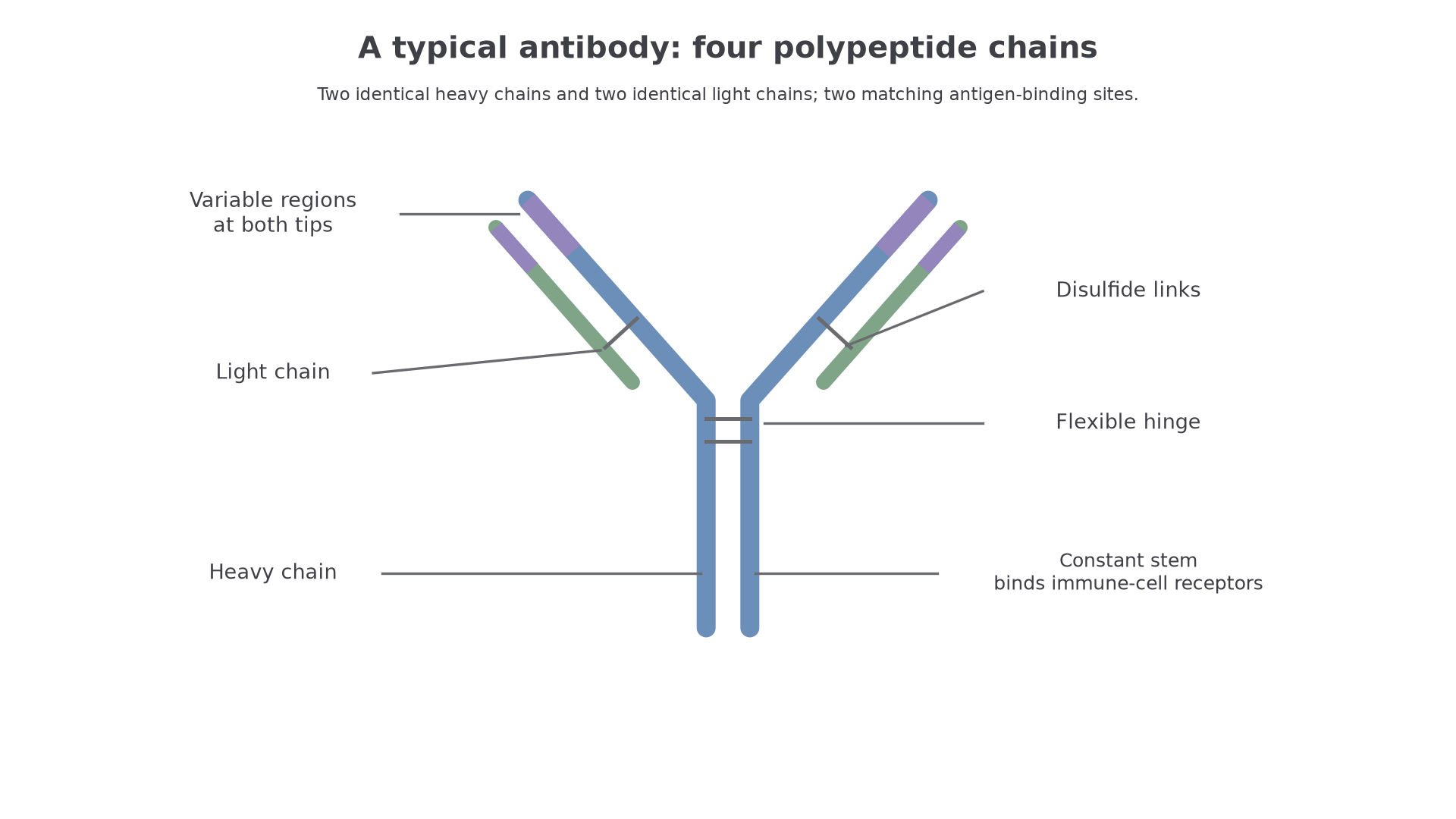
Each heavy chain extends from one binding tip through an arm into the stem; each shorter light chain lies alongside a heavy chain in an arm. The binding surface at each tip is formed by variable regions from both chains. Within a typical antibody molecule the two binding sites have the same specificity.
Continue this lesson.
You’re previewing NovaLearn without an account. Create a free account to read the rest.
Create free account